About the Journal

The EASI Scientific Journal: Engineering and Applied Sciences in Industry is a digital and print publication dedicated to disseminating original scientific research in the fields of engineering sciences and business management within the industrial context. The journal is edited and managed by the Faculty of Industrial Engineering at the University of Guayaquil and is published on a biannual basis. It holds the identifiers e-ISSN: 2953-6634 and p-ISSN: 3073-1526.
The journal operates under a no Article Processing Charges (APC) policy, meaning that authors are not required to pay any fees for submission, processing, or publication.

EASI is indexed in Latindex catálogo 2.0, Amelica, LivRe, Periódica, Google AcadémicoMiar , Dialnet and Road.


Announcements

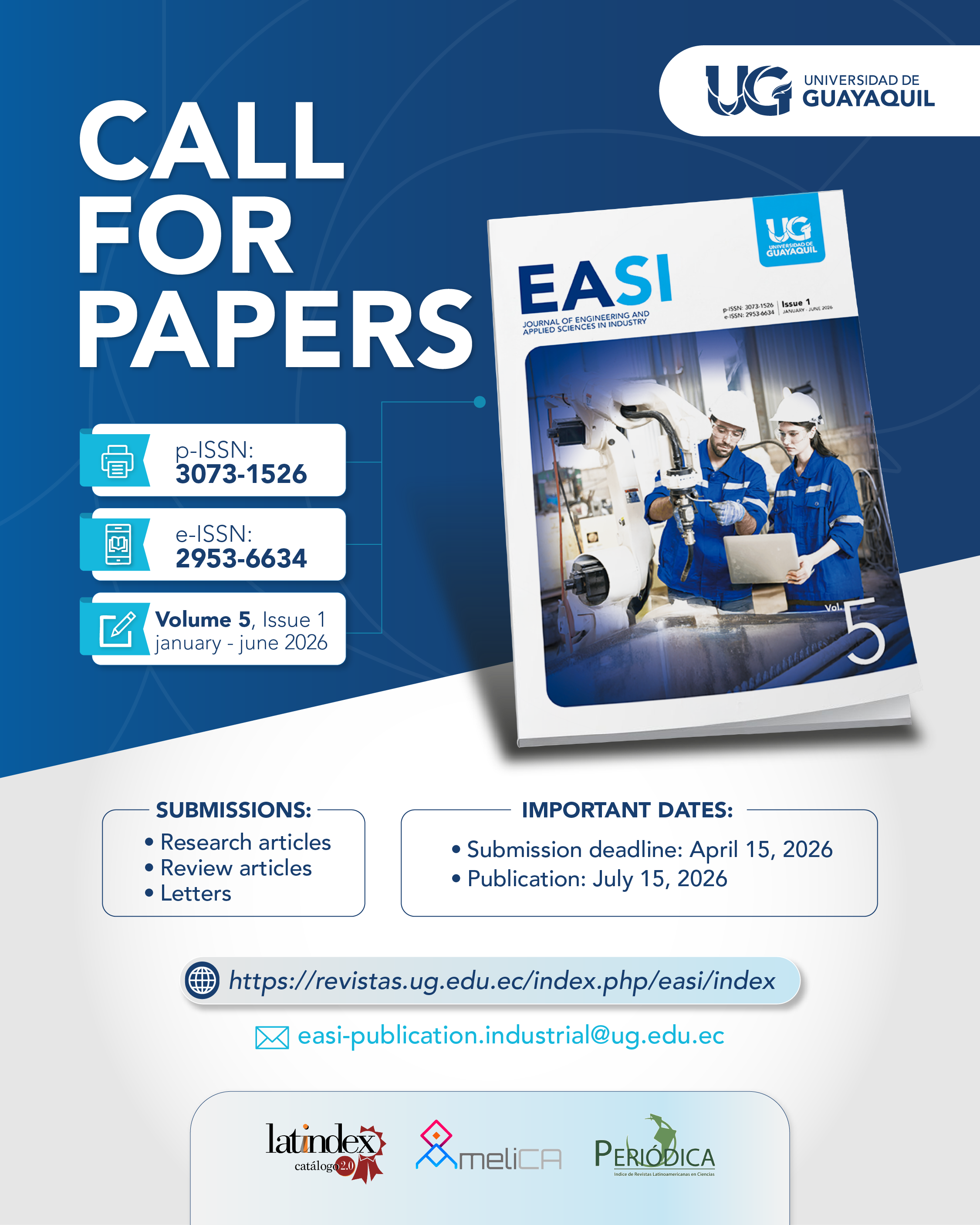
Call for Articles Vol. 05, Number 01 (2026): January-June

2026-02-09

EASI: Engineering and Applied Sciences in Industry is a biannual, indexed scientific journal dedicated to addressing the challenges of flexibility and interoperability in industry, as well as the relationship between industry and society.

We invite researchers and professionals to contribute to the upcoming issue of the journal: Vol. 5, No. 1 (2026): January-June. EASI accepts submissions of research articles, state-of-the-art reviews, and letters or reports. Additionally, specialists or organizers of scientific events can propose the editing of special issues on specific topics.

Deadline: 15/04/2026

Read more about Call for Articles Vol. 05, Number 01 (2026): January-June

Current Issue

Vol. 5 No. 1 (2026): Engineering Innovations for Sustainable Processes
Editor in chief: Raquel Vera-Ortega

EASI: Engineering and Applied Sciences in Industry presents in this issue a selection of studies that highlight the role of engineering as a driving force for innovation in the development of sustainable processes. Under the thematic focus "Engineering Innovations for Sustainable Processes," the published research addresses solutions related to digital transformation, industrial systems optimization, energy sustainability, food safety, and the circular economy, integrating emerging technologies with high-impact scientific approaches to address the current challenges faced by industry and society.

Vaca, G. et al. (2026) present a bibliometric evaluation of the biotechnological applications of graphene derivatives, identifying emerging trends in biosensors, tissue engineering, and hybrid materials for biomedical applications. Lara Alvear, R. and Salazar Fierro, F. (2026) conduct a systematic literature review on software engineering frameworks for web-based systems, highlighting Quality of Service and service-oriented architectures as key factors for enhancing user experience in Education 4.0 environments. Pachacama-Nasimba, V. et al. (2026) analyze the evolution of scientific knowledge on the thermodynamics of the Otto cycle, demonstrating the shift toward exergy-based approaches and alternative fuels to strengthen energy sustainability. Cruz, J. and Mariño, C. (2026) propose a conceptual model for intelligent urban traffic management by integrating the MaxPressure algorithm with Industry 4.0 technologies, providing a foundation for the development of smart mobility systems. Vicente Ycuña, J. et al. (2026) develop a portable optical device based on reflectance spectrometry for the rapid and non-invasive detection of pesticide residues in quinoa, contributing to food safety through accessible technological solutions. Finally, Vicente Ycuña, J. et al. (2026) validate the foaming capacity of quinoa saponin as a biosurfactant for sustainable fire extinguishers, demonstrating its potential to replace conventional surfactants while promoting the valorization of agro-industrial residues within the framework of the circular economy.

Published: 2026-06-25

Research articles

View All Issues