About the Journal
EASI: Engineering and Applied Sciences in Industry provides an international multidisciplinary forum for researchers and professionals from academia, industry, and government to discuss challenges related to flexibility and interoperability in industry, as well as the relationship between industry and society. Published since July 2022, it is released biannually in January and July. We stand out for maintaining a focus on areas of work related to interoperability and Industry 4.0, such as supply chain management, industrial automation, cybersecurity in industrial networks, cyber-physical systems, and Education 4.0 in engineering, among others, which together offer authors a range of possibilities for disseminating their research results.
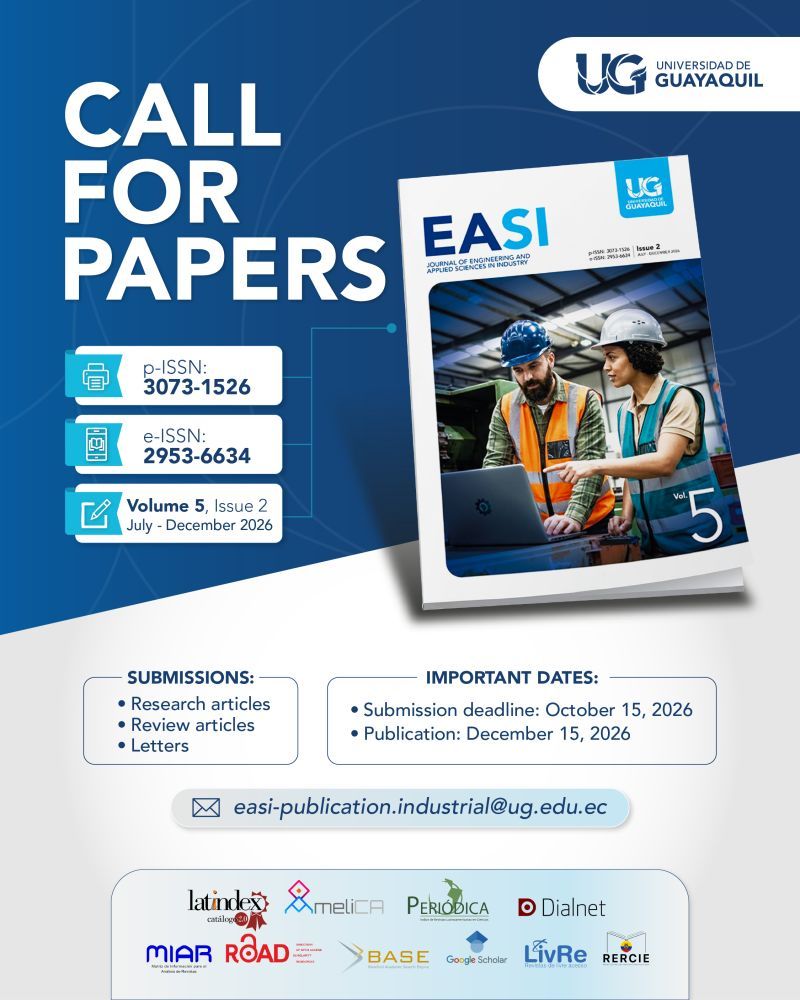
EASI is published in two versions: print (ISSN: 3073-1526) and electronic (e-ISSN: 2953-6634), in English and identified with a Digital Object Identifier System (DOI: 10.53591).
EASI is indexed in Latindex, catálogo 2.0, Amelica, LivRe, Periódica, Google Académico, Miar , Dialnet and Road.
Announcements
Indexed in Latindex 2.0 database
Current Issue
The International Conference on Applied Industrial Engineering aims to be a reference point for national and international innovation and collaboration. This year's edition focused on “Intelligent Models and Data Engineering.” Experts and researchers explored the transformative potential of these technologies, fostering academic exchange in a natural environment that promotes a sustainable approach.
Espitia-Cubillos, A. et al. (2025) reviews documents on smart forklifts to identify advances and knowledge gaps. Using the PRISMA 2020 guide and bibliometric analysis tools. Research conducted by Tigua-Villaprado, Y. projects energy consumption in Ecuador's tertiary sector through 2040 using the LEAP model, highlighting that most energy use is concentrated in three activities and depends on electricity for 76% of its needs, underscoring the need for sustainability strategies (2025). Banguera, L. et al. (2025) analyzes the recycling habits of millennials in Guayaquil, noting that a high percentage consume water in plastic bottles and that there are major barriers such as lack of infrastructure and lack of awareness. Loor-Alcívar, B. et al. (2025) applied a simulation to a plastic pipe processing plant, where a bottleneck was identified and it was demonstrated that increasing the number of mills could increase installed capacity by 22%. Espitia-Cubillos, A. et al. (2025) present an artificial intelligence algorithm based on neural networks to identify and classify labels and colors of liquid products through a camera. The system, tested in a virtual environment, achieved 100% accuracy with very fast processing times, demonstrating its robustness even with little data or low-quality images. Finally, Ortiz-Mosquera, N. et al. (2025) proposes a prototype for detecting forest fires using a drone equipped with a high-resolution camera and a Jetson Nano unit. The system uses convolutional neural networks to identify smoke and flames in real time.