INTRODUCTION
Knowledge consolidation is an essential pedagogical process for students to understand information, retain it, and use it effectively over time, thus differing from temporary memorization models. Thus, at the international level, adaptation to this process corresponds to the diversity of learning styles present in a classroom (Acuña & Liern, 2020), where the practical approach based on educational videos seeks to solve the excess of abstraction in mathematical knowledge and the lack of personalized school attention.
According to the PISA-D report (INEVAL & OECD, 2018), corresponding to the results of Mathematics performance in Ecuador, an average of 377 was obtained in 15-year-olds, which is two points lower than the regional average of 379. This places Ecuadorian students at a skill level prior to analysis, synthesis, and metacognition, which is why the Ministry of Education of Ecuador carried out curricular updates that resulted in the application of the competency-based prioritized curriculum (MINEDUC, 2021).
Some research points to the ease of transmitting information and knowledge, such as in Morales (2021) and in Pattier and Ferreira (2022), who establish educational videos as visually attractive didactic resources that address educational topics, explain concepts, develop skills, or present information in a clear and understandable manner. Thus, this conception covers a wide range of disciplines and educational levels, and categorizes educational videos as complementary tools in formal and informal teaching environments.
At the local level, some studies point to the combination of elements in educational videos as a key aspect for improving viewers' comprehension, retention, and application of information, thus promoting more effective and engaging learning (Bravo-Cobeña et al., 2021), and enriching the educational process, promoting comprehension, participation, and motivation of students in various learning contexts in Mathematics (Posligua & Zambrano, 2020).
Nevertheless, according to Valencia-Velasco and Guevara-Vizcaíno (2020), knowledge consolidation in Mathematics should be classified as a process of strengthening and deepening previously learned mathematical concepts, skills, and principles. This process involves the review and continuous practice of acquired knowledge, as well as its application in diverse contexts, thus seeking to achieve a more solid and lasting mastery of mathematical concepts, allowing students to transfer their knowledge to new and more complex situations.
Other studies refer to the learning of processes or algorithms as fundamental for the development of essential algebraic skills, because students practice by manipulating assumptions, thinking about resolution mechanisms, and applying properties of the topics covered (Ibarra, 2021), which strengthens analytical thinking by requiring the decomposition and simplification of equations, identifying key steps to reach the solution (George, 2020).
Based on the above, the research based on educational videos constituted an educational need grounded in the consolidation of knowledge associated with understanding concepts, solving problems, and modeling reality. In addition, it was considered of practical utility as an active tool for learning feedback, whose importance was based on providing students with a clear and concise explanation of procedures, and didactic opportunities for practice and evaluation.
The methodology considered descriptive research with a qualitative and quantitative approach. Bibliographic and field research was applied, supported by the inductive method and scientific observation. The research techniques were the survey of students, interviews with teachers, and non-participant observation. Information was tabulated and analyzed using descriptive statistics. For this, the following hypothesis was proposed: the application of educational videos improves the consolidation of knowledge in the formative leveling of Mathematics in Middle Education students.
The objective of the research was to analyze the application of educational videos in the consolidation of mathematical knowledge in Middle Education students at Unidad Educativa Fiscomisional Juan Montalvo in 2024. Finally, the following specific objectives were established: to investigate the perception of learning based on educational videos with respect to Mathematics learning; to identify methodologies for the implementation of educational videos as mechanisms for knowledge consolidation in Mathematics; and to examine the relationship between the use of educational videos and the integration of knowledge in Mathematics.
The results showed that educational videos significantly improve the knowledge consolidation process and contribute to formative leveling in Mathematics. Thus, the aim was to generate a positive impact on the understanding of basic mathematics concepts, enhance the ability to solve exercises, problems, and didactic situations, and generate student satisfaction with the planned reinforcement using educational videos.
Finally, this research maintains its focus on the analysis of the application of educational videos in the consolidation of mathematical knowledge, these being a highly useful pedagogical strategy. Its academic relevance lies in generating evidence on the benefits provided by the incorporation of these digital resources, supporting the strengthening of mathematical competencies in each student. In this way, the results obtained will be a contribution for future research related to educational videos and mathematics, thus promoting the use of methodological strategies that generate meaningful learning.
LITERATURE REVIEW
Educational Videos as a Support Tool in Mathematics
In recent years, Mathematics education has experienced significant changes driven by various factors, such as technological advances, new pedagogical approaches, and the changing demands of society (Burgos & Castillo, 2023). These changes have transformed the way we teach and learn, and have opened new opportunities and challenges in the educational field (Guaña, 2023). The impact of technology on education, with the emergence of computers, the Internet, and mobile devices, has revolutionized the way we access information and communicate.
Currently, as Romero et al. (2023) point out, students easily access online educational resources, participate in virtual classes, and collaborate with peers from around the world. This has expanded learning possibilities and blurred the geographic and temporal barriers that previously limited education. Thus, given the possibility of finding educational videos on practically any imaginable topic, and in a variety of formats, from short lessons to complete courses that help teachers and students, the teaching-learning process is strengthened.
For Burgos et al. (2020, pp. 243-247), the availability of educational videos on the web on topics associated with Mathematics is increasing at an accelerated pace, finding resources related to any topic and area of the exact sciences. Given this trend, educational institutions have an interest in contributing a wide diversity of educational content that helps students to better understand mathematical concepts, guiding the development of mathematical competencies (Rivadeneira-Loor, 2013).
Another relevant factor is the personalization of learning, which allows teachers to adapt learning to the individual needs of students. In this sense, Rodríguez et al. (2014, p. 38) mention that when a video is assigned to a student who needs to review a concept or who is interested in exploring a topic in depth, due to the ease of having control of the audiovisual resource and the characteristics of the video format, a precise understanding of the message or teaching pursued is achieved.
Likewise, fostering motivation, building study habits, and student participation are important, because educational videos actively involve students in the processes of reflection and application of knowledge. Interactivity, as indicated by Arias-Rueda (2021), between the resource and the ability of a Mathematics teacher achieves levels of confidence that lead to attention and participation in activities, answering questions, or performing tasks.
In this sense, the aim is to facilitate autonomous learning, considering the premise that when students play the videos at their own pace, they acquire and assimilate content easily (Velarde-Alvarado et al., 2017). However, given the complexity involved in the development of pedagogical processes, the role of the teacher is outlined to resolve doubts and teach how to learn autonomously, and, likewise, by empowering students in the process, teachers motivate and generate the need to investigate analytically, critically, and autonomously (Beltrán-Pellicer et al., 2018).
Consolidation of Knowledge in Mathematics
For Velasco-Burgos (2019), and in accordance with Kolb's theory (Paredes, 2021), the consolidation of knowledge in mathematics classes is fundamental to guarantee meaningful and lasting learning in students. Unlike the memorization of formulas and procedures, consolidation implies a comprehensive understanding of mathematical concepts and their application in different contexts (interdisciplinarity).
Therefore, as Condo (2022) refers, pedagogical practices that foster reflection, problem-solving, active learning, and interconnection are required. Thus, for Zayas-Batista et al. (2022), this improves academic performance and prepares students to face learning challenges with a solid foundation and sufficient motivation to sustain assimilation processes. According to Sandoval et al. (2014), new knowledge, skills, or attitudes are achieved through confrontation between four modes of experiential learning.
For the purpose of comprehensive consolidation, as Letelier-Farías et al. (2020) explain, students to develop educational competencies must strengthen four different types of skills: living concrete experiences, reflecting observationally, conceptualizing abstractly, and actively experimenting.
MATERIALS AND METHODS
The study employed the quantitative approach in data collection and assessment of methodological processes of teaching with educational videos, to verify the proposed hypothesis; while the qualitative approach was used in the contextualization of the research problem and deepening of the applied methodology. The level of research was descriptive, which characterized the research results within the framework of theoretical background and the systematization of the application as a proposal for educational innovation.
In this way, the research was framed within the use of pedagogical innovations in the processes of systematization of knowledge in the area of Mathematics. By way of spatial delimitation, the research was carried out at the Unidad Educativa Fiscomisional Juan Montalvo, located in Manta City, Manabí, Ecuador, allowing the study to be carried out in the formative leveling of the 2024 academic year.
The age group established was students of Middle Education, in the subject of Mathematics, aged between 13 and 14 years, based on the development of skills with performance criteria subject to the competency-based prioritized curriculum (MINEDUC, 2021). In addition, the research adhered to the ethical criteria established for scientific research, through the use of informed consent, anonymity, and non-commercialization of the data obtained.
Subsequently, field research was applied using the inductive method, with the collection of primary information, which was contextualized within the framework of the problem and expected results; and bibliographic research, where the relationship between the educational experience and the external results of Secondary Education institutions was analyzed, through consultation of journals, books, and manuals indexed in repositories and databases specialized in Education Sciences. In this way, the following research techniques and instruments were applied:
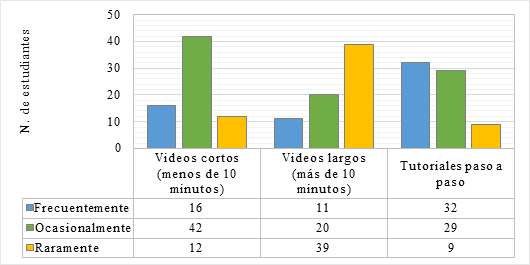
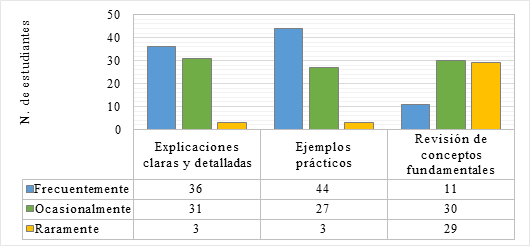
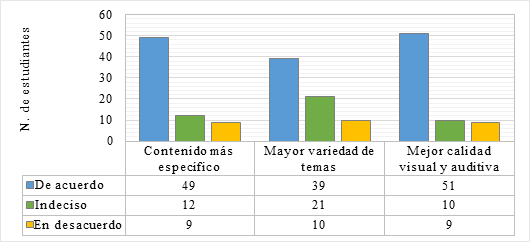
- Survey directed at students, which used questions under the topics: type of educational videos preferred to consolidate knowledge in Mathematics; aspects of educational videos considered useful in Mathematics; and, need for improvements in educational videos for knowledge consolidation. Independent Likert scales were considered for each topic, as shown in figures 1, 2, and 3 in the results.
- Interview directed at Middle Education teachers, which recorded didactic experiences and the perception of educational videos as active learning methodologies, associated with the use of educational videos in the institution. The following criteria were considered: use of educational videos in classes; contribution of educational videos to the consolidation of knowledge; and, student reaction to the use of educational videos in Mathematics classes.
- Non-participant observation, with the use of an observation guide on the implementation of educational videos in the consolidation of mathematical knowledge, that is, the functionality and interaction between peers during the application in the phases of concrete experience, reflective observation, abstract conceptualization and active experimentation, comprehension and consolidation of knowledge, and student behavior and motivation.
The validity of the research instruments was carried out using the expert judgment method, with the participation of five teachers with experience in teaching mathematics and in scientific research, who reviewed each of the instrument's questions, their relationship with the variables and with the research objectives. Based on the observations made, modifications were made to guarantee a correct collection of information.
The information was analyzed using descriptive statistics, using graphs that allowed interpreting the results obtained. Meanwhile, the qualitative information from the interview and observation was organized and analyzed using the content analysis technique to identify patterns, perceptions, and experiences related to the topic under study. The population consisted of 3 Mathematics teachers and 215 Middle Education students, legally enrolled at the Fiscomisional Educational Unit. A purposive sample of 70 students from the Ninth grade of General Basic Education was used, due to their availability and accessibility.
RESULTS
With the objective of investigating the student perception of learning based on educational videos with respect to Mathematics learning, a survey was applied to Middle Education students, obtaining the results shown in figures 1, 2, and 3.
Figure 1
Type of educational videos preferred to consolidate knowledge in Mathematics.
Note: Data obtained from the student survey.
As observed, to establish the processes of knowledge consolidation in Mathematics, most students occasionally played short videos, rarely did so with long videos, and frequently did so with step-by-step tutorials. In addition, a tendency to prefer concrete and specific audiovisual material was observed.
Figure 2
Aspects of educational videos considered useful in Mathematics.
Note: Data obtained from the student survey.
As can be seen, in correspondence with the characterization of an educational video, most students frequently considered clear and detailed explanations with practical examples useful, while, occasionally, the review of fundamental concepts was considered useful.
Figure 3
Need for improvements in educational videos for knowledge consolidation.
Note: Data obtained from the student survey.
As detailed, in relation to strengthening the current conditions in which an educational video is presented, in which students require as a need, the majority agreed to reproduce more specific content, with a greater variety of topics, and, with better visual and auditory quality.
Regarding the identification of methodologies for the comprehensive implementation of educational videos as mechanisms for knowledge consolidation in Mathematics, an interview was applied to Middle Education teachers, emphasizing specific didactics and their perception for learning. The results are recorded in Table 1.
Table 1.
Teaching methodology of educational videos in Mathematics.
|
PARTICIPANTS |
QUESTIONS |
||
|
Use of educational videos in classes |
Contribution of educational videos to knowledge consolidation |
Student reaction to the use of educational videos in Mathematics classes |
|
|
TEACHER 1 |
Yes, especially explanatory ones to improve understanding of theories. |
They contribute to improving the understanding of concepts and resolution rules. |
Positive. They reinforce explanations and allow them to review at home. |
|
TEACHER 2 |
Yes, tutorial type to consolidate problem-solving skills. |
They improve students' ability to apply specific algorithms. |
Very satisfactory. They understand a variety of examples and problems. |
|
TEACHER 3 |
Yes, at least once a month and focused on specific exercises. |
They increase student motivation and facilitate knowledge retention. |
They show interest; furthermore, they allow them to learn at their own pace and improve class participation. |
Note: Elaborated from the teacher interview.
As can be seen, all teachers, in the pedagogical development of their classes, have applied educational videos to reinforce learning and provide feedback on specific aspects of a planned topic. Likewise, the application of educational videos was related to an improvement in class motivation and reflection on learning, which allowed understanding processes, understanding concepts, and solving problematic situations.
Regarding the process of examining the relationship between the use of educational videos and the integration of knowledge in Mathematics, an observation was applied in the process of application of the audiovisual technological tool, obtaining the results indicated in Table 2.
Table 2.
Learning development during the application of educational videos.
|
OBSERVATION CRITERIA |
APPLICATION OF EDUCATIONAL VIDEOS |
|
Interaction between students and the teacher |
Most students asked questions based on the notes they took during video playback. Participation was active and group confidence was fostered. |
|
Comprehension and consolidation of knowledge |
Understanding of concepts and correct application of algorithms improved. Most students solved the proposed problems in a moderate time. |
|
Student behavior and motivation |
The level of attention and motivation of the students was good. Interaction with the teacher was more frequent. |
Note: Elaborated from non-participant observation in Mathematics classes.
As shown, with the application of a methodological class using educational videos, the following improved: student participation, which generated constant interaction between Middle Education students and each Mathematics teacher; problem and exercise solving because comprehension and knowledge consolidation were systematized; and, attention to explanations based on respectful and motivated behavior in the student group.
DISCUSSION
The results found in this research allowed validating the position of Beltrán-Pellicer et al. (2018), who point out the benefits of the large number of online videos currently available, and which highlights, in another position, the imprecise elaborations or erroneous didactic methods, together with the natural variability of the skill levels addressed. In this sense, as Bravo-Cobeña et al. (2021) express, validation and adequate categorization for adjustment to school needs in Mathematics is an indispensable requirement in the use of educational videos.
On the other hand, the affirmations of Burgos et al. (2020) and Romero-Tena et al. (2017), on the positive impact of a teaching methodology using educational videos, from an approach of suitability, design, and formative action, were related to what was obtained in the surveys of Middle Education students. Therefore, as Velasco et al. (2018) refer, the use of educational videos increases attention and concentration periods, which allows growth in problem-solving skills.
Nevertheless, the results obtained in this research differ from the findings of Burgos and Castillo (2023), where it was demonstrated that the implementation of educational videos presents significant deficiencies in various aspects of didactic suitability in Mathematics, being particularly relevant those identified in the epistemic dimension of knowledge consolidation. Thus, this approach proposed that not all students recognize deficiencies in the educational videos they watch, which opposed what was recorded in the student surveys, where an ability to explicitly articulate the improvements of the presented audiovisual material was presented.
Regarding the student survey, it was obtained that there is a positive perception towards the use of educational videos and their application in the knowledge consolidation phase, generating reflective processes, conceptualization, and application coherent with the chronological age in Middle Education. Furthermore, students quickly identified the elements of improvement in each educational video, arising from previous experience in the production of audiovisual material, due to their exposure to short productions with different levels of refinement, and, being technological natives.
Regarding the interview with Mathematics teachers, it was found that the specific didactics to establish a teaching based on educational videos are accepted and used with moderate frequency, with emphasis on ensuring that the group fully understands the new material; and, they were reinforced with learning through repetition and constant practice, the usability of knowledge in different contexts and situations to strengthen its integration, and the interconnection with new information and communication technologies with prior knowledge.
The observation results showed that the functionality of educational videos corresponded with the motivation generated by a resource that students are accustomed to as technological natives, and with momentary attention, based on the combination of pleasant colors, a clear tone of voice, and dynamism to explain the topic. Peer interaction during the application in the abstract conceptualization phases allowed the consolidation of mathematical knowledge, achieving higher levels in academic performance, going from a fair level of attention to a satisfactory one in a Mathematics class.
Regarding unexpected results, it was evidenced that the implementation and planned use of educational videos requires initial assessment of students and their perception towards ICTs. In this sense, study habits constituted an important aspect to ensure that viewing educational videos clarifies the doubts that arise from the process of solving mathematical problems and understanding concepts in different disciplinary contexts. It was recorded that educational videos do not achieve their effectiveness when the length exceeds ten minutes, which is why the immediacy in the presentation of specific algorithms was valued.
CONCLUSIONS
Through the application of educational videos and curricular planning based on knowledge consolidation, the understanding of the theoretical part in Mathematics classes, the analysis of exercise and problem-solving processes, and home feedback in students of a Fiscomisional Educational Unit in the 2023-2024 period were strengthened. Thus, it was found that the use of educational videos managed to integrate learning experiences with the disciplinary learning requirements in Mathematics in Middle Education.
It was identified that, considering the criteria of relevance, didactics of Mathematics, and motivation, to achieve sustained effectiveness of their functionality in knowledge consolidation, the main methodologies for the implementation of educational videos as mechanisms for knowledge consolidation in Mathematics are Kolb's cycle and problem-based learning. In this way, the use of educational videos became a teaching activity that, by showing conceptual summaries, contextualized explanations, and resolution algorithms, achieves a higher level of commitment to educational quality and the use of ICTs.
It was observed that there is a positive relationship between the use of educational videos and the integration of knowledge in Mathematics, which resulted in lasting retention and assimilation in long-term memory. That is, the employability of educational videos, in the progressive consolidation of knowledge derived from skills with performance criteria in Middle Education, contributed to improving class processes, in addition to understanding situations and interdisciplinary contexts of everyday life.
Finally, the systematic integration of educational videos into the Middle Education mathematics curriculum, in mainstreaming with teacher training in the use and creation of audiovisual content, was proposed as an educational policy aimed at improving educational quality, promoting equity in access to innovative learning tools, and preparing Middle Education students to successfully face academic challenges and meet the exit profile of the Ecuadorian Baccalaureate.
LIMITATIONS AND RECOMMENDATIONS
It is recommended that, in the application of video-based learning in the classroom, all problem-solving activities and moments of the class be planned, which generated the following conditions:
- The educational videos, which were used for the purpose of consolidating knowledge in Mathematics, required observation and evaluation by the teacher, which guaranteed compliance with the objectives of the micro-curricular planning.
- The consolidation of theories, concepts, and problem-solving, or didactic situations, required the application of methodological strategies that allowed integrating the audiovisual material into school activities.
- The training of Mathematics teachers, and students of Exact Sciences Pedagogy, considered continuous training in the use and creation of educational videos, which was related to strengthening contextualization in Educational Institutions and pedagogical innovations for achieving learning goals.
REFERENCES
Acuña, C., & Liern, V. (2020). Modos de enseñanza en los videotutoriales de matemáticas: equilibrio entre eficacia puntual y utilidad formativa. Bolema: Boletim de Educação Matemática, 34, 1125-1143. https://doi.org/10.1590/1980-4415v34n68a14
Arias-Rueda, J. (2021). El Modelo flipped classroom en educación virtual: Una experiencia en matemáticas universitarias. Revista EDUCARE-UPEL-IPB-Segunda Nueva Etapa 2.0, 25(2), 215-236. https://doi.org/10.46498/reduipb.v25i2.1468
Beltrán-Pellicer, P., Giacomone, M., & Burgos, M. (2018). Los vídeos educativos en línea desde las didácticas específicas: el caso de las matemáticas. Cultura y Educación, 30(4), 633-662. https://dialnet.unirioja.es/servlet/articulo?codigo=6799792
Bravo-Cobeña, G., Pin-García, L., Solís-Pin, S., & Barcia-Zambrano, A. (2021). El video educativo como recursos didáctico inclusivo en la práctica pedagógica actual. Polo del conocimiento, 6(1), 201-214. https://doi.org/10.23857/pc.v6i1.2132
Burgos, M., & Castillo, M. (2023). Idoneidad didáctica de vídeos educativos de matemáticas: una experiencia con estudiantes para maestro. Revista Latinoamericana De Investigación En Matemática Educativa, 25(3), 341-366. https://doi.org/10.12802/relime.22.2534
Burgos, M., Beltrán-Pellicer, P., & Godino, J. (2020). La cuestión de idoneidad de los videos educativos de matemáticas. Revista Española de Pedagogía, 78(275), 27-50. https://doi.org/10.22550/REP78-1-2020-07
Condo, J. (2022). El aprendizaje de la multiplicación basado en el ciclo de Kolb a través de herramientas digitales en el cuarto año de la escuela de Educación General Básica Isidro Ayora, año lectivo 2020-2021. [Tesis de Licenciatura]. Ecuador: Universidad Politécnica Salesiana. https://doi.org/http://dspace.ups.edu.ec/handle/123456789/22593
George, C. (2020). Reducción de obstáculos de aprendizaje en matemáticas con el uso de las TIC. IE Revista de Investigación Educativa de la REDIECH, 11, 1-16. https://doi.org/10.33010/ie_rie_rediech.v11i0.697
Guaña, J. (2023). El papel de la tecnología en la transformación de la educación y el aprendizaje. Revista Científica FIPCAEC (Fomento De La investigación Y publicación, 8(2), 394. https://doi.org/https://www.fipcaec.com/index.php/fipcaec/article/view/830
Ibarra, V. (2021). Actividades lúdicas en el aprendizaje de ecuaciones de primer grado en Educación Básica Superior. [Tesis de Maestría]. Ecuador: Universidad Técnica de Ambato. Facultad de Ciencias Humanas y de la Educación. https://repositorio.uta.edu.ec/jspui/handle/123456789/32861
INEVAL & OECD. (2018). Educación en Ecuador. Resultados de PISA para el Desarrollo. Quito, Ecuador: Instituto Nacional de Evaluación Educativa - OECD. http://evaluaciones.evaluacion.gob.ec/BI/informe-general-pisa-2018/
Letelier-Farías, R., Quiroz-Arriagada, N., & Paiyeé-Villegas, P. (2020). Desarrollo de procesos reflexivos por medio de innovación didáctica en el logro de habilidades. FEM: Revista de la Fundación Educación Médica, 23(4), 219-225. https://doi.org/10.33588/fem.234.1074
MINEDUC. (2021). Currículo Priorizado con énfasis en competencias comunicacionales, matemáticas, digitales y socioemocionales establece que las competencias digitales. Quito: Ministerio de Educación del Ecuador. https://n9.cl/tgm9j
Morales, R. (2021). El video como recurso didáctico digital que fortalece el aprendizaje virtual. Edutec: revista electrónica de tecnología educativa(77), 186-202. https://doi.org/10.21556/edutec.2021.77.1939
Paredes, M. (2021). Método de Kolb y el pensamiento matemático en niños de 4 y 5 años de la Unidad Educativa “Liceo Oxford” del cantón Salcedo. [Tesis de Psicopedagogía]. Ecuador: Universidad Técnica de Ambato. https://repositorio.uta.edu.ec/jspui/handle/123456789/33829
Pattier, D., & Ferreira, P. (2022). El vídeo educativo en educación superior durante la pandemia de la COVID-19. Pixel-Bit: Revista de Medios y Educación, 65, 183-208. https://doi.org/10.12795/pixelbit.93511.
Posligua, R., & Zambrano, L. (2020). El empleo del YouTube como herramienta de aprendizaje. Revista de Ciencias Humanísticas y Sociales (ReHuSo), 5(1), 11-20. https://doi.org/10.5281/zenodo.6795941
Rivadeneira-Loor, F. (2013). Los canales de matemáticas de YouTube y su aporte en el proceso de enseñanza aprendizaje. Acta del CIBEM, 35. https://funes.uniandes.edu.co/wp-content/uploads/tainacan-items/32454/1170973/Rivadeneira2013Los.pdf
Rodríguez, A., Montagud, M., & Trigos, J. (2014). LOS VIDEOS TUTORIALES COMO HERRAMIENTA FORMATIVA. INGENIO UFPSO, 10, 38. https://revistas.ufps.edu.co/index.php/ingenio/article/view/2077/2027
Romero, M., Romeu, T., Guitert, M., & & Baztán, P. (2023). La transformación digital en la educación superior: el caso de la UOC. RIED-Revista Iberoamericana de Educación a Distancia, 26(1), 163-179. https://doi.org/https://doi.org/10.5944/ried.26.1.33998
Romero-Tena, R., Ríos-Vázquez, A., & Román-Graván, P. (2017). YouTube: evaluación de un catálogo social de vídeos didácticos de matemáticas de calidad. Prisma Social(18), 515-539. https://www.redalyc.org/pdf/3537/353751820018.pdf
Sandoval, V., Peña, M., Carrasco, V., & González, C. (2014). Ciclos de Kolb y 2 razones para ser utilizados. Temuco: Universidad Católica de Temuco. http://revistas.udec.cl/index.php/paideia/article/view/2270/2604
Valencia-Velasco, F., & Guevara-Vizcaíno, C. (2020). Uso de las TIC en procesos de aprendizaje de matemática, en estudiantes de básica superior. Dominio de las Ciencias, 6(3), 157-176. https://doi.org/10.23857/dc.v6i3.1279
Velarde-Alvarado, A., Dehesa-Martínez, J., López-Pineda, E., & y Márquez-Juárez, J. (2017). Video tutorials as a support to the teaching-learning process and its pedagogical implications in. Revista EDUCATECONCIENCIA, 14(15), 67-86. https://core.ac.uk/download/pdf/268579032.pdf
Velasco, A., Montiel, S., & Ramírez, S. (2018). Los videos educativos como herramienta disruptiva para apoyar el proceso de aprendizaje de algoritmos de resta y multiplicación en estudiantes de segundo grado de primaria. Revista educación, 42(2), 149-169. https://www.scielo.sa.cr/pdf/edu/v42n2/2215-2644-edu-42-02-00149.pdf
Velasco-Burgos, D. (2019). Aportes del ciclo de Kolb al pensamiento numérico del área de matemáticas de estudiantes de grado cuarto. Tunja, Boyacá: Universidad Pedagógica y Tecnológica de Colombia. https://repositorio.uptc.edu.co/bitstream/handle/001/2726/TGT_1365.pdf?sequence=1&isAllowed=y
Zayas-Batista, R., Escalona-Reyes, M., & Cedeño-Intriago, R. (2022). La enseñanza-aprendizaje de los conceptos de la Matemática Superior. Estrategia para su perfeccionamiento. Luz, 21(3), 99-112. http://scielo.sld.cu/scielo.php?pid=S1814-151X2022000300099&script=sci_abstract&tlng=pt
CONFLICT OF INTEREST
The authors report no conflicts of interest.