INTRODUCTION
Currently,
service quality is an integral factor in the success of companies, considering
internal processes, customer needs, and service delivery capacity. For this
reason, Internet service providers focus their efforts on the continuous
improvement of this aspect, as it allows them to satisfy users and optimize
interaction, often generating loyalty toward the company.
In
today’s globalized world, emerging markets are pushing for adequate service
quality that meets the high expectations of customers (Jiang et al., 2020).
From this perspective, it can be added that companies must be capable of
meeting customer goals, and to achieve this, it is necessary to provide
personalized service and excellent customer care, which ensures growth in their
client portfolio.
In
the city of Machala, the commercial sector has experienced significant growth,
benefiting many companies. For example, in the case of companies providing
internet services, there has been an increase in the number of customers
purchasing these services; however, there are shortcomings in the quality of
service provided has a negative impact on customer
loyalty.
For
this reason, it is crucial to address service quality, as it is the main
differentiator against the competition. If a company offers good service, it
can manage sustainable alternatives. Moreover, customer satisfaction goes
beyond technical efficiency; it also encompasses the quality of care and
support received—crucial elements for establishing long-term relationships.
Figure 1.
Relationship between Incentives,
Retention, and Loyalty
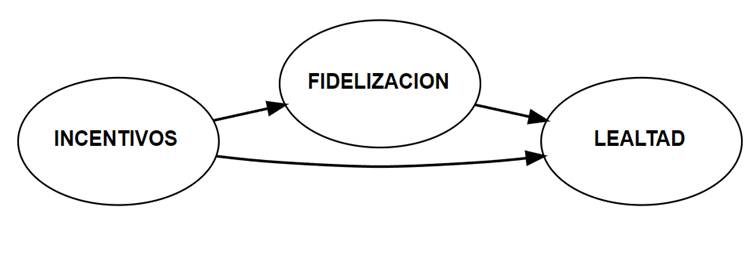
Note.
Service quality is a key factor in strengthening the relationship between
incentives, loyalty, and customer retention.
In
Figure 1, the relationship between incentives, loyalty, and retention is
essential for the commercial development of a company, particularly when
offering a basic service like internet in a competitive market such as Machala.
Customer retention refers to the strategies and actions implemented by
companies to retain their customers, usually through incentives or tangible
benefits. Meanwhile, customer loyalty involves both an emotional and rational
commitment to the brand, based on trust and perceived value.
Through
well-designed strategies, the use of incentives can lead customers to take
specific actions aligned with the company’s objectives, such as making payments
for the service, recommending it to potential customers, or strengthening their
brand loyalty. In other words, service quality can be defined as a key factor
in customer retention. When these factors are considered by companies offering
internet services in the city of Machala, they can effectively retain customers
and attract new ones.
As
mentioned earlier, this study will evaluate internet service companies in the
city of Machala, considered an efficient commercialization area where companies
can expand and offer quality services. In this context, the general objective
of the research is: To identify how the impact of incentives, retention, and
loyalty influences internet service companies, through the analysis of their
effect on perceived brand value, customer engagement, and the construction of
long-term relationships.
Literature Review and Hypothesis Development
Theoretical Background
The background of the relationship between retention, incentives,
and loyalty in the growth of a company dates back to studies primarily focused
on the field of relationship marketing, which is characterized by the strong
consumer loyalty toward a company’s products over a given period. These ideas
go back to the 1980s with the contributions of Berry (2002), who emphasized the
importance of long-term relationships between a company and its consumers,
basing the strength of that relationship on trust and satisfaction with the
service provided.
By the end of the decade, the service quality theory proposed by
Parasuraman et al. (1988) highlighted how consumers, based on their perception
of the service or product, would be willing to develop a loyalty relationship
with the selling brand. Later, in 1999, Oliver’s model of satisfaction and
loyalty further developed these concepts by linking satisfaction with repeat
purchasing behavior.
Currently, customer retention has been enhanced by various digital
implementations, such as personalized marketing programs, aimed at
strengthening the emotional bonds that can be formed with consumers. These
aspects are vital for retaining customers and improving a company’s financial
performance, making this type of strategy fundamental in the pursuit of
commercial competitiveness.
Independent Variable
Retention
Currently,
customer retention is a fundamental aspect in the development of any company, employing
a variety of strategies to build long-term relationships that help define the
company’s strategic goals. It is also essential to differentiate from
competitors and ensure that the customer considers the brand as their primary
choice when making economic decisions (Seminario et al., 2022).
Retention
is achieved through consistent experiences. A clear example of this is ongoing
and positive interactions (V. Kumar, 2018). Customer retention programs are key
tools for better understanding the customer and successfully connecting them
with the brand (V. Kumar, 2018). Additionally, these programs aim to design
effective strategies to engage with clientele by identifying target market
segments. One particularly valuable resource is word-of-mouth as a promotional
method supported by strong communication and interpersonal relationships
(Barrientos & Caldevilla, 2022).
Service
quality is understood as the expectations held by the customer—what they
anticipate before receiving the service—as well as the perception they form
after the service has been delivered. These expectations are shaped by various
factors, such as recommendations from friends, past experiences, or the
company’s reputation (Silva et al., 2021).
Moreover,
service quality can vary depending on the context in which it is offered and
the available competition. Meeting or exceeding these expectations is essential
for generating satisfaction, loyalty, and differentiation in the market.
Within
this framework, retention emerges as a key component, as results from consistent
service quality that not only meets but exceeds customer expectations.
Thus,
service quality can be defined as the effort companies make to satisfy customer
needs and desires, ensuring that the service provided aligns with those
expectations. This quality is determined by two main factors: the customer’s
experience at any given time and the fulfillment of expected standards, which
may be set by the company itself or stem from the customer’s prior expectations
of the service (Norawati et al., 2021).
In
this way, high service quality not only meets the customer’s needs but
surpasses them, contributing to the creation of a positive brand image. It is
vital to the structure of a company, as providing high-quality service
strengthens long-term relationships (Homburg et al., 2017). Additionally,
service quality affects various strategic aspects such as market
differentiation and competitiveness, since customers tend to prefer brands that
deliver a superior and consistently reliable experience (Silva et al., 2021).
Consequently,
companies should place greater importance on understanding these two variables —expectation
and perception—to coordinate and implement improvements in service quality.
This involves not only fulfilling promises made to customers, but also
continuously striving to enhance all aspects of service, from staff training to
innovation in products and services. The goal is to satisfy customers of
internet service companies in the city of Machala—not only by meeting but
exceeding their expectations— to retain customers and encourage
positive feedback and recommendations.
Customer
service is considered one of the key tools for ensuring service quality,
focusing on assisting users or consumers throughout the purchasing process. All
companies, regardless of type, aim to maintain their financial stability by
employing strategies aligned with their business goals (Ordoñez &
Zaldumbide, 2020). In this sense, customer service has gained increasing
relevance in recent decades, given the growing competition fueled by service
innovations and rising customer expectations—not only for higher quality but
also for better pricing to meet their needs (Martínez et al., 2022).
Service
quality plays a crucial role in shaping the customer’s perception of their
experience with the company. However, this depends not only on network
performance but also on factors such as security, information, organization,
and above all, the user's satisfaction with the product (Cordero et al., 2023).
Personalized attention and beneficial experiences strengthen the connection
between the buyer and the brand, making the relationship more meaningful and
engaging.
Customer
experience encompasses the overall impression a customer forms of a company, based
on all interactions—before, during, and after the purchase. It includes factors
such as the quality of the product or service, customer service, ease and
convenience. Additionally, elements such as branding, marketing, and social
media presence also contribute significantly to shaping customer experience.
Consequently,
a positive experience can generate loyalty and recommendations, while a
negative one can lead to customer churn and harm the company’s reputation (Rane
et al., 2023). Positive experience fosters customer satisfaction, leading to a
stronger connection to the company’s services.
Customer
experience is essential to companies’ marketing strategies, serving as a tool
to engage consumers through innovative strategies. These strategies aim to engage
and influence customers through sensory experiences to encourage visits to
company reference points (Dubuc-Pina, 2022).
A
recommendation system suggests specific items among a broader range, based on user
preference. Recommendation systems are increasingly used in an evolving and
interconnected society, as they help reduce information overload by redirecting
the user toward relevant content, offering the most appropriate
recommendations. Therefore, they play a crucial role in improving user
experience and guiding decision-making.
Superior
service quality not only strengthens customer loyalty but also promotes
long-term retention. Key factors related to service quality and its impact on
customer satisfaction include immediate response, transaction wait times, and
prompt attention to prompt attention to complaints, all of which are key
indicators of perceived service quality (Zavala & Valencia, 2021).
Incentives
It
is essential to recognize the value of customers, reward their loyalty, and
share some of the benefits generated through their relationship with the
company. Implementing incentive programs is seen as a positive factor in
building customer trust and enhancing consumer experience and the development
of an optimal consumer experience. In this regard, incentives are linked to
factors such as marketing and communication, which help support effective
customer retention strategies. (Arcentales & Ávila, 2021).
Furthermore,
companies today are focusing on how they utilize social media to launch
customer loyalty programs using different types of economic incentives. This
strategy does not necessarily require monetary investment, as the aim is for
the audience to actively engage in sharing and promoting the brand’s content
(Barragán et al., 2022).
Relatedly,
customer retention is defined as the next step following an interaction between
the customer and the company offering a chance for existing
customers to return and make repeat purchases from the same company
(Sağlam & Montaser, 2021, p. 192). Retaining customers is essential
for reducing acquisition costs (Zeithaml et al., 2020).
Moreover,
the dimensions of customer retention include both repeat purchases and
referrals to other consumers. Repeat purchases refer to customers continuing to
buy products or services from the same company while referrals involve
customers encouraging others to make purchases from the same company (Harriet
et al., 2024).
Therefore,
prioritizing retention to retain customers is more important than losing customers; it is a critical
factor to manage, especially in highly competitive markets or when new customer
acquisition becomes difficult. (Cavaliere et al., 2021). Most companies focus
on processes that emphasize service quality to retain their customers, adapting
to changing expectations and offering added value. This approach allows them
not only to secure a strong customer base but also to build a reputation that
distinguishes them from the competition—an essential aspect in increasingly
competitive markets (Flores et al., 2021).
Additionally,
customer orientation refers to the ability of company staff to assist and serve
customers, with employees acting as guides in both decision-making and service
delivery. Customer orientation can be understood in terms of two dimensions:
needs and enjoyment. The needs dimension relates to the employee’s belief in
their ability to meet customer demands. Enjoyment, on the other hand, is
associated with the employee’s satisfaction and enthusiasm in interacting with
and serving customers (Aburayya et al., 2020).
Dependent
Variable
Loyalty
Loyalty
is the commitment a person makes to another person or to a company. As a
regular buyer, the customer demonstrates a preference and recognizes the
company that best meets their expectations. This allows them to recommend the
company’s services objectively, without being influenced by competitors
(Khairawati, 2020, p. 17).
Loyalty
is based on commitment to the company, in which the customer does not merely
act as a conventional buyer, but rather demonstrates a consistent and
predictable pattern of behavior. Likewise, the customer seeks to maintain a
positive attitude and choose companies that meet their needs, with the
intention of making continuous purchases (Hari et al., 2019).
Therefore,
customers are more likely to develop loyalty toward a company when they are
offered quality service, promotions, product variety, discounts and special
bonuses. This not only creates a memorable experience for the customer but also
helps establish a strong emotional bond. In this way, companies encourage
continued purchasing and can implement retention strategies to meet customer
needs. Additionally, companies feel rewarded when customers demonstrate loyalty
(Chee & Husin, 2020).
From
this, it is possible to evaluate the experiences customers have had with the
competitive sector, and and respond quickly to show that the company offers
superior growth potential and service quality. In the case of internet service
providers, it is essential to ensure strong signal quality and to provide
reliable and efficient service to customers (Albari & Kartikasari, 2019).
Hypothesis
Development
After
conducting a thorough investigation into this issue, three main hypotheses have
been formulated, offering a comprehensive perspective on the impact of service
quality. These hypotheses focus on key aspects that could
transform how internet service providers manage customer service strategies and
improve their competitive positioning in the market.
H1.
Incentives significantly strengthen customer loyalty.
Incentives
have a positive impact on brand consolidation and on achieving loyalty from
both new and existing customers. Incentives are considered a functional
commercial tool based on the rewards offered to customers for their loyalty.
Currently, there are countless loyalty programs based on incentives,
emphasizing that investing in the brand’s identity facilitates the creation of
the emotional bond needed for the customer to remain connected to the service
or product for an extended period (Mejía, 2020).
H2.
Incentives are seen as a key business tool that rewards customer loyalty.
Engagement
refers to how customers are attracted to participate or interact with the
service or product offered by the company. This can be achieved by implementing
strategies designed to build a stronger relationship with the customer,
prioritizing their satisfaction with the service, and thus emphasizing the
achievement of business objectives (Vera & Ornelas, 2020).
H3.
Long-term relationships resulting from retention significantly impact customer
loyalty.
Customer
retention involves strategies aimed at building a solid brand–customer
relationship, thereby generating trust and fostering a prolonged relationship
between the consumer and the company These actions bring
benefits such as improved customer segmentation, higher sales, and financial
stability through better targeting of customer needs (Espinosa & Schol,
2022).
METHODOLOGY
This
research takes a quantitative approach to determine how incentives impact
customer retention and loyalty by analyzing their effect on perceived brand
value, customer engagement, and the development of long-term relationships.
This
approach also aims to collect and analyze numerical data to answer the research
questions and is characterized by the systematic collection of quantifiable
information followed by detailed analysis (Vizcaino et al., 2023).
Population
and Sample
This
study used a non-random convenience sampling method, selecting participants
based on their availability. This approach is appropriate given that the
objective of the study is to analyze the effects of incentives and customer
loyalty on internet service providers located in the city of Machala.
The
analysis group consisted of internet service users who voluntarily agreed to
participate in the survey, which facilitated efficient and accurate data
collection in the city (Velasco & Martínez, 2019).
Although
convenience sampling does not guarantee an exact representation of the general
population, it has provided valuable data for understanding consumer loyalty
and retention dynamics in the region's telecommunications sector. In total, 384
surveys were conducted, providing accurate and relevant information for the
study.
Data
Collection Instrument
A
Likert scale survey was administered. This type of scale quantifies
respondents' perceptions using a range of options scored from one to five. For
this study, the following response options were used: Strongly disagree,
Disagree, Neutral, Agree, and Strongly agree.
The constructs of incentives,
loyalty, and retention were measured using the following scales:
Incentives (IYP):
- Measured
items included clear communication of promotions, recognition of loyal
customers, and perceived benefits.
- Reliability:
Cronbach’s alpha = 0.93
- Average
Variance Extracted (AVE): 0.76
Loyalty (LEA):
- Items
evaluated: Repeat purchases, provider preference, and recommendations to
third parties.
- Reliability:
Cronbach’s alpha = 0.91
- Average
Variance Extracted (AVE): 0.78
Retention (FID):
- Items
evaluated: Service recommendation, preference as first choice, and
fulfillment of expectations.
- Reliability:
Cronbach’s alpha = 0.92
- Average
Variance Extracted (AVE): 0.69
All
factor loadings exceeded the 0.50 threshold, ranging from 0.78 to 0.90. Discriminant
validity was also confirmed using the Fornell–Larcker criterion and HTMT ratios
(all < 0.85).
Dependent
Variable: Loyalty
Customer
loyalty was measured through indicators such as repeat purchases, service
preference, third-party recommendations, customer satisfaction, perceived
service quality, and the company’s long-term operation.
Independent
Variables: Incentives and Retention
Incentives:
Incentives refer to rewards offered by a company to encourage customer loyalty.
For example, discounts or promotions on internet services. In this context,
internet service providers should leverage incentives as strategic tools to
enhance customer retention and loyalty, ultimately contributing to business
growth.
Retention:
Retention refers to strategies companies use to maintain long-term customer
relationships. These strategies should focus on offering personalized services,
meeting customer needs, and fostering a sense of belonging.
Data
Analysis Techniques
The
data were analyzed using correlation analysis within a structural equation
modeling (SEM) framework. This method allows for evaluating and quantifying the
relationships between independent and dependent variables, providing deeper
insight into the underlying dynamics of the study.
Correlation
analysis was initially used to determine the existence and strength of
associations among the variables considered in the research. Correlation
coefficients were calculated based on the data characteristics and the
statistical assumptions satisfied.
Subsequently,
the SEM model allowed for the simultaneous analysis of multiple relationships
between latent and observed variables, overcoming the limitations of
traditional analyses such as multiple regression.
The
correlation matrix among the observed indicators reveals significant patterns
in the relationship between the variables associated with loyalty (LEA),
retention (FID), and incentives (IYP). High correlations within each group of
indicators suggest that the items measure well-defined constructs. Additionally,
moderate correlations between groups indicate a connection among the
dimensions, suggesting that factors such as retention and incentives play a
relevant role in customer loyalty.
As
shown in Table 1, the loyalty indicators (LEA2, LEA3, LEA4) display high
inter-correlations, with values ranging from 0.76 to 0.79. Customers who are
willing to subscribe to additional services with their current provider (LEA2) intend
to continue using the service as their primary choice (LEA3), and prefer to
stay with their current provider even when similar alternatives exist in the
market (LEA4). These relationships reinforce the internal consistency of the
loyalty construct.
In
the case of the retention indicators (FID1, FID2, FID3, FID5), the correlations
range from 0.62 to 0.73. The strongest relationships are found between service
recommendation (FID3) and preference for the current provider (FID5), suggesting
that satisfaction with the benefits and promotions offered has a direct impact
on customers’ willingness to recommend the company and prioritize it over other
options. This underscores the importance of meeting customer expectations
regarding benefits and promotions.
Regarding
incentives (IYP2, IYP3, IYP4, IYP5), correlations are particularly high, with
values between 0.71 and 0.83. This indicates that these items are closely
related, measuring aspects such as the provider’s effective communication,
recognition of customer loyalty, and perception of offered benefits. The
highest correlation (0.83) occurs between the variables assessing information
about promotions (IYP3) and rewards for loyal customers (IYP4), suggesting that
maintaining clear and active communication with customers has a significant
impact on their perception of incentives.
Finally,
the moderate correlations among the loyalty, retention, and incentive
constructs (ranging from 0.55 to 0.71) show that these dimensions are
interconnected. For example, incentives and provider communication (IYP) have
an impact on retention (FID), which in turn reinforces loyalty (LEA). These
relationships highlight that, although each construct measures distinct
aspects, together they contribute to an integrated customer experience.
In
conclusion, the results suggest that the indicators consistently measure the
constructs of loyalty, retention, and incentives. Customer loyalty toward
internet providers is influenced by both retention and incentives. Strategies
such as clear communication about benefits and promotions, recognition of loyal
customers, and providing services that meet customer expectations can
significantly strengthen loyalty. Internet companies should focus on optimizing
these aspects to improve customer perception and foster long-term
relationships.
Confirmatory
Model
Table 2. Construct Reliability and
Convergent Validity (AVE)
|
Latent
Variables
|
Observed
Variables
|
Factor
Loading
>0.5
|
Cronbach’s
Alpha
>0.7
|
Composite Reliability >0.7
|
Average
Variance Extracted (AVE) >0.5
|
|
LOYALTY
|
LEA2
LEA3
LEA4
|
0.88
0.87
0.90
|
0.91
|
0.91
|
0.78
|
|
RETENTION
|
CDS3
FID1
FID2
FID3
FID5
|
0.78
0.82
0.83
0.86
0.86
|
0.92
|
0.92
|
0.69
|
|
INCENTIVES
|
IYP2
IYP3
IYP4
IYP5
|
0.81
0.90
0.90
0.88
|
0.93
|
0.93
|
0.76
|
χ2 standardized = 296.808
(gl = 113); p < 0.000; GFI = 0.856; NFI = 0.898; CFI = 0.934; RMSEA = 0,092
Table 3.- Discriminant Validity
|
Fornell–Larcker
Criterion
|
|
|
|
|
Construct
|
LOYALTY
|
RETENTION
|
INCENTIVES
|
|
LOYALTY
|
0.78
|
0.66
|
0.69
|
|
RETENTION
|
|
0.69
|
0.66
|
|
INCENTIVES
|
|
|
0.76
|
|
Heterotrait-Monotrait Ratio
(HTMT)
|
|
|
|
|
Construct
|
LOYALTY
|
RETENTION
|
INCENTIVES
|
|
LOYALTY
|
1
|
|
|
|
RETENTION
|
0.81
|
1
|
|
|
INCENTIVES
|
0.83
|
0.80
|
1
|
Table
3 shows that the analysis of reliability and convergent validity for the
constructs Loyalty, Retention, and Incentives was carried
out using factor loadings, Cronbach’s alpha, Composite Reliability (CR), and
Average Variance Extracted (AVE). The results indicate that the constructs meet
the established criteria, suggesting that the indicators consistently and
validly measure the proposed dimensions.
Reliability
and Internal Consistency
Table
2 shows that Cronbach’s alpha for all three constructs exceeded the acceptable
threshold of 0.7, with values of 0.91 for Loyalty, 0.92 for Retention,
and 0.93 for Incentives. These results confirm that the observed
variables associated with each construct exhibit adequate internal consistency
(Hair et al., 2019). In addition, the Composite Reliability (CR), which
assesses the stability and precision of the measurements, reached values of
0.91, 0.92, and 0.93 respectively, all surpassing the recommended threshold of
0.7.
Convergent
Validity
The
Average Variance Extracted (AVE) for the constructs also met the minimum
criterion of 0.5, suggesting that more than 50% of the variance in the
indicators is explained by their corresponding construct. The AVE values were
0.78 for Loyalty, 0.69 for Retention, and 0.76 for Incentives.
These results indicate adequate convergent validity, meaning that the items
within each construct are highly correlated and appropriately represent the
underlying concept.
Factor
Loadings
All
item factor loadings exceeded the threshold of 0.5, with values ranging from
0.78 to 0.90. This supports the evidence that each indicator significantly
contributes to its respective construct. For instance, the items LEA2, LEA3,
and LEA4—used to assess loyalty—showed factor loadings of 0.88, 0.87, and 0.90,
respectively, demonstrating a strong association with the Loyalty
construct. Similarly, the indicators for Retention and Incentives
also presented high factor loadings, confirming the relevance of each item in
measuring its corresponding construct.
The
Loyalty, Retention, and Incentives constructs demonstrated
solid reliability and adequate convergent validity. Cronbach’s alpha and
Composite Reliability values exceeded the 0.70 benchmark for all constructs,
confirming strong internal consistency. Similarly, all AVE values were above
0.50, indicating that the manifest variables adequately explain the variance of
their respective constructs. These findings confirm that the observed variables
reliably and validly measure the constructs, supporting their use in structural
modeling and other related statistical analyses.
Structural
Model Fit Analysis
The
structural model demonstrated satisfactory fit across incremental, absolute,
and parsimony indices. The Comparative Fit Index (CFI = 0.98) and Tucker–Lewis
Index (TLI = 0.97) exceeded the 0.90 threshold, indicating excellent model fit.
The Normed Fit Index (NFI = 0.96) further supported the quality of the
incremental fit.
As
for absolute fit, the Root Mean Square Error of Approximation (RMSEA) was 0.07,
with a 90% confidence interval of [0.06, 0.09], indicating acceptable fit The
Standardized Root Mean Square Residual (SRMR = 0.02) indicated excellent
agreement between the observed and predicted covariance structures.
Parsimony
and goodness-of-fit indices also indicated consistent and acceptable model
performance. The Parsimonious Normed Fit Index (PNFI = 0.73) was within the
acceptable range for parsimonious models. Additionally, the Goodness of Fit
Index (GFI = 0.94) and McDonald’s Fit Index (IMF = 0.88) indicated a
satisfactory model fit. The Expected Cross-Validation Index (ECVI = 0.54)
suggested good generalizability of the model to independent samples.
Overall,
the structural equation model demonstrated strong reliability and validity,
with satisfactory fit across key incremental, absolute, and parsimony indices
The constructs of Loyalty, Retention, and Incentives can be reliably used to
model user perceptions and behaviors in the context of internet services.
However, although the RMSEA value was within the acceptable range, it suggests
that further model refinement may improve overall fit. These results reinforce
the model’s utility for statistical applications and for generating meaningful
insights about users.
Structural
Relationships Model
Structural
Equation Modeling (SEM) is a statistical technique used to assess causal
relationships between variables. It integrates elements of regression and
factor analysis to model complex relationships among observed and latent
variables.
Fit
indices are used to evaluate how well the SEM model represents the data. Several
common indices are used to assess model fit:
- Chi-square
(χ²): Assesses whether
there is a significant discrepancy between the observed and expected data.
- RMSEA
(Root Mean Square Error of Approximation): Evaluates the fit of the
model while accounting for model complexity.
- CFI
(Comparative Fit Index): Measures the improvement of the model relative
to a null model.
- TLI
(Tucker–Lewis Index):
Similar to the CFI, but penalizes model complexity.
- SRMR
(Standardized Root Mean Square Residual): Evaluates the average
difference between the observed and predicted correlations.
When
conducting SEM, model modifications may be necessary to improve fit. Such
modifications should be grounded in theoretical justification, not solely in
the desire to improve statistical fit.
In
some cases, model constraints may be relaxed to allow additional relationships
between variables, provided these changes are theoretically justified.
Figure 2. Factor Loadings (λ) of the Indicators
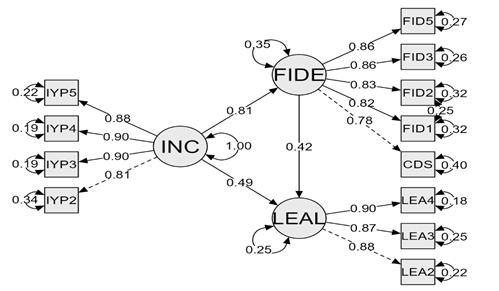
Tabla 4.
Hypothesis Testing
|
Hypothesis
|
Path
|
|
Standardized
Coefficient
|
Standard
Error
|
Z-Value
|
p
|
95%
Confidence Interval
|
Decision
|
|
Lower bound
|
Upper bound
|
|
H1
|
INCENTIVES
|
LOYALTY
|
0.49
|
0.11
|
4.61
|
0.00***
|
0.28
|
0.69
|
Ö
|
|
H2
|
INCENTIVES
|
RETENTION
|
0.81
|
0.04
|
20.69
|
0.00***
|
0.73
|
0.88
|
Ö
|
|
H3
|
INCENTIVES
|
LOYALTY
|
0.42
|
0.11
|
3.77
|
0.00***
|
0.20
|
0.63
|
Ö
|
The
analysis of the structural equation model (SEM) revealed significant insights
into the influence of incentives on both retention and loyalty, as well as the
impact of retention on loyalty. These results are consistent with the
theoretical framework, and the reported values reinforce the robustness of the
model.
As
shown in Table 4, there is a positive and statistically significant
relationship between Incentives and Loyalty (β = 0.49, Z = 4.61, p <
0.001). This standardized coefficient suggests that incentives exert a
substantial influence on loyalty. The 95% confidence interval [0.28, 0.69]
excludes zero, confirming the statistical significance of the relationship.Moreover, the low standard error (SE = 0.11)
indicates a precise and stable estimate.
Similarly,
Incentives demonstrated a strong and statistically significant effect on
Retention (β = 0.81, Z = 20.70, p < 0.001). This result suggests that
incentives not only directly affect loyalty, but are also a key factor in
fostering customer retention. The 95% confidence interval [0.73, 0.88] further
supports the validity of this relationship, while the low standard error (SE =
0.04) is consistent with a well-fitting model.
Finally,
Retention was found to have a positive influence on Loyalty (β = 0.42, Z = 3.77, p
< 0.001). Although the effect size is smaller than that of incentives, the
relationship remains statistically significant, suggesting that retained
customers are more likely to exhibit loyalty. The 95% confidence interval
[0.20, 0.63] supports the significance of this relationship, although the wider
range and higher standard error (SE = 0.11) indicate greater variability in the
estimate.
Discussion
The
structural equation model (SEM) is designed to analyze interrelationships among
variables within a given field of study, a methodological approach that has
gained considerable relevance in recent years. In this context, SEM can help
validate compensatory factors present in educational and digital environments,
supporting improvements in teaching and learning processes.
Customer
retention has been extensively studied, particularly regarding how service
quality and positive experiences influence continued brand preference. Recent
studies suggest that the most effective retention strategies are strongly tied
to customer satisfaction, which is influenced by both emotional factors and the
quality of customer interaction (Quezada et al., 2024). Additionally, offering
personalized experiences and maintaining close contact with users have proven
to be fundamental elements in building long-term relationships, particularly in
industries such as tourism (Sanagustín et al., 2021).
Furthermore,
Macas et al. (2024) explain that loyalty also depends on product quality. For
internet service providers, the way the service is delivered plays a critical
role—what differentiates one provider from another is their ability to attract
customers and foster meaningful connections. This allows for the development of
customer-centric strategies that foster loyalty, enhancing retention and
promoting positive word-of-mouth and brand referrals.
Customer
loyalty has also been studied from different perspectives, including perceived
quality and overall satisfaction. Findings suggest that loyalty is influenced
not only by service quality but also by sustainability initiatives adopted by
companies (Granados et al., 2022).
Organizations
that adopt sustainable practices can enhance both the customer experience and
their overall value proposition. Organizations that adopt sustainable practices
can enhance both the customer experience and their overall value proposition (Rodríguez
et al., 2023).
Similarly,
Silva et al. (2021) argue that customer loyalty is demonstrated through repeat
purchases, third-party recommendations, and perceived service quality. In this
context, it is essential to assess how customers perceive the company over time
and identify strategies to strengthen those relationships.
According
to Pierrend (2020), implementing strategic actions is essential for companies
aiming to maintain their customer base and attract new clients. Among the most
common strategies are personalized attention programs, competitive interest
rates, and the addition of unique value propositions.
Regarding
incentives, it has been confirmed that they are a fundamental part of
maintaining a loyal customer base. These incentives can be monetary or
non-monetary (Carreón & Ramírez, 2023). Their effectiveness depends on the
company’s ability to manage customer relationships while honoring the mutual
commitment between both parties (Miranda et al., 2022).
In
summary, the studies reviewed indicate that customer retention and loyalty are
influenced by multiple factors, including service quality, research tools,
marketing strategies, technology, and the establishment of stable
company–customer relationships. Consequently, there is a strong emphasis on
implementing strategies that help companies improve their services over the
long term.
Limitations
and Future Research Directions
Limitations
·
Geographic context: The study was limited to internet service companies in Machala
(Ecuador), which restricts its applicability to other markets or sectors.
·
Non-probability sampling: There is a risk of self-selection bias and lack of
representativeness.
·
Reliance on self-reported data: Possible bias due to the subjective responses of participants.
·
Quantitative approach: The study did not explore qualitative perspectives on customers’
in-depth perceptions.
Future
Research
Future studies could replicate this
research in other cities in Ecuador or emerging economies to compare results
across diverse sociocultural contexts. This approach would contribute to a more
global understanding of the factors that determine consumer loyalty and
retention.
It is also important to examine
moderating variables such as demographics (e.g., age, income) or cultural
factors that may affect the impact of incentives and service quality, offering
a more nuanced understanding of the results.
Finally, incorporating additional
variables—such as the impact of technology, service sustainability, or market
competition—could offer a more comprehensive perspective on the factors
affecting retention. In conclusion, while the current findings emphasize the
role of incentives and service quality, future research should address the
study’s methodological limitations and expand its scope to gain a deeper and
more diverse understanding of the phenomenon across different contexts.
CONCLUSIONS
In
conclusion, the findings show that incentives are a key driver of both customer
retention and loyalty. Although retention also has a positive effect on
loyalty, its impact is slightly less significant than that of incentives. These
findings suggest that companies should develop marketing strategies that
prioritize service design and incentive structures.
Efficient,
personalized, and effective customer service is essential, as it increases the
likelihood of continued customer engagement. This aligns with strategies aimed
at fostering strong, long-term customer relationships.
Moreover,
providing good customer service also improves the image and reputation of
companies in Machala. Consumers tend to recommend businesses where they have
had satisfactory experiences, generating new customers through word-of-mouth.
Thus, companies that focus on improving customer care not only retain their
current client base but also attract new potential customers.
REFERENCIAS BIBLIOGRAFÍCAS
Aburayyaa, A., Marzouqib,
A. A., Alawadhic, D., y Taryame, F. A. (2020). An empirical investigation of the
effect of employees’ customer orientation on customer loyalty through the
mediating role of customer satisfaction and service quality. Contents lists
available at GrowingScience. doi:doi: 10.5267/j.msl.2020.3.022
Ahmad, S. A.-A., y
Maher, A.-H. (2019). Impulsando
la lealtad electrónica del cliente: una escala extendida de calidad de servicio
en línea. 10(12),
7. doi:https://doi.org/10.3390/info10120380
Albari, y Kartikasari.
(2019). The Influence of Product Quality,Service Quality and Priceon Customer
Satisfaction and Loyalty. Asian Journal of Entrepreneurship and Family Business
.
Arcentales, G., y Avila,
V. (2021). Marketing
relacional y su incidencia en la fidelización del cliente en tiendas de
productos de consumo: caso Tía S.A. 593 Digital Publisher CEIT, 132-143.
Aurajo, L., y Lopez, C.
(2022). Estado del arte de los estudios del modelo SERVQUAL en la gestión
pública. Ciencia Latian Revista Multidisciplinar, 6(6).
doi:https://doi.org/10.37811/cl_rcm.v6i6.3879
Barragan, A., Santamaría,
E., y Guerrero, C. (2022). Marketing relacional, una estrategia para fidelizar
clientes a través de redes sociales: caso Melisa La Serranita. REVISTA
ERUDITUS, 9-29.
Barrientos, A., y
Caldevilla, D. (2022). Comunicacion en los progamas de referenciacion y
fidelizacion de los clientes . Venezolana de Gerencia, 1280-1295.
Bayad, A., Bayar, G.,
Baban, O., Shahla, A., Nechirwan, I., Pshdar, A., . . . Kofand, A. (2021). Hotel
Service Quality: The Impact of Service Quality on Customer Satisfaction in
Hospitality. International Journal of Engineering Business and Management.
Berry, L. (2002).
Relationship Marketing of Services Perspectives from 1983 and 2000. Journal of Relationship
Marketing, 59-77.
Burgos, N., y Montesdeoca,
J. (2024). Percepeción de la calidad de los servicios de empresas proveedoras
de internet en Ecuador. Revista Cientifica Multidisciplinaria Arbitrada
YACHASUN, 8(14), 2. Obtenido de
https://www.editorialibkn.com/index.php/Yachasun/article/view/475/782
Carreón, R., y Ramírez, A.
(2023). Incentivos como instrumento para mejorar la productividad y eficiencia
de una microempresa purificadora de agua. Cult. Científ. y Tecnol, 20(2), 4–10.
doi:https://doi.org/10.20983/culcyt.2023.2.2.1
Cavaliere, L., Pio, L.,
Khan, R., y Sundram, S. (2021). The Impact Of Customer Relationship Management On
Customer Satisfaction And Retention: The Mediation Of Service Quality. Turkish Journal of
Physiotherapy and Rehabilitation .
Chee, y Husin, (2020). El
efecto de la calidad del servicio, la satisfacción y la lealtad hacia la
retención de clientes en la industria de las telecomunicaciones. Revista
Internacional de Investigación Académica en Ciencias Empresariales y Sociales,
10(9), 59. doi:http://dx.doi.org/10.6007/IJARBSS/v10-i9/7496
Comisión Económica para
América Latina y el Caribe. (marzo de 4 de 2021). Pandemia provoca aumento en
los niveles de pobreza sin precedentes en las últimas décadas e impacta
fuertemente en la desigualdad y el empleo. Recuperado el 23 de diciembre de
2024, de
https://www.cepal.org/es/comunicados/pandemia-provoca-aumento-niveles-pobreza-sin-precedentes-ultimas-decadas-impacta
Cordero, D., Erazo, J., y
Bermeo, K. (2023). Calidad del servicio en organizaciones proveedoras de
internet desde la perspectiva de estudiantes de los diferentes niveles
educativos. . Conrado, 83-91.
Dubuc-Pina, A. (2022).
arketing sensorial como estrategia persuasiva para la fidelización del cliente
en el sector de servicios. . Koinonía, 53-71.
Flores, G., Villegas, F., y
Napán, A. (2021). Calidad de servicio y su relación con la fidelización de los
clientes. Revista Arbitrada Interdisciplinaria KOINONIA.
Granados, J., Pedraza, J.,
Pérez, L., y Gallarza, M. (2022). Las condiciones explicativas de la lealtad
del cliente en las relaciones comerciales B2B. Innovar, 32(85), 49 - 66.
doi:https://doi.org/10.15446/innovar.v32n85.101126
Hari, P., Iqbal, M., y
Novandari, W. (2019). Customer
Satisfaction As The Moderating Variable Of. Jurnal Akuntansi Manajemen Dan
Ekonomi.
Harriet, N., Nuwagaba,
A., Birungi, M., y Mugizi, T. (2024). Service Quality, Customer Loyalty and
Customer Retention among Private Health Care Services in Mbarara City. Open
Journal of Social Sciences.
Homburg, Jozić, y
Kuehnl. (2017). Customer experience management: toward implementing an evolving
marketing concept. Journal of the Academy of Marketing Science .
Jamal, B. A., Gardi, B.,
Baban Jabbar Othman., S. A., y Nechirwan. (2021). Hotel Service Quality: The
Impact of Service Quality on Customer Satisfactión in Hospitality.
ResearchGate, 5(3). doi:DOI: 10.22161/ijebm.5.3.2
Jiang, F., Mei, S., y
Zhong, W. (2020). Impact of Customer’s Social Value on Optimizing Referral
Reward Programs. Journal of Organizational Computing and Electronic Commerce,
279-295.
Khairawati, S. (2020).
Effect of costumer loyalty program on customer satisfaction and its impact on
customer loyalty. INTERNATIONAL JOURNAL OF RESEARCH IN BUSINESS AND SOCIAL
SCIENCE.
Kumar, y Werner, R.
(2018). Customer Relationship Management. Berlín: Springer Berlin, Heidelberg.
Macas, A., González, E.,
González, D., y Toapanta, E. (2024). Análisis de los Factores que Influyen en
la Fidelidad del Consumidor. Ciencia Latina Revista Científica
Multidisciplinar,, 8(1), 3134-3146.
doi:https://doi.org/10.37811/cl_rcm.v8i1.9644
Mahaboob, Rajaiah,
Penchalaiah, Raja, y Niranjana. (2020). Machine Learning-Structural Equation Modeling
Algorithm:. International Journal of Emerging Trends in Engineering Research.
Mardolkar, S., y Virani,
H. (2018). Detection of Mosquito Borne Disease in Human Blood using Image
Processing Technique. International Journal of Computer Application, 180(40),
48 - 54.
doi:https://www.ijcaonline.org/archives/volume180/number40/29399-2018917060/
Martinez, E., Licona,
J., y Rivera, P. (2022). Importancia
del servicio al cliente como factor de preferencia comercial en una pyme .
Revista De Investigación Académica Sin Frontera: Facultad Interdisciplinaria De
Ciencias Económicas Administrativas - Departamento De Ciencias Económico
Administrativas-Campus Navojoa, 17.
Miranda, A., Santamaría,
E., y Guerrero, C. (2022). Marketing relacional, una estrategia para fidelizar
clientes a través de redes sociales: caso Melisa La Serranita. evista eruditus,
3(2), 9–29. doi:https://doi.org/10.35290/re.v3n2.2022.616
Moreira, R., Yoenia, P., y
Lema, B. (2023). Plan de atencion al cliente en una empresa de limpieza.
Revista de Ciencias Sociales y Humanas.
Norawati, Arman, Ali, y
Ihsan. (2021).
Analysis of Product Variation, Quality of Service and Their Effect on Customer
Satisfaction. International Journal of Entrepreneurship and Business
Development.
Oliver, R. (1999). De
dónde viene la lealtad del consumidor. Journal of Marketing, 33-34.
Ordoñez, K., y Zaldumbide,
D. (2020). La calidad del servicio al cliente como ventaja. Digital Publisher.
Ortega, R., Portilla, Y., y
Lema, B. (2023). Plan de atención al cliente en una empresa de limpieza.
Revista de Ciencias Sociales Humanas, 5(2), 2.
doi:https://doi.org/10.47606/ACVEN/PH0187
Parasuraman, A.,
Zeithaml, V., y Berry, L. (1988). SERVQUAL A Multipleitem Scale for Measuring Consumer
Perceptions of Service Quality. Journal
of Retailing, 12-40.
Pierrend , S. (2020). La
Fidelización del Cliente y Retención del Cliente: Tendencia que se Exige Hoy en
Día. Gestión en el Tercer Milenio(23), 5 - 13.
doi:https://doi.org/10.15381/gtm.v23i45.18935
Quezada, N., Sánchez, T., y
Aguilar, W. (2024). Factores que inciden en la fidelización de clientes de las
pymes en la ciudad de Machala. 593
Digital Publisher CEIT, 9(4), 300-311 .
doi:https://doi.org/10.33386/593dp.2024.4.2396
Rane, N. L., Anand, A., y
Choudhary, S. P. (2023). ENHANCING CUSTOMER LOYALTY THROUGH QUALITY OF SERVICE:
EFFECTIVE STRATEGIES TO IMPROVE CUSTOMER SATISFACTION, EXPERIENCE,
RELATIONSHIP, AND ENGAGEMENT. International Research Journal of Modernization
in Engineering Technology and Science, 05.
doi:https://www.doi.org/10.56726/IRJMETS38104
Rodríguez, D., Arista, A., y
Cruz, J. (2023). Calidad de servicio y su efecto en la satisfacción y lealtad
de los clientes. Revista San Gregorio, 1(55), 65–77.
doi:https://doi.org/10.36097/rsan.v1i55.2326
Samperio, V. (2019).
Ecuaciones estructurales en los modelos educativos: características y fases en
su construcción. Apertura, 11(1), 90-103.
doi:https://doi.org/10.32870/Ap.v11n1.1402
Sanagustín, V., Puyuelo ,
J., y Martínez, V. (2021). La fidelidad de los clientes según los maîtres en el
sector de la restauración: análisis sociológico del dinescape de la experiencia
antes y durante la covid-19. Cuadernos de Turismo(48), 1–24.
doi:https://doi.org/10.6018/turismo.492561
Seminario, R., Perez, L., y
Castro, E. (2022). Fidelización en los clientes de la tienda Platanitos. Ágora,
47-54.
Silva, J., Macías, B.,
Tello, E., y Delgado, J. (2021). La relación entre la calidad en el servicio,
satisfacción del cliente y lealtad del cliente: un estudio de caso de una
empresa comercial en México. CienciaUAT, 15(2), 85 - 101.
doi:https://doi.org/10.29059/cienciauat.v15i2.1369
V. Kumar, W. R. (2018). Customer Relationship
Management. Berlín : Springer Berlin, Heidelberg.
Velasco, M., y Martinez, M.
(2019). Muestreo probabilístico y no probabilístico. Licenciatura en.
Vizcaino, P., Cedeño, J., y
Maldonado, I. (2023). Metodología de la investigación científica: guía
práctica. Ciencia Latina Revista Científica Multidisciplina.
Zavala, L., y Valencia, M.
(2021). Calidad del servicio y su relación con la satisfacción al cliente en la
empresa pública de agua potable del cantón Jipijapa. . Polo del Conocimiento:
Revista científico-profesional, 570-591.
Zeithaml, V., Parasuraman,
P., y Berry, L. (2020). Delivering
quality service: Balancing customer perceptions and expectations. United States of America:
The free press.
CONFLICT
OF INTEREST
The authors declare no conflict of
interest.