INTRODUCTION
In recent years, generative artificial intelligence has arrived forcefully in university classrooms. Tools such as ChatGPT are changing how we teach, learn, and assess. This opens many possibilities, but also poses significant challenges that we have not yet fully understood (Bozkurt et al., 2023).
Today, any university student can ask generative AIs such as ChatGPT, DeepSeek, or others to write a summary, explain a difficult concept, or even generate code for a project. This is possible thanks to large language models (OpenAI, 2023). All of this occurs within what is often called the Fourth Industrial Revolution, alongside the consolidation of digital ecosystems in the educational sphere. In theory, algorithmic personalization promises to make learning processes more efficient, but this promise collides with a real problem: as the use of generative AI increases, so does the amount of personal data that students end up exposing. This brings with it legitimate concerns about privacy, security, and the control that they themselves can exercise over their information (Zuboff, 2019; Dwivedi et al., 2023).
From the perspective of sustainable development, integrating AI into education is not an isolated fact: it is directly related to Sustainable Development Goal 4, which seeks inclusive, equitable, and quality education; also to SDG 9, focused on innovation and technological infrastructure; and to SDG 16, which emphasizes solid institutions and respect for fundamental rights, including the protection of personal data (United Nations, 2015). However, when AI technologies are implemented without adequate governance frameworks, negative effects can be generated, such as privacy violations, worsening digital divides, or the perpetuation of algorithmic biases (UNESCO, 2021).
From a historical perspective, the foundations of artificial intelligence are found in the initial work of Alan Turing, who in 1950 raised the question of whether machines could imitate human intelligence, as well as in that of John McCarthy, who in 1956 introduced the term "artificial intelligence." In the educational field, the advancement of intelligent systems has been consolidated first with intelligent tutoring systems and, more recently, with adaptive learning platforms and generative tools that allow natural language interaction (Holmes et al., 2019). Today, generative AI represents a significant qualitative advance, since it not only processes information but also generates original content and offers personalized interaction in real time, which has accelerated its incorporation into universities around the world.
What has been published so far shows that research on AI in education has grown enormously in a short time, especially regarding generative models and the way they affect both learning and academic assessment (Kasneci et al., 2023).
Various recent works highlight advantages such as the possibility of personalizing learning, more agile feedback, and better support for students to regulate their own process (Luckin et al., 2016; Holmes et al., 2019). But there is also research that warns about the dangers of using these technologies, especially due to massive data collection, the lack of transparency of algorithms, and how unclear it is to know how personal information is actually handled (Floridi et al., 2018). Added to this is that students, while valuing the usefulness of generative AI, have conflicting perceptions regarding the privacy of their data, which reflects a gap between the level of technological adoption and critical awareness of its consequences (Tsai et al., 2021).
To provide theoretical support for this work, we draw on approaches such as the Technology Acceptance Model (TAM), which explains why people adopt a technology based on how useful they find it and how easy it seems to use (Davis, 1989). We also rely on more current theories about the data economy, which understand personal information as a strategic resource in the digital age (Zuboff, 2019). At the same time, contextual privacy theory suggests that risk perception depends on the scenario in which data is shared and on what users consider normal or expected in each situation (Nissenbaum, 2010). In the case of generative AI applied to education, these ideas help us understand how students negotiate between the academic benefits they obtain and the possible risks of exposing their information.
At the conceptual level, we understand generative artificial intelligence as a set of models capable of producing new content, whether text, images, audio, or code, from patterns learned from large volumes of data (OpenAI, 2023). On the other hand, the perception of risk in data privacy refers to the extent to which people believe that their personal information can be misused, stored without their consent, or shared with third parties without them having control (Malhotra et al., 2004). Thus, the relationship between both variables constitutes a very relevant field of analysis if we want to understand how trust is built and how technology is adopted in educational environments.
The legal framework is also key to putting this problem in context. At the international level, regulations such as the European Union's General Data Protection Regulation (GDPR) establish clear principles on the handling of personal data, such as informed consent, data minimization, and the right to be forgotten (European Parliament, 2016). In Latin America, several countries have advanced in similar regulations, recognizing data protection as a fundamental right. However, the rapid evolution of generative AI poses important regulatory challenges, because many of these tools operate transnationally and are sustained by business models that depend on collecting and analyzing large amounts of data.
Despite technological and regulatory advances, notable failures remain in how AI is implemented in higher education. Among them are the lack of critical digital literacy among students, the scarce transparency of the algorithms used by platforms, and the absence of clear institutional policies on the use of AI tools (UNESCO, 2021). There is also a tendency to exaggerate the benefits of personalization without sufficiently considering the costs in terms of privacy, which can lead to an unreflective adoption of these technologies. This situation reveals an underlying problem: the tension between achieving more efficient education and protecting students' digital rights.
In this context, the research problem is formulated around the need to understand how the use of generative artificial intelligence in educational environments relates to the perception of risk regarding data privacy in university students.
Although there is increasing interest in the use of generative AI in education, we still have little empirical evidence that analyzes its link with the perception of risk in data privacy, especially in Latin American contexts. Most studies have been carried out in different realities, which reveals the need to generate situated knowledge that allows understanding this relationship in university populations in the region.
For all these reasons, the objective of this study is to analyze the relationship between the use of generative artificial intelligence in educational environments and the perception of risk in data privacy among university students. More specifically, we propose: to identify the levels of use of generative AI in higher education students; as a second point, to evaluate their perception of risk in data privacy; and finally, to determine the statistical relationship between both variables.
Finally, it is important to recognize the challenges and limitations inherent to this line of research. Among the main challenges are the rapid evolution of AI technologies, which makes it difficult to keep theoretical and methodological frameworks updated; the heterogeneity in access to and use of these tools; and the complexity of measuring constructs such as risk perception and trust in automated systems. Likewise, the fact of relying on self-reported data can introduce certain biases in the results, so it is essential to use validated instruments and robust statistical techniques. Even so, facing these limitations is essential to generate scientific evidence that contributes to an ethical, responsible, and sustainable integration of artificial intelligence in higher education.
Based on the literature review and theoretical approaches to technological adoption and digital privacy, the conceptual model of the study that guides the relationship between the analyzed variables is proposed (Figure 1).
Figure 1.
Conceptual model of the relationship between the use of generative artificial intelligence and the perception of data privacy risk among university students.
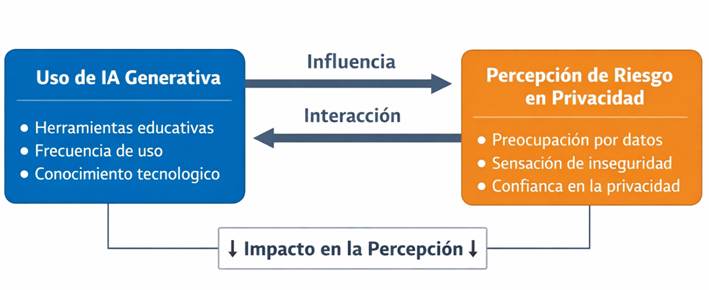
Note. The conceptual model proposes that the use of generative artificial intelligence tools in educational environments influences the perception of risk associated with the privacy of students' personal data. Constant interaction with these technologies can modify the perception of security, trust, and control over personal information in digital environments.
METHODOLOGY (MATERIALS AND/OR METHODS)
To address the research question, a study with a mixed-method approach was designed. This meant combining quantitative and qualitative approaches, seeking a broader understanding of how the use of generative artificial intelligence in educational contexts relates to the perception of risk regarding data privacy among university students. The quantitative part served to examine the statistical relationships between variables, while the qualitative part allowed us to approach the perceptions and experiences that students themselves have when using these technologies in their daily academic life. This combination favors triangulation of methods and reinforces confidence in the findings obtained (Creswell & Plano Clark, 2018).
From an epistemological point of view, this research is basic, but with an applied orientation. It contributes to the existing scientific knowledge on how artificial intelligence, education, and data privacy are related, and at the same time offers empirical evidence that is useful for decision-making in higher education institutions. It is also worth noting that the study has a prospective character, because it analyzes a contemporary phenomenon whose future implications will affect the digital transformation processes of educational systems.
Regarding its scope, the research is descriptive, correlational, and interpretative. It is descriptive because it characterizes the patterns of use of generative artificial intelligence tools among university students; correlational because it examines the statistical relationship between the use of said tools and the perception of risk in data privacy; and interpretative because it incorporates a qualitative analysis that allows understanding the subjective perceptions of participants regarding the phenomenon analyzed.
The research design is non-experimental and cross-sectional, since the variables were not deliberately manipulated and data collection was carried out at a single point in time. The research process was developed between October 2025 and January 2026, during which period the measurement instrument was designed, its validation was carried out, the survey was applied to participants, and the statistical analysis of the data was performed.
The study population consisted of students enrolled in higher education institutions who use generative artificial intelligence tools in their academic activities. It is important to highlight that university students are one of the sectors that most interact with emerging technologies in digital learning environments. For this reason, this population group is especially relevant for the study.
To select the participants, a non-probabilistic convenience sampling was used, taking into account accessibility criteria and willingness to participate voluntarily. The inclusion criteria were three: being enrolled in a higher education institution, having used at least one generative artificial intelligence tool in academic activities, and agreeing to participate in the study by signing an informed consent form.
All students participated voluntarily and were asked for their informed consent. Confidentiality and anonymity of the information collected throughout the entire process were ensured.
The study was conducted in compliance with ethical principles for research on human subjects.
The final sample consisted of 200 university students, a size considered adequate for correlational studies and multivariate models in social and educational research (Hair et al., 2019). This sample size allows guaranteeing adequate statistical power to detect significant relationships between the analyzed variables.
Data collection was carried out using the survey technique, using a structured questionnaire with a five-point Likert scale. The instrument was developed based on theoretical models widely used in the scientific literature, particularly the Technology Acceptance Model (TAM) proposed by Davis (1989) and the Internet Users' Information Privacy Concerns (IUIPC) model developed by Malhotra et al. (2004). The integration of these models allowed evaluating both the level of technological adoption and the perception of risk associated with data privacy.
The validity of the instrument was determined through a content validity process through expert judgment, in which five specialists in the areas of statistics, education, and information technologies participated. The expert evaluation worked on the relevance, clarity, and coherence of the items, which allowed adjustments to be made before its final application.
Subsequently, construct validity was evaluated through exploratory factor analysis (EFA), which allowed identifying the underlying structure of the measured variables. The Kaiser-Meyer-Olkin (KMO) index obtained a value of 0.86, considered adequate for the application of factor analysis, while Bartlett's test of sphericity was significant (p < 0.001), confirming the adequacy of the factorial model.
The reliability of the instrument was determined using Cronbach's alpha coefficient, obtaining a global value of 0.87, which indicates high internal consistency of the instrument (Nunnally & Bernstein, 1994).
Statistical analysis was performed using specialized software such as SPSS and R. In a first phase, descriptive statistics techniques were applied, including measures of central tendency, dispersion, and frequencies. Subsequently, normality tests (Kolmogorov-Smirnov) were applied to determine the distribution of the data. To evaluate the relationship between variables, the Pearson correlation coefficient was used, while the influence between variables was analyzed using simple linear regression.
Additionally, the coefficient of determination (R²) was estimated in order to determine the proportion of variance explained by the statistical model. In the qualitative component, a thematic content analysis was applied, which allowed identifying emerging categories in students' perceptions regarding the use of generative artificial intelligence.
RESULTS
Characterization of the sample
The distribution of participants according to gender is presented in Table 1.
Table 1
Distribution of participants according to gender
|
Gender |
Frequency |
Percentage |
|
Male |
108 |
54% |
|
Female |
86 |
43% |
|
Other / Prefer not to say |
6 |
3% |
|
Total |
200 |
100% |
Note: Data obtained from the survey applied to university students participating in the study.
The results show a relatively balanced distribution among participants according to gender. A slight predominance of the male gender (54%) is observed, followed by the female gender (43%), while 3% preferred not to specify their gender. This distribution allows for a diverse sample that contributes to the representativeness of the analysis on the use of generative artificial intelligence in the university context.
Table 2
Frequency of use of generative artificial intelligence tools
|
Level of use |
Frequency |
Percentage |
|
Occasional use |
38 |
19% |
|
Weekly use |
72 |
36% |
|
Frequent use |
90 |
45% |
|
Total |
200 |
100% |
Note: Data obtained from the survey applied to university students participating in the study.
The results show that 45% of students use generative artificial intelligence tools frequently, while 36% report weekly use and 19% occasional use. These data reflect a high penetration of these technologies in the academic sphere, confirming the growing incorporation of generative AI tools as support in learning processes in higher education.
Descriptive statistics
Table 3
Descriptive statistics of the analyzed variables
|
Variable |
Mean |
Std. Deviation |
Minimum |
Maximum |
|
Use of generative AI |
3.87 |
0.74 |
1 |
5 |
|
Perception of data privacy risk |
3.21 |
0.82 |
1 |
5 |
Note: Own elaboration based on data obtained from the survey applied to students.
The results indicate that the variable use of generative artificial intelligence presents a mean of 3.87, suggesting a relatively high level of use among students. For its part, the perception of risk in data privacy presents a mean of 3.21, indicating a moderate perception of risk associated with the use of these technologies. The standard deviation shows moderate variability in responses, evidencing differences in students' perception regarding interaction with artificial intelligence tools.
Correlation analysis
Table 4
Pearson correlation between the use of generative artificial intelligence and the perception of privacy risk
|
Variables |
r |
p-value |
Interpretation |
|
Use of generative AI – Perception of privacy risk |
-0.41 |
<0.001 |
Moderate negative correlation |
Note: r = Pearson correlation coefficient; p < 0.001 indicates statistical significance.
The results show a moderate and statistically significant negative correlation between the use of generative artificial intelligence and the perception of privacy risk (r = −0.41; p < 0.001). This suggests that as the use of generative artificial intelligence tools increases, the perception of risk associated with data privacy tends to decrease. However, this relationship should be interpreted with caution, given that the cross-sectional design of the study does not allow establishing causal relationships between the variables.
Figure 2
Relationship between the use of generative artificial intelligence and the perception of data privacy risk
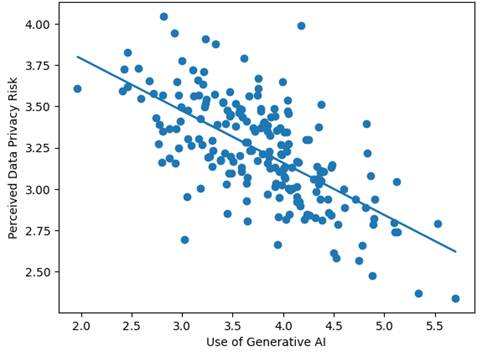
Note: The scatter plot represents the relationship between both variables analyzed in the study.
The figure shows the relationship between the use of generative artificial intelligence and the perception of data privacy risk. The downward trend observed in the scatter plot supports the results of the correlation analysis, evidencing that greater use of generative artificial intelligence tools is associated with lower perception of risk regarding the privacy of personal information.
Table 5
Results of the simple linear regression model
|
Independent variable |
β |
t |
p |
|
Use of generative AI |
-0.38 |
-5.74 |
0.000 |
Note: β = regression coefficient; t = test statistic; p = significance level.
The simple linear regression model shows that the use of generative artificial intelligence exerts a significant influence on the perception of data privacy risk (β = −0.38; p < 0.001). The negative coefficient indicates that an increase in the use of these tools is associated with a decrease in the perception of privacy risk. Furthermore, the coefficient of determination (R² = 0.16) indicates that approximately 16% of the variability in risk perception can be explained by the level of use of generative artificial intelligence.
Figure 3.
Correlation matrix between questionnaire items
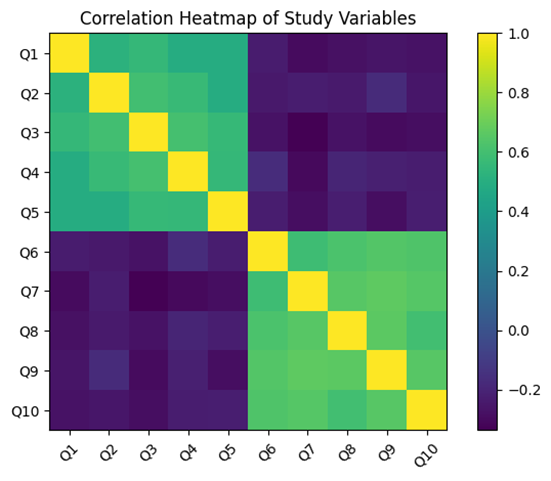
Note: Q1–Q5 correspond to items related to the use of generative artificial intelligence; Q6–Q10 correspond to items associated with the perception of data privacy risk.
The heatmap shows the correlation matrix between the questionnaire items used to measure the use of generative artificial intelligence (Q1–Q5) and the perception of data privacy risk (Q6–Q10). A high positive correlation is observed between items belonging to the same dimension, which supports the internal consistency of the instrument. Likewise, negative correlations are identified between items associated with the use of artificial intelligence and those related to the perception of privacy risk, which is consistent with the results obtained in the Pearson correlation analysis and the regression model.
The visual analysis of the correlation matrix confirms the internal consistency of the instrument, evidencing positive associations between items belonging to the same dimension and negative relationships between the dimensions of AI use and perception of privacy risk. This pattern supports the validity of the construct evaluated in the study.
Qualitative results
The content analysis of open responses allowed the identification of three main categories:
- Academic utility of AI, related to idea generation and task support.
- Moderate privacy concern, where some students recognize possible risks.
- Trust in technological platforms, based on the perception of security of digital tools.
DISCUSSION
The results obtained show that the use of generative artificial intelligence tools in the university setting reaches relatively high levels among students. The descriptive analysis revealed that a good part of the participants frequently uses these technologies in their academic tasks, confirming that artificial intelligence is increasingly being integrated into higher education learning processes.
Within this framework, several studies have pointed out that incorporating intelligent technologies into educational processes can help strengthen digital competencies and create more innovative learning environments. Facuy Delgado and Díaz Espinoza (2025) point out that systems based on ambient intelligence and smart technologies can support educational processes oriented toward sustainable development, as long as their implementation is accompanied by well-defined pedagogical and ethical strategies. More recent research has also found that the use of digital tools in university contexts can significantly contribute to the development of research competencies and the reinforcement of academic skills in students (Toledo et al., 2026).
The findings of this study suggest that there is an association between greater use of generative artificial intelligence tools and lower perception of privacy risk. However, this relationship should be interpreted with caution, because the cross-sectional design of the study does not allow establishing cause-and-effect relationships. The qualitative results support this observation, as they show that students tend to prioritize the academic benefits they obtain from these tools, even when they recognize that there are associated privacy risks.
The fact that the relationship between variables is statistically significant should not obscure that the model has limited explanatory capacity. It is very possible that the perception of risk in data privacy is influenced by other factors not included in the model, such as the level of knowledge that students have about data protection, the trust that digital platforms generate in them, or their previous experience with similar technologies.
These results make it clear that institutional strategies for digital literacy and technological ethics need to be reinforced, in order to promote a critical and responsible use of artificial intelligence in higher education.
What we have found coincides with what other previous research reports, which point out that greater use of technologies based on artificial intelligence can lead to a normalization of the risks associated with the handling of personal data. Recent studies in the field of digital education have observed that students tend to value the academic benefits of these tools more than concerns related to privacy (Holmes et al., 2019; Tsai et al., 2021).
On the other hand, recent research has also shown that artificial intelligence systems can process large volumes of data and generate useful predictive models for different technological and social contexts. Facuy et al. (2025) highlight that ambient intelligence systems and predictive models based on artificial intelligence can improve the ability to analyze complex information, which reinforces the importance of understanding how data is managed and protected in digital environments.
It is necessary to point out some limitations of this study. First, the use of non-probabilistic sampling may restrict the possibility of generalizing the results to other student populations. Second, the data were collected through self-report, which may introduce certain biases in the responses. Finally, the cross-sectional design of the study prevents establishing causal relationships between the analyzed variables.
All of the above indicates that the growing incorporation of generative artificial intelligence in higher education makes it necessary to develop institutional frameworks that guarantee algorithmic transparency, the protection of personal data, and the strengthening of critical digital literacy among students.
CONCLUSIONS
The findings of this research show that the use of generative artificial intelligence tools in university environments reaches high levels among students, which confirms that these technologies are increasingly being integrated into digital learning processes. The descriptive analyses indicate that a significant part of the participants frequently uses these tools in their academic activities, thus reflecting that artificial intelligence is consolidating as an emerging resource within higher education.
The statistical analysis yielded a moderate and statistically significant negative correlation between the use of generative artificial intelligence and the perception of risk regarding data privacy (r = -0.41; p < 0.001). This means that, in the studied sample, the greater the use of these tools, the lower the perception of risk associated with the privacy of personal information.
On the other hand, the linear regression model showed that the use of generative artificial intelligence significantly influences the perception of risk regarding privacy (β = -0.38; p < 0.001), and explains about 16% of the variability of that phenomenon (R² = 0.16). These results point to the fact that the use of generative AI is related to how students perceive the risks to their data. However, it should be clarified that this relationship refers to subjective perception and should not be interpreted as evidence of changes in the actual conditions of security or information protection.
The qualitative results reinforce the above, as they show that students see generative artificial intelligence primarily as an academic aid that facilitates content production, information search, and idea generation. Although some participants recognize that there may be risks with the handling of their personal data, these concerns do not seem to curb their use of these technologies.
Together, these findings highlight the need to promote institutional strategies aimed at strengthening digital literacy, technological ethics, and personal data protection, with the objective of guaranteeing a responsible and critical use of artificial intelligence in higher education.
REFERENCES
Bozkurt, A., Xiao, J., Lambert, S., et al. (2023). Speculative futures on ChatGPT and generative artificial intelligence in education. Asian Journal of Distance Education.
Creswell, J. W., & Plano Clark, V. L. (2018). Designing and conducting mixed methods research (3rd ed.). SAGE Publications.
Davis, F. D. (1989). Perceived usefulness, perceived ease of use, and user acceptance of information technology. MIS Quarterly, 13(3), 319–340.
Dwivedi, Y. K., Kshetri, N., Hughes, L., et al. (2023). So what if ChatGPT wrote it? Multidisciplinary perspectives on opportunities, challenges and implications of generative conversational AI. International Journal of Information Management, 71.
European Parliament. (2016). Regulation (EU) 2016/679 (General Data Protection Regulation).
Facuy Delgado, J. P., & Díaz Espinoza, M. (2025). El rol de la inteligencia ambiental en la promoción del desarrollo sostenible en la educación básica superior. Revista InveCom, 5(3). https://doi.org/10.5281/zenodo.14635894
Facuy, J., Aguirre-Munizaga, M., Pasini, A., Estévez, E., Moran-Castro, C. (2026). Validation of an Ambient Intelligence System Applied to the Prediction of Electronic Waste in Smart Cities. In: Valencia-Garcia, R., et al. Technologies and Innovation. CITI 2025. Communications in Computer and Information Science, vol 2776. Springer, Cham. https://doi.org/10.1007/978-3-032-11494-5_17
Floridi, L., Cowls, J., Beltrametti, M., et al. (2018). AI4People—An ethical framework for a good AI society. Minds and Machines, 28(4), 689–707.
Hair, J. F., Black, W. C., Babin, B. J., & Anderson, R. E. (2019). Multivariate data analysis (8th ed.). Cengage Learning.
Holmes, W., Bialik, M., & Fadel, C. (2019). Artificial intelligence in education: Promises and implications for teaching and learning. Center for Curriculum Redesign.
Kasneci, E., Sessler, K., Küchemann, S., et al. (2023). ChatGPT for good? On opportunities and challenges of large language models for education. Learning and Individual Differences, 103, 102274.
Luckin, R., Holmes, W., Griffiths, M., & Forcier, L. (2016). Intelligence unleashed: An argument for AI in education. Pearson.
Malhotra, N. K., Kim, S. S., & Agarwal, J. (2004). Internet users’ information privacy concerns (IUIPC). Information Systems Research, 15(4), 336–355.
Nissenbaum, H. (2010). Privacy in context: Technology, policy, and the integrity of social life. Stanford University Press.
Nunnally, J. C., & Bernstein, I. H. (1994). Psychometric theory (3rd ed.). McGraw-Hill.
OpenAI. (2023). GPT-4 technical report. arXiv. https://doi.org/10.48550/arXiv.2303.08774
Toledo, A., Facuy Delgado, J., Aldaz, J., & Yerovi, E. (2026). Evaluación cuasi-experimental del uso de herramientas digitales en el desarrollo de competencias investigativas en estudiantes universitarios. Atlas Research Journal, 4(1), 69–90. https://doi.org/10.65305/arj.v4n1.2026.51
Tsai, Y. S., Moreno-Marcos, P. M., Jivet, I., et al. (2021). The SHEILA framework. Journal of Learning Analytics, 8(1), 1–15.
UNESCO. (2021). Recommendation on the ethics of artificial intelligence.
United Nations. (2015). Transforming our world: The 2030 agenda for sustainable development.
Zuboff, S. (2019). The age of surveillance capitalism. PublicAffairs.
CONFLICT OF INTEREST
The author reports no conflicts of interest.