INTRODUCTION
Education is an activity that can be called an art, which is carried out by vocation, but it is also true that it is a task that can be developed by all individuals who wish to guide and orient others. On occasion, this is developed naturally and instinctively, which can be evidenced in the earliest forms of teaching among human beings and/or in some animal species. The above is observed when one speaks of the individual training process that parents carry out with their child in each of the teachings and orientations aimed at formation and preparation for life. In the case of animals, it is evidenced in the set of basic survival instructions that a mother gives to her young. As an example, one can mention the case of the mother orangutan, who guides the learning of skills so that her young can survive in the jungle, accompanying her offspring in basic preparations such as finding food and feeding until the age of nine (SINC, 2021).
In both cases, prior and experience-based knowledge is shared by the one who teaches, where love is the engine that drives the educational process, in which knowledge is shared in an instinctive manner free of any petulant pride and/or arrogance. On the contrary, it is affection that guides the giving and sharing of knowledge to help open paths in life. It is important to highlight that the connotation is different when this educational process takes place within the school setting and from the role of the teacher. It is important to specify that to exercise teaching, determining elements are necessary, where vocation is the force that drives pedagogical action, and this must be full of sensitivity, knowledge, didactics, and patience.
The teaching process supported by any of the methodologies must create a synergy that results in the construction of experiences, concepts, and constructs to achieve meaningful learning that builds and enriches comprehensive formation, projected toward the formation of capable, critical individuals, sensitive to differences, empathetic, who with humility contribute to the construction of a society where justice, equity, healthy coexistence, and respect are pillars of change for a new and better world that cares for nature and protects life and peace. However, this contrasts with other situations that arise in the educational and academic sphere, which are also part of a reality that cannot ignore or disregard the negative attitudes of some teachers who, despite being academics and/or professors distinguished by the extensive support of their degrees and intellectual achievements with brilliant curricula, are overshadowed by attitudes of disrespect, contempt, and discrimination toward their peers who have less education, where manifestations of arrogance call into question the value and contribution of their knowledge for the construction of a society where one can live together, share, and coexist in harmony with sensitivity, recognition, and understanding of the need for the development of intellectual skills and qualities with the support of all, where collaborative work contributes to the individual's growth without forgetting the human sense.
Discrimination due to knowledge arrogance is evidenced in interactions between teachers and students, between teachers and teachers, not forgetting the relationship between teachers and educational administrators; just as in some countries peasants or indigenous people are not considered subjects of knowledge and are therefore discriminated against (Cruz, 2024). On the other hand, one can speak of the racism of intelligence (Bourdieu, 1978) when in some latitudes the quality and quantity of an individual's knowledge are not valued, recognized, or respected, simply because of their place of origin. An example of this is the way in which Latin American professionals are viewed in Europe and the United States, where they are relegated to secondary positions, thus perpetuating yet another form of injustice and social inequality. Similarly, today there are attitudes, conducts, and behaviors around the knowledge of professors, academics, and some teachers that can trigger discrimination and injustice, since it is also possible to speak of the arrogance of knowledge, which, in the opinion of the author of this article, can occur when, in the praxis of teaching, possessing degrees and knowledge inflates the ego and leads one to view the other as an inferior being, as someone less worthy of respect, without recognition, with opinions of lesser value, thereby potentially legitimizing greater inequalities through knowledge and education.
MATERIALS AND METHODS
This reflective document is elaborated with a qualitative approach, in a production that could be called hybrid, integrating documentary review along with the opinions of the group of interviewed teachers, where one can recognize primary education teachers, secondary education teachers, and university professors, with educational levels ranging from bachelor's degrees in education, specializations, master's degrees, doctoral candidates, to doctors in education, as well as the author's own opinion based on experiences lived over more than three decades of teaching work, achieving a reflective descriptive scope, relating different elements to the expressions of arrogance evidenced by some teachers holding degrees that place them one step higher on the hierarchical scale of power or knowledge compared to other subjects of knowledge who are not recognized but are discriminated against and/or excluded for that reason. This article allows for the interpretation of the phenomenon of arrogance and intellectual humility and generates a deep understanding of the implications of each of these attitudes expressed within the collective.
The distance that separates humility and arrogance is short and depends on each individual's interpretation and attitudes. They can be seen as two concepts located at each end of the same line; they could be understood as the two poles of the same essence, where they differ in their intensity or the focus of their objectives and the result achieved by the effects of one and the other. They become different if viewed and framed from the perspective of the principles of Hermes Trismegistus, in his work The Kybalion (1908): different degrees within the same polarity. Science, academia, and humanity have known great sages, some arrogant and others humble, who through their ideas, concepts, and new knowledge became famous references and starting points for creating and/or sharing new opinions and knowledge.
However, it is not necessary to be famous, nor to be an erudite in a subject or field of knowledge; it can appear not only in great postulates and complex theories but also in a simple idea, in a key word, perhaps in the advice or guidance of a subject who, with their extensive experience, directs and illustrates another with respect and genuine solidarity. Knowledge can be found in a simple expression of nature, in a humble individual through a phrase, word, or advice; knowledge in itself belongs to everyone and is for everyone, and understood in this way, intellectual humility is a quality that Fajardo-Pascagaza (2024) proposes as indispensable in the field of knowledge, as it allows for promoting learning in a climate of constructive dialogue, which gives value to one's own and others' contributions, accepting autonomy on the part of the individual and recognizing their own limits.
On the other hand, intellectual arrogance deserves criticism for becoming a barrier that limits sensible, enriching dialogue and restricts collaboration that can be offered among peers when one of them considers themselves the owner of knowledge. The opportunity for the exchange of ideas and concepts that give rise to new postulates, learning, ideas, hypotheses, and knowledge is lost. As Masquijo, JJ. (2025) explains, it is important for the evolution of knowledge that the teacher, the academic, or the professional within a self-reflective approach makes the decision to change their opinion to advance. His analysis is based on the field of medicine, but it is equally applicable in the field of education, since thinking more openly within the framework of intellectual flexibility releases the tension of absolute truths that close the path to discussion and constructive participation.
However, the problem does not stop there; it is also normal to find academics and teachers who express false modesty, this being another way of attacking the expansion of knowledge when subjects framed in this category put on the mask of humility and hide their arrogance or self-sufficiency, which becomes evident in interactions. The most negative aspect of this condition is that it makes it difficult for them to recognize and rectify their errors. The above could lead to a reflection on the need to avoid and remove intellectual arrogance from the path of teaching so as not to break the communication channel conducive to ideological interaction, the exchange and constructive discussion of concepts and ideas that foster inclusive and constructive learning, thus preventing the acquisition of new knowledge. On the other hand, it is valuable to see and understand intellectual humility as a virtue in the dynamics of dialogue between fellow teachers, academics, and/or professors, which allows for valuing the contributions of others in academic interaction, leading to the recognition of new ideas and learning from relationships with peers who are also considered subjects of knowledge as important as oneself.
RESULTS AND DISCUSSION
1. Narcissism
Some authors express that there are subjects in academia with the need to mark transcendence in a highly competitive and mortal world, which leads them to develop and manifest selfishness, psychopathy, Machiavellianism, but a marked narcissism stands out, which is expressed and evidenced in today's society that promotes various but disguised forms of self-sufficiency and individualism, stimulating and exacerbating narcissism and knowledge arrogance, which authors such as Sáinz (2007) criticize, considering that in the educational sphere this can be detrimental to values such as empathy and solidarity, hindering connection in educational processes, fostering dehumanization in the sector since creating an environment of competition and mistrust negatively affects coexistence in school environments, where some educational actors may feel belittled or discriminated against, leading them to a state of demotivation and emotional disconnection in interaction, feeling the lack of empathy that forgets respect and solidarity.
One can speak of a destructive and dangerous relationship between narcissism and the arrogance of scholars and academics, where the need to seek recognition and prestige is the engine that moves emotions and stimulates anti-values, generating disconnection from other subjects in the environment. With the above, one could daringly refer to the existence also of intellectual narcissism, in which the teacher or academic overvalues their knowledge, admiring themselves and their qualities, which in itself would not be a problem, but it becomes a complex situation when exaggerated self-recognition leads the subject to view the other teacher or academic peer with less value and a sense of inferiority. To complement what has already been mentioned, one can cite the contributions of Sanguinetti (2025), who highlights how pride and arrogance are aspects that block affective knowledge as a gentle and kind path in the search for truth, and as seen from the perspective of Thomas Aquinas, he highlights that the proud and arrogant person refuses to support their understanding in something outside themselves and to learn from others, fostering an exaggerated self-perception of their qualities and a distorted one of reality, refusing support in others, limiting the possibility of acquiring new knowledge.
There are teachers who consider themselves the sole possessors of true and universal knowledge, as mentioned by Arias-Ortega et al. (2023), which leads them to deny values relative to the knowledge of others, and at this point one can mention, for example, the richness of the ancestral knowledge of indigenous groups (which coincides with what was previously mentioned by Cruz Vadillo), thus materializing one of the many forms of exclusion and discrimination in educational and knowledge environments, fostering blockage and stagnation of inclusive, intercultural, and healthy coexistence relationships that affect educational quality and student learning. On the other hand, in China, it is possible to find hundreds of publications that, while important and interesting, are not cited or read in the world and remain forgotten, sometimes motivated by different forms of regionalism and discrimination by subjects of knowledge blinded by arrogance who belittle the production, knowledge, and contributions of others to superimpose and exalt their own studies.
2. Meritocracy
The perception of superiority existing among successful people is evidenced not only in their own sensation but is also supported by the way others perceive them, which can lead a subject of knowledge to develop intellectual arrogance by considering themselves superior, understanding knowledge as a result of their individual effort. It is here that meritocracy appears as another element on the scene of knowledge, perhaps not as a negative element in the first instance, but its connotation changes when it appears as the sole determining element in academic interaction, ignoring the existing structural inequalities in society and its individuals, which cannot be considered a pure system since it continuously fosters and reproduces social inequalities (Rujas J., 2021), leading to a revaluation of the definition of merit and of those who are considered deserving, without taking into account the equality of positions, forcing one to look from the perspective of justice and equity.
Outside this context, meritocracy can be misinterpreted and qualified as an element that perpetuates inequalities by fostering the idea of superiority, whose attitude in the subject leads to the devaluation of the experiences, knowledge, and capacities of others, promoting an exclusionary environment that forgets the collaborative and equitable aspect. Duque (2020) criticizes competitive meritocracy for stimulating arrogance in academics, arguing that in educational contexts, social inequalities and their impact related to access to opportunities are ignored. On the other hand, he proposes a meritocracy that does not give priority and relevance to individual success based on personal triumphs and achievements, but rather values equity and collaboration; he also proposes a reflection that reevaluates honoring democratic merit, which gives priority to the social context and not only to individual achievements, with which coexistence between teachers and academics could be positively impacted by stimulating mutual support and thus improving educational dynamics and teamwork. The democratization of knowledge is impacted by arrogance, which, as Mena & Quiroz (2006) mention, limits the active and adequate participation of students and/or teachers in processes, affecting coexistence, learning, and interactions. They propose fostering dialogue, participation, respect, and equity without the authoritarian imposition of knowledge; on the contrary, giving space to the figure of the teacher as an autonomous and reflective knowledge holder who contributes to human and social development as a reflection of their intellectual humility in a more empathetic and supportive society.
Without being able to define meritocracy as negative, destructive, or harmful, it can have a positive sense, be effective and just; it can and should be an element that brings balance to freedom, social conditions, and healthy competition, fostering in each individual the development of their virtues and qualities, which, added to those of others, enrich and improve the panorama of interaction between teachers without contempt, without arrogance, with respect and recognition for differences in everyone's knowledge. The problem of meritocracy lies in the interpretation and meaning given to it, since meritocracy can be positive and constructive if value is given to merit, if the importance of the right of conscience is recognized, which assists each subject in being one step ahead, granted to those who fulfill their responsibilities with diligence.
3. Arrogance & Confidence
People who feel pride in their achievements, their accomplishments, and the breadth of their knowledge enjoy them with satisfaction, with respect for themselves and for everyone. They are people who know what they do, who speak kindly, and are usually specialists in an area of knowledge or a specific profession. They are respectful by valuing interactions with their peers, controlling their sensations and emotions without becoming excessive in self-recognition. They can be defined as humble people with much knowledge who share their knowledge cordially with those who need it. They are empathetic and careful not to cross the thin line that leads them to petulant pride. With these two words, another category of people is highlighted—those who end up in arrogance, often believing or considering themselves possessors of vast and broad knowledge that makes them superior to others. However, it is possible to find that these subjects try to hide insecurities, emotional voids, and lack of knowledge with such attitudes. Deep down, they know they have not developed all the necessary capacities, and one can presume that boasting is a defense mechanism.
One could infer that arrogance arises from the insecurities of those who manifest it, and their haughty attitudes may be a consequence of some childhood trauma. González (2023) considers that arrogant people do not exercise adequate control over their emotions and allow unkind and inappropriate attitudes to surface, as they always seek to present a good image, forgetting to be, in essence, a good person. Arrogance leads the individual to demonstrate at all costs that they are the best, and in this way, they can trample over others, evidencing one of the many forms of violence. Proud people are aware of who they are, know themselves, and work on their own growth; they know how to find solutions to difficulties, control their vocabulary and emotions, while in others, arrogance arises from ignorance disguised as vast knowledge, and with it, respect for others diminishes.
The above affects teamwork dynamics and trust among members of a teaching group, where interactions should be framed in mutual respect and reflection, preventing the lack of humility in teachers and academics from deepening the crisis of values in society and education, affecting communities that demand change, given the need for teachers to be pioneers in fostering values and the recognition of their limitations. Diaz-Rubio (2023) mentions that on occasion, the teacher feels threatened by a colleague who possesses updated knowledge, generating confusion, misinformation, and tense situations with little collaboration, affecting trust and coexistence. In response to this, it is worth mentioning that this is not a problem exclusive to teachers; it also manifests among students, where the knowledge holder belittles the one with less knowledge and not only treats them with arrogance but exceeds the limit of respect to exclusion and discrimination, affecting coexistence, now with other actors.
In recent UNESCO (2023) studies, the existing gap between knowledge subjects and the entry of new technologies is mentioned, where in addition to social class, geographic location, age, and sex, technology influences the awakening of the sense of superiority, causing expressions of arrogance due to possessing greater knowledge in a specific field of knowledge. However, the effort of the UN and UNESCO is to promote the approach of "constructive pride," where humility stimulates lifelong learning based on collaboration and thus rejects or minimizes the arrogance of knowledge that becomes a barrier to the development of educational and training processes.
Currently, when life is mediated by technology, the field of knowledge sees it as an important tool in the era of artificial intelligence and its rise, as Bilbao (2023) mentions. It greatly helps to continue creating, sharing, and developing new knowledge at a dizzying pace, but just as it favors, it is also very close to being harmful by generating a crisis in scientific publication, where AI leads to the path of easy work and fraud when used to immediately produce large productions lacking originality and ethics, then the collaborative work of science, the effort, or the authorship of all those who participate in research with humility and altruism is not recognized.
Therefore, it is interesting to clarify that humility can be understood as the teacher's ability to recognize their weaknesses, limitations, and accept that they can learn from others, admit their mistakes, improve their pedagogical practice, and value others' opinions, stimulating positive conditions for collaboration in a friendly and democratic climate. Meanwhile, pride in the educational sphere indicates the satisfaction felt for a job well done, leading students to achieve their goals in a good relationship with their peers and the joy of seeing the positive impact of their actions in their environment, where pride becomes energy that drives them to continue improving and creates teamwork; its excess is harmful and can lead the teacher to arrogance, a term that refers to the attitude and feeling of superiority with which fellow teachers or students are rejected and belittled, characterized by focusing on oneself and one's knowledge, being unreceptive and unreflective toward others' opinions, which makes learning and collaborative work at all levels difficult.
Regarding pedagogical interaction between teachers, Ocampo (2008) comments on how Freire recognizes and gives the character of being basic to mutual respect in the academic setting, since knowledge without vocation, without sensitivity, and without respect leads the teacher to be a mere manager of the "banking education" he criticizes, where the teacher only deposits knowledge into the student in an authoritarian manner. On the contrary, he proposes an educational relationship based on dialogue so that the teacher becomes a facilitator of learning for students and colleagues, where they share and build knowledge collectively through critical reflection and epistemic dialogue, placing humility in the academic setting as a sign of courage and confidence in the teacher to recognize the wisdom of others and their capacity to transform collective reality.
In the educational context, the development of key virtues such as empathy, humility, and justice leads to the recognition of the limits of the teacher's knowledge, making them receptive to valuing the knowledge of others, learning from them and their realities. Thus, Rodríguez (2014) mentions Adela Cortina when highlighting the importance of active listening and dialogue as important elements for pedagogical and ethical relationships that are supported by the basis of meaningful learning and mutual respect, since knowledge without an ethics to guide it can lead to professional corruption. Likewise, for Cortina, the exercise of knowledge must be linked to the exercise of values and the ethics of cordial reason; where she emphasizes the need for teachers to be consistent between their discourses and their actions, from which one can deduce that knowledge arrogance is ethically unacceptable, since knowledge should lead the individual to be a better person and not someone who discriminates against and excludes their colleagues and students. Ethics and knowledge are not based solely on rational argumentation but highlight the importance of the affective dimension and empathy.
The above can be reaffirmed by highlighting the words of Dr. Susana M. Vidal, former President of UNESCO's Bioethics Commission, who mentions and highlights how important bioethics can be in education, which, when applied to the field of knowledge, can positively influence reducing or minimizing expressions of arrogance and fostering a more humanistic environment, where values that recognize the greatness of all the subjects who are protagonists in the field of knowledge and in society are weighted, in her phrase: The task will be the construction of a democratic environment that favors respect for diversity and plurality and where interaction is given by dialogue and tolerance (Vidal, 2012, 21), which the author of this article interprets as meaning that differences in concepts, ideas, and knowledge in a group of teachers, academics, and/or students are very valuable if viewed through the lens of respect and empathy.
Recognizing that knowledge arrogance and intellectual humility affect coexistence in schools and academic communities, it is important to look from another perspective, as mentioned by Carvajal (2016) on the concepts of Cortina and Nussbaum about the need for bioethical education in Latin America that goes beyond an education of knowledge and makes the leap to an education of skills, knowledge, and competencies that forge the construction of a better citizen, which, in the author's opinion, is applicable to all countries in the world, where arrogant attitudes and decisions of leaders blinded by petulant pride can escalate to another level of decisions and in multiple ways impact peoples and nations, where they impose their wishes on political, social, and economic issues in which money is above ethical and human value, giving priority to the selfish satisfaction of their interests in search of personal benefit above all else.
For more than a century, psychology has conducted studies on human evil and intelligence; only after various highly structured tests, examinations, and analyses, a so-called Factor D emerged as a consequence of these studies. This consists of the tendency or habit of human beings to place their interests, desires, and personal needs above other people or any other condition. It is composed of nine traits that integrate into a dark personality that ignores the rights of others and seeks personal benefit at all times (González, 2022). People with high Factor D habitually lie, manipulate, and cheat in pursuit of their interests and justify their behavior with cognitive distortions and/or beliefs such as that they are superior to others, showing lack of empathy, insensitivity, lack of consideration for their peers and colleagues; they manipulate, are selfish, and overvalue their concepts, ideas, knowledge, and their usefulness, which in teachers, academics, and doctors or researchers undermines the importance of the contribution or richness that their knowledge can provide.
On the other hand, one can infer that the impact of Factor D touches various aspects of individuals' lives, thus impacting their interpersonal relationships, the tendency to manifest antisocial conduct and behaviors, generating difficulties in interactions at work, and it can be interpreted that also in academic life, it hinders collaborative work due to the tendency to seek personal benefit, trampling over everything, ignoring others, causing them harm, or classifying their peers as not very useful to achieve their objectives, championing cognitive justifications to disguise or avoid guilt and remorse, as expressed by (Moshagen, 2018) and their research team when they describe that Factor D brings together human evil and the tendency to place one's own interests above others, thus affecting or hindering proper teamwork.
The above leads to reflection on the importance of placing that dose of love in the task—love for the other and love for the bond that fosters such interactions, as is knowledge, which should be reflected in the harmony of horizontal dialogue between peers or with students, relationships in which knowledge, experience, and wisdom do not foster division into levels or hierarchies but rather are present in collective and collaborative intellectual growth, which can be deduced from the words expressed by (Freire, 1978a) in his book Pedagogy of the Oppressed: On the other hand, there is no dialogue if there is no humility. The pronouncement of the world, with which men constantly recreate it, cannot be an arrogant act. Ideas and concepts that, despite the passage of time, always remain valid due to their depth and meaning; however, they seem to be forgotten in some teachers and academics in whom other attitudes overshadow humility.
4. Interdisciplinarity and Intellectual Modesty
These two terms and their meaning can be linked in the academic, scientific, and philosophical setting in relation to intellectual modesty and its opposite, highlighting that when one acts in the academic sphere stripped of all arrogance, one recognizes one's own limits, making it possible to rely on teamwork and continue the construction of knowledge in different fields where disciplinary plurality opens new paths to understand and accept the significant contributions of all in the search for solutions to real social problems, since distinguishing the attributes of another peer as a subject of knowledge is definitive for the establishment and strengthening of interdisciplinary dialogue between individuals in scientific and/or philosophical knowledge to build a broader, more complete, and specialized framework of knowledge than the preceding one. The message of Pérez García et al. (2023) highlights the importance of assuming intellectual humility as a fundamental value to foster authentic, original, sensitive, and transformative education that serves as a stepping stone to meaningful knowledge, avoiding superficiality and egocentrism, which does not lead only to the accumulation of meaningless information but rather directs efforts toward the discovery and approach of new perspectives of knowledge, which does not limit the complexity and depth of creations and learning from the perspective of the various areas of knowledge and research—a pedagogy inspired by Taoism, where value is given to modesty and emptiness to give rise to transformative knowledge that guarantees its authenticity. With the above, the importance of understanding that interactions between different disciplines or subjects of knowledge generate new logics, concepts, and knowledge from specialties that allow complementing concepts and exchanging experiences (see Figure 1) is highlighted.
Figure 1:
Comparative table: Knowledge arrogance and intellectual modesty. Own elaboration.
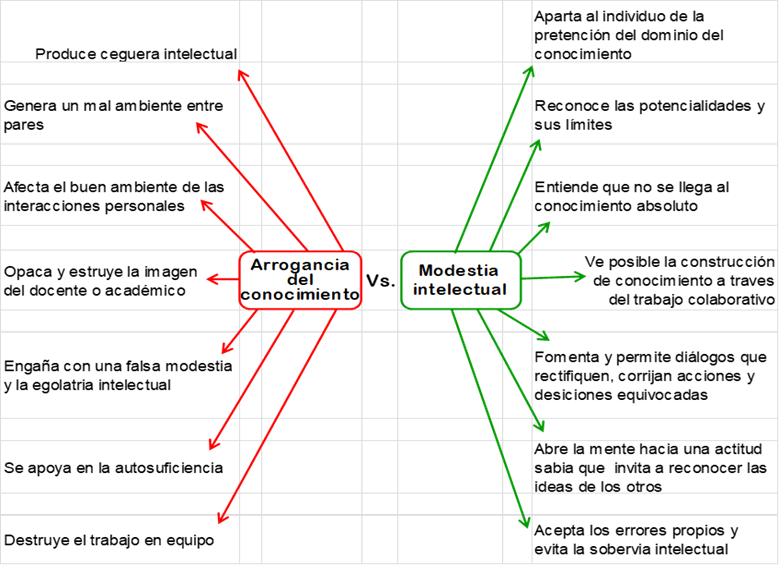 |
Knowledge arrogance prevents marveling at the knowledge of another human being who seeks truth, who uses the openness of their mind to visualize a new reality from valuable prior knowledge, accepting and recognizing that one does not possess all knowledge, but rather needs to know more, to delve deeper, respecting truth without forgetting that human knowledge is achieved and built from the simplest, leading one to recall the famous phrase of Socrates: "I only know that I know nothing" and as expressed by (Fajardo-Pascagaza, 2024) p.p. 198, What characterizes the wise person is the awareness of their ignorance, which is not about denying knowledge or not accepting one's own imperfection; it is about being aware of one's own errors and that one can be wrong at any time. The above could be interpreted as a reference to Socratic thought, who considered that admitting one's own ignorance was a gesture of intellectual humility that at the same time shows paths open to new ideas, beliefs, and concepts.
He also saw arrogance as an obstacle in the search for truth or new possibilities, becoming a key element that blocks opportunities to learn and question. From Socrates' point of view, the good teacher does not use their knowledge to impose it in an authoritarian or arbitrary manner but rather becomes a guide for their students or fellow teachers, leading them to develop their own learning and critical thinking that will be necessary to give continuity to learning and knowledge through interactions framed in the humility of that teacher or professor who bases their praxis on constructive dialogue and critical reflection, where empathy and simplicity in sharing knowledge are the true essence of wisdom, evidenced not in the accumulation of knowledge but as an essential virtue for learning, thus nullifying the obstacle that arrogance represents in the academic environment.
As mentioned in previous paragraphs, knowledge arrogance has a negative impact on collaborative work, on the organization or assembly of true work teams, since these are not compatible with attitudes that deteriorate clear, objective, and constructive communication. True teams are based on respectful and honest coexistence, where interactions and dialogues are supported by recognizing the importance and value of everyone's contributions. On the contrary, when intellectual modesty is placed as a principle of social and academic relations in groups of teachers, students, and/or teachers and students, the effect is highly positive, since the knowledge of some is enhanced and promoted as raw material for the construction and creation of others.
Another form of arrogance in academia is evidenced by the incomprehension of women's identity in recognition of the quality, promotion, and acceptance of their intellectual work, as evidenced by Hurtado (2026), who highlights that the importance, value, and complexity of women's thoughts and capacities are ignored, leading to a critique of the still-present androcentrism and a rejection of those currents that delegitimize female voices. On the contrary, it is necessary to propose and foster a feminist epistemology that makes visible the productions and contributions of female teachers and students, promoting an education with more inclusive and critical interactions that link emotional, gender, and social dimensions in the academic sphere.
It is important to bear in mind that in the academic sphere, coexistence is present in work teams and is the result of the sum of actions, contributions, and habits of all the subjects involved, where each from their position contributes to that collective construction with their attitudes and expressions, where academic dialogues between knowledge actors build an amalgam of ideas, knowledge, and concepts of their own or acquired that make the academic environment great, strengthening respect, well-being, and knowledge. However, this ideal framework is affected when pedantry—understood as the quality or behavior of that person who ostentatiously displays their knowledge and flaunts it in an annoying manner on occasion—is present in the interpersonal relations of the work group, discomforting their peers with the use of complicated, highly technical language unnecessarily and sometimes with very refined or sophisticated vocabulary on the part of one or several knowledge holders.
The above affects, through their behavior and attitudes, the harmony, individual and group peace, emotional tranquility, and mental health of the work team, producing a negative impact as a consequence of their arrogance and lack of humility. Therefore, Mena, M. & Huneeus, M. (2017) formulate a critique of arrogance among fellow teachers, where the contributions of some are exalted and the concepts of others are minimized, thus affecting the inclusive process and hindering learning. However, they believe that school coexistence can be positively impacted when respectful dialogue and open recognition of different points of view are stimulated, and from this horizon, new knowledge is constructed, transforming relationships and social realities. By presuming knowledge in an exaggeratedly pretentious manner, pedantry leads to rejection of teachers and professors by those around them, as they display this attitude of superiority.
Petulant pride becomes another negative element in the interactions of educational actors and characterizes people with expressions of vanity and arrogance who consider themselves superior to others because of their knowledge, this being an inadmissible behavior. On the contrary, their bonds should be characterized by intellectual humility. These subjects tend to manifest arrogance, petulant pride, and/or pedantry in their connections, since some of them seem to be dazzled by the amount of information in their knowledge and choose to show off with an air of self-sufficiency before their peers and/or those around them, showing contempt for the being and knowledge of the other, negatively affecting coexistence.
In relation to this, Navarro Fuentes (2022) criticizes how arrogance blocks coexistence and the flow of knowledge among teachers, losing an immense opportunity to share knowledge, and at the same time proposes minimizing epistemic disagreements through the respectful appreciation of the different perspectives and conceptual positions of teachers and, in other cases, of students. For its part, humility has been recognized through the centuries as a necessary and important virtue in academia to enrich the dialogue of knowledge and the production of knowledge, avoiding the generation of conflicts that socio-emotionally affect other teachers. However, it is important to mention that this has nothing to do with the amount of knowledge or the multiplicity of knowledge of the teacher or professor; it has to do with one's own attitude, with that dark trait of personality that, as some psychologists describe, obeys a specific way of manifesting one's behavior, and it is one's own decision.
Having a lot of knowledge is not a bad symptom; what is bad may be the inappropriate use of it and, on the contrary, belittling other subjects of knowledge, not fostering or stimulating the creation or dissemination of more and new knowledge. Then the question arises: Why arrogance in people? From the point of view of psychology, in response to this question, it can be mentioned that on occasion it presents itself as a form of defense, looking down on others and as self-protection behind which the individual shields themselves to hide their insecurities and fragility in self-esteem, appearing confident and in control because they themselves fear being controlled, thus exhibiting a superiority that does not exist, and when affected with wounded ego, they tend to react haughtily, without recognizing or realizing that their actions, added to the lack of empathy in their behavior, negatively impact others. Teachers, academics, or professors who express knowledge arrogance constantly boast about their achievements, do not accept their mistakes, act stubbornly, do not listen to their interlocutor, almost always consider themselves right, and believe they are the owners of the truth.
CONCLUSIONS
Education and the transmission of knowledge through time, generations, people, and species is a natural, almost instinctive vocational process in which sensitivity, respect for oneself, for others, and for their knowledge within a context play a relevant role in the educational process, where the subject of knowledge values the knowledge they possess as a treasure for themselves and for the community, accepts the limits of their own knowledge, and recognizes the gaps and flaws that accompany them, confirming that they are a being under construction.
Discrimination and exclusion from knowledge and wisdom is a scourge that is not only evident toward indigenous cultures, Afro-descendants, and peasants but is frequently present among teachers, professors, and professionals from different fields of knowledge, where one subject considers themselves of greater value or more important than another because of the number of degrees they possess, forgetting that there is no absolute knowledge and that there is always much left to learn.
Arrogance in the teacher can negatively affect the dynamics of teamwork in educational institutions and trust among members of the teaching staff, where on the contrary, it is expected that through collaborative work, reflections, contributions, and solutions are collective, always promoting mutual respect and recognition; this should also be present in interactions with students, to whom a climate of kindness and trust should be offered to facilitate their learning process.
In the author's opinion, there is an urgent need for critical reflection by some professors and teachers about their attitude toward others that leads them to take autonomous actions to remedy the communicative and collaborative work fractures that their arrogance can generate in academic peers, teachers, and students who develop disinterest and disconnection with academic processes. As Cortina (2016) said, educators must adopt postures of intellectual humility and openness, stimulating and participating in dialogues of respect for different points of view.
By reducing arrogance in teachers, professors, and academics, an environment of respect and collaboration is promoted that positively affects coexistence by allowing an educational approach based on reflective and critical dialogue, equity, and the active participation of fellow teachers or students, which will favorably impact the interest in sharing knowledge and, parallel to this, the subtle traces of intellectual abuse would decrease, improving socio-emotional conditions in the educational community.
From every point of view, knowledge arrogance is harmful in the educational environment, since it affects from the planning and development of programs and activities within teaching teams to reaching students. On the contrary, it is urgent to bring intellectual modesty to the scene, promoting an environment of respect, recognition, and appreciation, evidencing a more inclusive, less hierarchical school culture, without violence or discrimination due to the amount of knowledge, studies, and/or degrees one may possess.
When referring to knowledge arrogance, one can use the analogy of the "tongue," which can be used to say motivating words, to seduce or to console, but with the same "tongue" one can offend, insult, or verbally hurt. Another example is that of AI, which can be used as a tool or aid in education, at work, to facilitate and expedite constructive processes, but misused, it is used to deceive, defraud, and falsify. In the case of knowledge, teachers, academics, and professors can use it to educate, invite learning, stimulate personal and intellectual growth, but with arrogance, it can be used to humiliate, assault, and cause mental, emotional, and psychological harm.
Many teachers who consider themselves the sole possessors of "universally true knowledge" (Arias et al., 2023) develop in people and in the world of knowledge expressions of arrogance that may be the simple way to hide insecurities, preventing genuine, respectful, collaborative, empathetic, and sincere interpersonal or group relationships, thus trying to cover the emotional fragility present.
One can speak of false modesty in intellectuals, teachers, and professors who, with their attitudes, end up affecting the work and academic environment. However, it is also necessary to highlight the positive influence exerted by other teachers who operate with true intellectual humility, becoming "inspiring people" who, with their knowledge, stimulate, motivate, and foster in their peers and students an interest in researching, creating, and contributing to the construction of new knowledge, thus enriching teamwork and/or collaborative work.
REFERENCES
Arias-Ortega, K., Muñoz, G., & Quintriqueo, S. (2023). Educ. Pesqui., 49, e250586. Santiago de Chile: Ministerio de Educación.
Bilbao, M. G. (2023). La humildad intellectual en tiempos del ChatGPT. CIENCIA VETERINARIA, 25(2).
Bourdieu, P. (1978). Racismo de la Inteligencia. En P. Bourdieu, Cahies Droit et liberté (Races, Sociétés et Aptitudes: Apports et limits de la science) (págs. 261-265).
Carvajal, H. (2016). Educación en bioética y formación para la ciudadanía. Praxis & Saber, 7(13).
Cruz, V. R. (2024). Justicia y Justicia social. (C. J. Rivera, Entrevistador).
Diaz-Rubio, G. M. (2023). ¿Están desapareciendo los maestros? Nanales Ranm, 133-141.
Duque, D. J. (2020). Meritocracia: Libertad, igualdad de oportunidades y competencia. Dictamen Libre, 247-267.
Fajardo-Pascagaza, E. (2024). Lo interdisciplinar y la virtud epistémica de la humildad intelectual. Eduscientia. divulgación de la ciencia educativa, 194-201.
Ferrer, A. T. (2012). Análisis de la reforma de Thomas Arnold a través del concepto de función moralizadora. Citius, Altius, Fortius, 119-130.
Freire, P. (1978a). Pedagogía del oprimido. Madrid: Siglo XXI.
González, S. d. (2022). La mente es maravillosa. Recuperado el 20 de septiembre de 2025, de https://lamenteesmaravillosa.com/el-factor-d-y-los-9-rasgos-que-definen-la-maldad-humana/
González, S. d. (2023). La mente es maravillosa. Recuperado el 28 de julio de 2025, de https://lamenteesmaravillosa.com/orgullo-o-arrogancia-aprende-a-diferenciarlos/
Hurtado, V. M. (2026). Episteme, sociedad y academia: Una aproximación a la visión ontológica de la praxis docente desde la perspectiva de género en ingeniería. Revista interdisciplinaria de Ciencias de la Educación, Salud y Sociología, 1(1). https://doi.org/10.66136/fvhnk341
Machado, T. V. (2011). Historia de la humanidad y el deporte: Un análisis desde una perspectiva político social. Revista motricidad humana, 43-47.
Masquijo, J. J. (2025). Flexibilidad intelectual: por qué es importante cambiar de opinión y los riesgos de las convicciones absolutas. Acta ortopédica mexicana, 39(6), 341-342. https://doi.org/10.35366/121811
Mena, M., & Huneeus, M. (2017). Convivencia Escolar para el aprendizaje y buen trato de todos: hacia una mejor comprensión del concepto. Cultura, Educación y Sociedad, 8(2), 9-20. http://dx.doi.org/10.17981/cultedusoc.8.2.2017.01
Mena Lozano, Á., & Quiroz Posada, R. E. (2006). El conocimiento y las relaciones de poder en los procesos docentes educativos. Uni-pluri/versidad, 6(1). Universidad de Antioquia.
Moshagen, M., et al. (2018). El núcleo oscuro de la personalidad. Psychological Review. https://doi.org/10.1037/rev0000111
Navarro Fuentes, C. A. (2022). La humildad intelectual como epistemología de la virtud. Un problema con el conocimiento. Rev. Filosofía Univ. Costa Rica, 61(160), 27-38.
Ocampo, L. J. (2008). Paulo freire y la pedagogía del oprimido. Historia de la educación Latinoamericana, 57-72.
Pérez García, A., Feijoo Fernández, B., & López Martínez, A. (Eds.). (2023). Los menores ante las redes sociales. Pensamiento crítico y reflexión ética. Tirant humanidades.
Rodríguez, M. F. (2014). Ética de la razón cordial como complemento y fundamento de una ética intercultural. Cuadernos de filosofía, 71-90.
Rujas, J. (2021). Meritocracia y educación: más allá de la igualdad de oportunidades. con-ciencia social, 207-218.
Sáinz Bermejo, F. (2007). Narcisismo y sociedad, entre la carencia y la arrogancia. Talarn A, 1055-1127.
Sanguineti, J. J. (2025). El conocimiento virtuoso en Tomás de Aquino. Publicado en la revista de Bioética de la Universidad Católica Argentina “Vida y Ética”, 25, 129-159. https://erevistas.uca.edu.ar/index.php/VyE
SINC. (2021). SINC Ciencia contada en español. Recuperado el 15 de agosto de 2025, de https://www.agenciasinc.es/Noticias/Las-madres-orangutan-ensenan-de-manera-activa-a-sus-crias-a-desenvolverse-en-la-vida
Tres Iniciados. (2004). El Kibalión: Estudio sobre la filosofía hermética del antiguo Egipto y Grecia. Editorial Kier.
Unesco. (2023). www.unesco.org/es/articles. Recuperado el 11 de agosto de 2025, de https://www.unesco.org/es/articles/la-comision-de-la-banda-ancha-destaca-en-un-nuevo-informe-la-aparicion-de-una-brecha-mundial-del
CONFLICT OF INTEREST
The author reports no conflicts of interest.