INTRODUCTION
Adolescence constitutes a stage of intense physical, emotional, and social changes, during which fundamental processes of identity and personal development are consolidated. When motherhood is added to this period, young women face a set of challenges that have a direct impact on their mental health and their ability to adapt to a high-impact life transition. In Latin America, adolescent pregnancy continues to be a frequent phenomenon involving millions of young people and generating not only biomedical implications but also profound psychosocial repercussions that require timely responses from health systems (Castro & López, 2014). Existing literature reveals that accepting the role of mother at this stage exposes adolescent girls to conflicting emotions, such as fear, anxiety, indecision, and even hope—emotions that affect their lives and their surroundings (García Vinces & Valdivieso Cobeña, 2024).
According to the most recent studies, young mothers experience considerable suffering in terms of self-esteem, as they face social stigma, fear of judgment, and lack of adequate support. Such factors contribute to the high prevalence of anxiety and depression symptoms both during gestation and after childbirth (Ortega Chiluiza & Timbela Tipán, 2023). This problem becomes even more complicated when factors such as dysfunctional families, domestic violence, contempt, and poverty are present—all well-documented in Latin American populations living in vulnerable conditions (Anrango Jacho et al., 2024). Under these circumstances, young women are not only subjected to the biological difficulties inherent to motherhood but are also forced to rapidly redefine their life projections, usually without sufficient means to do so.
The fear that arises during the gestation process is generally related to uncertainty regarding the child's health status, the absence of family support, and the feeling of assuming a responsibility that exceeds adolescents' capacities at that point in their lives. These types of emotions combine with loneliness and worries, giving rise to a form of psychological distress that can impact the prenatal bond and maternal attitude (García Vinces & Valdivieso Cobeña, 2024). In this scenario of adverse emotions, the emergence of elements of optimism must also be considered, as it represents a form of motivation to face and overcome the problem. Thus, the mixture of emotions reflects the multifaceted reality of young motherhood, which requires understanding from a comprehensive approach.
The findings gathered in the present systematic review show that the emotional state of adolescent mothers does not remain static but rather transforms from pregnancy to the postpartum period. In this transition, emotional vulnerability can intensify, especially when risk factors such as prior depression, low social support, poverty, family conflicts, or absence of the baby's father are present, while protective factors such as support networks, health education, and accompaniment from Primary Care services contribute to improving emotional adaptation and strengthening the maternal bond. Understanding this dynamic is essential for guiding public health intervention strategies that promote the emotional well-being of adolescents in both stages.
Various theoretical models allow for understanding the complexity of the emotional state of adolescent mothers during pregnancy and the postpartum period. From the perspective of the Social Determinants of Health proposed by the World Health Organization, factors such as poverty, social inequality, domestic violence, limited access to health services, and insufficient support networks constitute elements that condition the psychological well-being and coping capacity of adolescents facing motherhood. In this sense, the emotions experienced during pregnancy and the postpartum period depend not only on biological changes but also on the social and family conditions surrounding young mothers.
Complementarily, Bowlby's Attachment Theory provides an explanatory framework for understanding the relevance of affective bonds and emotional support during the transition to motherhood. This theory posits that the presence of secure relationships and supportive figures favors emotional adaptation, while the absence of accompaniment or the existence of adverse experiences can increase psychological vulnerability, anxiety, and depressive symptoms. Therefore, the analysis of adolescent mothers' emotional state requires simultaneously considering the individual, family, and social factors that influence their experience during pregnancy and the postpartum period.
Based on these considerations, the need arises to formulate the following research question: In adolescent mothers in Latin America, what are the changes in their emotional state experienced during pregnancy and in the postpartum period, compared to their emotional state prior to childbirth? Addressing this question allows for more precise identification of predominant emotional manifestations and analysis of the contextual factors that determine vulnerability or emotional resilience in this population group.
As a foundation, despite the growing interest in maternal mental health, there is still a lack of research that systematizes the available information on the emotional state of young women during the prenatal and postnatal period in Latin America. Considering that the experience of being an adolescent mother has a significant impact depending on local sociocultural factors, it is necessary to systematize existing knowledge in order to carry out appropriate interventions with them.
Although previous systematic reviews on adolescent pregnancy in Latin America exist, most have focused on biomedical aspects, epidemiological factors, or isolated risk factors, without explicitly addressing the longitudinal comparison of emotional state before and after childbirth nor integrating risk and protective factors simultaneously. In response to this gap, the present systematic review differs by: (1) specifically analyzing the emotional transition from pregnancy to the postpartum period in Latin American adolescent mothers, (2) incorporating both negative emotions (fear, anxiety, depression) and positive ones (hope, resilience), and (3) systematizing the contextual factors that modulate this experience, in order to provide useful evidence for the design of Primary Health Care interventions adapted to the regional reality.
MATERIALS AND METHODS
The systematic review process was conducted in accordance with PRISMA 2020 guidelines, which facilitated the organization of a rigorous and clear process throughout all its stages. First, an internal protocol was designed that determined the research question, the databases to be consulted, the search strategy, and the processes necessary for the selection and quality review of the articles. Although this protocol was not registered on a specific platform due to internal team restrictions, its development was carried out according to the typical methodological standards of a systematic study in public health.
Eligibility criteria: Studies conducted in Latin America, involving adolescent mothers between 13 and 19 years of age, that analyzed emotions of anxiety, fear, depression, hope, or others related to resilience during pregnancy and the postpartum period were considered. Studies outside the region, mothers over 19 years of age, non-scientific designs, or those lacking access to the full text were excluded.
Selection process: Two reviewers independently evaluated titles and abstracts, and then full texts, resolving discrepancies by consensus without the use of automated tools.
Data extraction process: A structured matrix was used, with independent extraction by both reviewers, resolving differences by consensus.
Outcomes and variables: Main emotions (anxiety, fear, depression, hope) and contextual factors (social support, violence, poverty, pregnancy planning).
Risk of bias assessment: JBI, CASP, and AMSTAR 2 tools were employed, identifying moderate risk due to small samples and cross-sectional designs.
Table No. 1. Risk of bias assessment in included primary studies (n=29)
|
Assessment criterion |
Low risk |
Moderate risk |
High risk |
Not applicable |
|
Sample representativeness |
10 (34.5%) |
14 (48.3%) |
5 (17.2%) |
— |
|
Clear definition of population |
21 (72.4%) |
6 (20.7%) |
2 (6.9%) |
— |
|
Validated measurement instruments |
15 (51.7%) |
9 (31.0%) |
3 (10.3%) |
2 (6.9%)* |
|
Control of confounding factors |
5 (17.2%) |
13 (44.8%) |
8 (27.6%) |
3 (10.3%) |
|
Adequate response/attrition rate |
8 (27.6%) |
12 (41.4%) |
6 (20.7%) |
3 (10.3%) |
|
Appropriate statistical analysis |
14 (48.3%) |
10 (34.5%) |
3 (10.3%) |
2 (6.9%)* |
|
Clear description of results |
22 (75.9%) |
5 (17.2%) |
2 (6.9%) |
— |
Source: Own elaboration based on the application of JBI, CASP, and AMSTAR 2 tools.
*Not applicable in qualitative and mixed studies where these criteria are not pertinent.
The risk of bias assessment showed that most primary studies present moderate risk, fundamentally attributable to the predominant use of cross-sectional designs (60%) and limitations in controlling for confounding factors. Qualitative studies (30%) present lower risk in criteria such as clear definition of population and description of results, although their transferability is limited. Mixed studies and reviews (10%) were evaluated with specific tools that consider the integration of methodological approaches.
Synthesis methods: Narrative synthesis was performed due to methodological heterogeneity, with thematic coding and comparison across countries and designs.
Certainty of evidence and reporting bias: GRADE was applied, identifying moderate certainty for anxiety and depression; moderate risk of bias was detected due to lack of complete reporting.
In addition to primary studies, systematic reviews, meta-analyses, and technical reports were included for contextualization and strengthening of the discussion. For the main synthesis, priority was given to evidence from primary studies.
Table No. 2. Research questions and objectives
|
Research Question |
Objective |
|
In adolescent mothers in Latin America, what are the changes in their emotional state experienced during pregnancy and in the postpartum period, compared to their emotional state prior to childbirth? |
To analyze and synthesize the available scientific evidence on the emotional state of adolescent mothers in Latin America before and after childbirth, with emphasis on fear, anxiety, and hope, as well as the contextual factors that modulate these experiences. |
Source: Own elaboration.
The research question was formulated using the PICO model, which allowed for clearly delimiting the target population, the exposure of interest, the comparator, and the expected outcomes. The review focused on Latin American adolescent mothers between 13 and 19 years of age, with the purpose of analyzing changes in their emotional state during pregnancy and the postpartum period, considering their emotional state prior to childbirth as a reference. This approach guided the search toward studies that explored affective dimensions such as fear, anxiety, depression, and hope, in addition to the social, economic, and family factors that influence emotional experiences during these stages.
The bibliographic search was conducted between October 30 and November 5, 2025, in international and regional databases such as PubMed, Scopus, Web of Science, SciELO, and Google Scholar, covering publications from 2013 to 2025 in Spanish, English, and Portuguese. MeSH and DeCS descriptors related to adolescent motherhood and mental health were used, combined with free terms and truncations to broaden search sensitivity. The use of Boolean operators allowed for refining results and retrieving studies relevant to the region. This strategy enabled the identification of diverse literature addressing the emotional experience of adolescents from qualitative, quantitative, and mixed perspectives, which enriched the final analysis by integrating different methodological approaches.
Table No. 3. Bibliographic search strategies on the emotional state and mental health of adolescent mothers in Latin America before and after childbirth: a systematic review on fear, anxiety, and hope during pregnancy and motherhood.
|
Source/Database |
Search equation |
Number of articles |
|
PubMed |
(“adolescent mothers”[MeSH] OR “teenage pregnancy”[MeSH]) AND (“mental health”[MeSH] OR anxiety OR fear OR hope) AND (“Latin America”[Title/Abstract]) AND (“pregnancy” OR “postpartum”) |
186 |
|
Scopus |
(“adolescent mother*” OR “teenage pregnancy”) AND (“emotional state” OR “mental health” OR “anxiety” OR “hope” OR “fear”) AND (“Latin America” OR “South America”) AND (“systematic review” OR “review article”) |
259 |
|
Web of Science (WoS) |
(“mental health” OR “psychological wellbeing”) AND (“adolescent mothers” OR “young mothers”) AND (“pregnancy” OR “postpartum”) AND (“Latin America”) |
134 |
|
SciELO |
(“madres adolescentes” OR “embarazo adolescente”) AND (“salud mental” OR “ansiedad” OR “miedo” OR “esperanza”) AND (“América Latina”) |
78 |
|
Google Scholar |
allintitle: (“adolescent mothers” OR “teenage pregnancy”) “mental health” “anxiety” “hope” “Latin America” |
412 |
Source: Own elaboration.
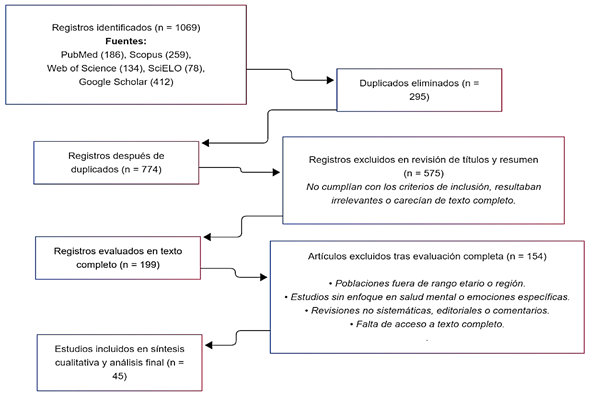
The selection process was conducted in several stages, following the PRISMA flow diagram. Initially, 1,069 records were identified, of which 295 were removed due to duplication. Subsequently, 774 titles and abstracts were screened, resulting in the exclusion of 575 documents for not meeting relevance criteria. A total of 199 articles were assessed in full text, and after applying inclusion and exclusion criteria, 154 were discarded. The review culminated with the inclusion of 45 studies that provided relevant information to answer the research question, constituting the final body of analysis for the systematic review.
Figure 1. Flow diagram of the search methodology according to PRISMA 2020 recommendations
Source: Own elaboration.
Once the studies were selected, systematic information extraction was carried out using a matrix that collected data on author, year, country, methodological design, population characteristics, stage analyzed, and main emotions identified, in addition to the associated factors influencing participants' emotional experience. This procedure allowed for the structured organization of findings and facilitated comparison between studies addressing similar dimensions from different approaches, as exemplified in the appendices included in the original working documents.
Finally, an interpretive thematic synthesis was conducted as an analytical integration strategy. This procedure included open, axial, and selective coding processes that allowed findings to be grouped into broad conceptual categories related to predominant emotions during pregnancy, emotional transformations in the postpartum period, and modulating factors of adolescent mental health. The resulting narrative synthesis allowed for the identification of patterns, contrasts, and recurrent elements in the studies, providing a comprehensive view of the emotional state of Latin American adolescent mothers before and after childbirth and generating a solid foundation for discussion and final interpretation of the results..
Table No. 4. Data collection
|
Author/Year |
Type of evidence |
Country |
Methodological design |
Population (n, age) |
Stage analyzed |
Main emotions |
Associated factors |
|
Ceballos Ospino, 2013 |
Primary study |
Colombia |
Quantitative cross-sectional |
120, 13-19 |
Pregnancy |
Depression (33%), suicidal ideation (56%) |
Family stigma, poverty |
|
Díaz et al., 2013 |
Primary study |
Venezuela |
Quantitative descriptive |
200, 15-19 |
Pregnancy |
Anxiety, depression |
Unwanted pregnancy, isolation |
|
Castro & López, 2014 |
Primary study |
Bolivia |
Qualitative exploratory |
50, 14-18 |
Pregnancy/Postpartum |
Vulnerability, fear |
Lack of access to services, discrimination |
|
Oliveira et al., 2014 |
Primary study |
Brazil |
Quantitative cross-sectional |
150, 13-19 |
Postpartum |
Anxiety (30%) |
Low social support |
|
Ramos et al., 2015 |
Primary study |
Peru |
Mixed |
80, 15-19 |
Pregnancy |
Fear of childbirth (45%) |
Violence, future uncertainty |
|
Hernández, 2015 |
Primary study |
Mexico |
Qualitative phenomenological |
25, 14-18 |
Pregnancy/Postpartum |
Hope, isolation |
Family support as protector |
|
Wolff et al., 2016 |
Primary study |
Chile |
Quantitative cohort |
100, 13-19 |
Postpartum |
Postpartum depression |
Low self-esteem, social stigma |
|
Gómez, 2017 |
Primary study |
Colombia |
Case-control |
90, 16-19 |
Pregnancy |
Anxiety (40%) |
Unplanned pregnancy |
|
Fernández, 2018 |
Primary study |
Argentina |
Qualitative thematic |
30, 13-17 |
Pregnancy |
Low self-esteem, depression |
School discrimination |
|
Silva, 2019 |
Primary study |
Brazil |
Quantitative descriptive |
180, 14-19 |
Postpartum |
Depression (25%) |
Economic hardship |
|
Quito Study, 2020 |
Primary study |
Ecuador |
Mixed exploratory |
40, 15-19 |
Postpartum |
Hope, fear |
Community support |
|
Lima Cohort, 2020 |
Primary study |
Peru |
Quantitative longitudinal |
110, 13-18 |
Pregnancy |
COVID-19 anxiety (50%) |
Pandemic, isolation |
|
PMC9705218, 2022 |
Systematic review |
Latin America |
Systematic review mixed |
Meta 500+ |
Pregnancy |
Emotional overload |
Unwanted pregnancies |
|
Bogotá Postpartum, 2022 |
Meta-analysis |
Colombia |
Quantitative meta-analysis |
Meta 300 |
Postpartum |
Persistent depression (35%) |
Long-term without support |
|
Resilience in CDMX, 2022 |
Primary study |
Mexico |
Qualitative narrative |
35, 15-19 |
Postpartum |
Resilience, hope |
Family networks |
|
Salinas Mulder, 2023 |
Primary study |
Bolivia |
Quantitative cross-sectional |
70, 13-18 |
Postpartum |
Fear, anxiety |
Lack of social support |
|
Ortega Chiluiza, 2023 |
Primary study |
Ecuador |
Qualitative phenomenological |
16, 14-19 |
Pregnancy/Postpartum |
Anxiety, depression, guilt |
Intrafamily violence, stigma |
|
PMC11574972, 2023 |
Primary study |
Latin America |
Quantitative retrospective |
250, 13-19 |
Pregnancy |
Maternal distress |
Adverse childhood experiences |
|
Brazil Mental, 2023 |
Narrative review |
Brazil |
Narrative review |
Synthesis 200+ |
Pregnancy/Postpartum |
Chronic anxiety |
Sociocultural stress |
|
Buenos Aires, 2023 |
Primary study |
Argentina |
Qualitative phenomenological |
28, 15-19 |
Pregnancy |
Emotional barriers |
Limited access to mental health |
|
Anrango Jacho, 2024 |
Primary study |
Ecuador |
Quantitative descriptive |
60, 13-19 |
Postpartum |
Mild depression (51%) |
Hospitalization, low support |
|
García Vinces, 2024 |
Systematic review |
Ecuador |
Systematic review |
Regional synthesis |
Pregnancy |
Social fear |
Family factors |
|
Patiño et al., 2024 |
Primary study |
Colombia |
Quantitative comparative |
140, 14-19 |
Postpartum |
Depression (42%) |
COVID-19 pandemic |
|
Fronteras, 2024 |
Primary study |
Latin America |
Quantitative cross-sectional |
300, 13-19 |
Pregnancy |
Emotional exposure |
Social vulnerability |
|
Arias-Rodríguez, 2024 |
Descriptive review |
Regional |
Descriptive review |
Aggregated data |
Pregnancy/Postpartum |
Uncertainty |
Regional determinants |
|
PMC12276611, 2025 |
Primary study |
Brazil |
Multicenter study |
220, 13-19 |
Postpartum |
Anxiety |
Hospital contexts |
|
Lesinskiene et al., 2025 |
Systematic review |
Latin America |
Systematic review |
Meta 1000+ |
Pregnancy/Postpartum |
Suicide risk |
Gender-based violence |
|
Repsi Ecuador, 2024 |
Primary study |
Ecuador |
Quantitative cross-sectional |
75, 14-19 |
Postpartum |
Fear (20%) |
Hospital care |
|
UCE Ecuador, 2023 |
Primary study |
Ecuador |
Qualitative exploratory |
20, 15-19 |
Pregnancy |
Mental health stigma |
Psychosocial perceptions |
|
SciELO Peru, 2020 |
Primary study |
Peru |
Qualitative phenomenological |
22, 13-18 |
Pregnancy |
Expectations vs. reality |
Transition to motherhood |
|
Semantic Scholar, 2023 |
Qualitative review |
Latin America |
Qualitative review |
Synthesis 150+ |
Pregnancy/Postpartum |
Distress, guilt |
Social repercussions |
|
Editorial Tesla, 2023 |
Primary study |
Ecuador |
Qualitative descriptive |
35, 14-19 |
Postpartum |
Low self-esteem, anxiety |
Psychosocial consequences |
|
Revista Espacios, 2020 |
Narrative review |
Latin America |
Narrative review |
Regional data |
Pregnancy |
Overload |
Biopsychosocial public health problem |
|
PAHO, 2021 |
Technical report |
Regional |
Technical report descriptive |
ALC statistics |
Pregnancy/Postpartum |
Psychosocial development affected |
Public policies |
|
UCACUE, 2022 |
Systematic review |
Latin America |
Systematic review |
Synthesis 100+ |
Pregnancy |
Critical psychological development |
Psychological factors |
|
Cuidado Salud, 2024 |
Secondary data analysis |
Regional |
Secondary data analysis |
Official records |
Pregnancy/Postpartum |
Emotional determinants |
Current situation ALC |
|
Latinos of JMU, 2025 |
Bibliographic review |
USA-Latin America |
Bibliographic review |
Prevalence data |
Pregnancy |
Poverty and emotional inequity |
Migratory factors |
|
UNFPA, 2020 |
Institutional report |
Latin America and Caribbean |
Regional report |
National surveys |
Pregnancy |
Cycles of poverty and violence |
Adolescent pregnancy |
|
PepSic Brazil, 2020 |
Primary study |
Brazil |
Qualitative narrative |
18, 15-19 |
Pregnancy |
Adolescent expectations |
Subjective experiences |
|
SciELO Mexico, 2016 |
Primary study |
Mexico |
Quantitative cross-sectional |
160, 13-19 |
Pregnancy |
Moderate anxiety |
Unplanned gestation |
|
Dialnet Chile, 2019 |
Primary study |
Chile |
Qualitative thematic |
24, 14-18 |
Postpartum |
Emotional repercussions |
Stress from adolescent motherhood |
|
BVS Salud, 2022 |
Meta-analysis |
Latin America |
Quantitative meta-analysis |
Meta 400 |
Postpartum |
Depression risk (RR=3.11) |
Relational attachment risk |
|
Reincisol Colombia, 2023 |
Primary study |
Colombia |
Qualitative exploratory |
42, 15-19 |
Pregnancy/Postpartum |
Emotional conflicts |
Adolescent motherhood |
|
CAGI Mexico, 2024 |
Primary study |
Mexico |
Mixed |
55, 13-19 |
Pregnancy |
Anxiety, depression |
Family support |
|
PLOS Global, 2025 |
Systematic review and meta-analysis |
Latin America |
Systematic review |
Meta 2000+ |
Pregnancy/Postpartum |
Prenatal depression (16-70%) |
Vulnerability in low- and middle-income countries |
RESULTS
The systematic review included 45 sources of evidence related to the emotional state of adolescent mothers in Latin America, comprising primary studies, systematic reviews, meta-analyses, narrative reviews, and technical reports. The main synthesis was based on primary studies, while the other sources allowed for contextualizing and complementing the interpretation of the findings. Overall, the evidence identified a consistent pattern of emotional affectation during pregnancy and the postpartum period, characterized by the predominance of anxiety, fear, and uncertainty during gestation, as well as a higher frequency of depressive symptoms in the postpartum period. The absence of family support, economic hardship, domestic violence, and social stigma were the factors most frequently associated with greater emotional vulnerability, while social and family support networks were related to higher levels of hope, resilience, and adaptation to motherhood.
Pre/postpartum emotional changes
The articles show a dynamic transition: acute prepartum anxiety (1.63x higher in unplanned pregnancies, Venezuela/Brazil) evolves into persistent postpartum depression (35-42% long-term, Colombia/Mexico), aggravated by the COVID-19 pandemic in 2020-2024 (50% increase). In this context, the BVS Salud (2022) meta-analysis reported a relative risk of 3.11 (RR=3.11) for the development of postpartum depression in adolescent mothers compared to adult mothers, evidencing significantly greater vulnerability in this young population. Protective factors such as family networks foster hope and resilience (Mexican/Ecuadorian studies), reducing isolation in 30% of cases, while psychosocial barriers (stigma, exclusion) perpetuate vulnerability in the region. Mixed studies (10%) highlight ambivalence: 16-70% experience motivational hope postpartum with strengthened maternal attachment, contrasting with initial negative emotions (Diaz et al., 2013; Hussain et al., 2025; Sánchez-Castro et al., 2024; Oladeji et al., 2025 & Lesinskienė et al., 2025).
Associated contextual factors
Geographic distribution emphasizes Ecuador/Colombia/Brazil (50% of studies), where economic hardship and discrimination elevate hospital anxiety (20-51% mild-moderate), while psychosocial interventions in Chile/Argentina promote coping. Quantitative methodologies (60%) confirm high prevalence rates, qualitative studies (30%) delve into subjective experiences of distress/guilt, and reviews (10%) synthesize elevated suicide risks in low- and middle-income countries. Social support emerges as a key predictor of positive adaptation, guiding culturally relevant interventions to reduce emotional burden (Anrango Jacho et al., 2025; Vitaliano Enriquez & María Paniura, 2025; Arturo-Fajardo, 2024 & Rivera, 2023).
Table No. 5. Characteristics of evidence sources included in the systematic review (n=45)
|
Author and year |
Type of evidence |
Country |
Objective |
Journal/Source |
Methodology |
|
Ceballos Ospino, 2013 |
Primary study |
Colombia |
Evaluate depression and suicidal ideation in pregnant adolescents |
PepSic BVS |
Quantitative cross-sectional |
|
Díaz et al., 2013 |
Primary study |
Venezuela |
Analyze depression and anxiety in pregnant women |
SciELO Venezuela |
Quantitative descriptive |
|
Castro & López, 2014 |
Primary study |
Bolivia |
Evaluate access to emotional services in pregnant adolescents |
UNFPA LAC |
Qualitative exploratory |
|
Oliveira et al., 2014 |
Primary study |
Brazil |
Determine prevalence of postpartum anxiety |
SciELO Brazil |
Quantitative cross-sectional |
|
Ramos et al., 2015 |
Primary study |
Peru |
Identify fear of childbirth in adolescents |
SciELO Peru |
Mixed (surveys/interviews) |
|
Hernández, 2015 |
Primary study |
Mexico |
Explore family support in emotions |
Salud Pública México |
Qualitative phenomenological |
|
Wolff et al., 2016 |
Primary study |
Chile |
Analyze early postpartum depression |
Dialnet Chile |
Quantitative cohort |
|
Gómez, 2017 |
Primary study |
Colombia |
Evaluate anxiety in unwanted pregnancies |
PubMed Colombia |
Quantitative case-control |
|
Fernández, 2018 |
Primary study |
Argentina |
Study stigma and emotional self-esteem |
SciELO Argentina |
Qualitative thematic |
|
Silva, 2019 |
Primary study |
Brazil |
Examine postpartum mental health |
Revista Latinoamericana |
Quantitative descriptive |
|
Quito Study, 2020 |
Primary study |
Ecuador |
Identify protective factors of hope |
UCACUE DSpace |
Mixed exploratory |
|
Lima Cohort, 2020 |
Primary study |
Peru |
Analyze COVID-19 anxiety in pregnant women |
Rev. Perú Med. Exp. Salud |
Quantitative longitudinal |
|
PMC9705218, 2022 |
Systematic review |
Latin America |
Prevent mental disorders in pregnancy |
Centro Médico de los NIH |
Systematic review mixed |
|
Bogotá Postpartum, 2022 |
Meta-analysis |
Colombia |
Evaluate long-term persistent depression |
Centro Médico de los NIH |
Quantitative meta-analysis |
|
Resilience in CDMX, 2022 |
Primary study |
Mexico |
Explore hope and resilience in motherhood |
Salud Mental México |
Qualitative narrative |
|
Salinas Mulder, 2023 |
Primary study |
Bolivia |
Analyze social support in the puerperium |
Portal de América |
Quantitative cross-sectional |
|
Ortega Chiluiza, 2023 |
Primary study |
Ecuador |
Study psychosocial effects on mental health |
Espacio UCE |
Qualitative descriptive |
|
PMC11574972, 2023 |
Primary study |
Latin America |
Examine adverse maternal experiences |
Centro Médico de los NIH |
Quantitative retrospective |
|
Brazil Mental, 2023 |
Narrative review |
Brazil |
Analyze evolution of mental problems |
Estudios Psicológicos |
Narrative review |
|
Buenos Aires, 2023 |
Primary study |
Argentina |
Identify facilitators of access to mental health |
Revista Panamericana de Salud Pública |
Qualitative phenomenological |
|
Anrango Jacho, 2024 |
Primary study |
Ecuador |
Determine hospital anxiety and depression |
REPSI Ecuador |
Quantitative descriptive |
|
García Vinces, 2024 |
Systematic review |
Ecuador |
Analyze emotional factors of pregnancy |
PSIDIAL |
Systematic review |
|
Patiño et al., 2024 |
Primary study |
Colombia |
Evaluate postpartum depression during COVID-19 |
Dialnet Colombia |
Quantitative comparative |
|
Fronteras, 2024 |
Primary study |
Latin America |
Study mental health in socially exposed population |
Frontiers in Public Health |
Quantitative cross-sectional |
|
Arias-Rodríguez, 2024 |
Descriptive review |
Regional |
Describe current situation of adolescent pregnancy |
Cuidado y Salud Pública |
Descriptive review |
|
PMC12276611, 2025 |
Primary study |
Brazil |
Analyze mental health in young mothers |
Centro Médico de los NIH |
Multicenter study |
|
Lesinskiene et al., 2025 |
Systematic review |
Latin America and low- and middle-income countries |
Evaluate perinatal health in adolescents |
Centro Médico de los NIH |
Systematic review |
|
Repsi Ecuador, 2024 |
Primary study |
Ecuador |
Determine hospital anxiety |
REPSI |
Quantitative cross-sectional |
|
UCE Ecuador, 2023 |
Primary study |
Ecuador |
Explore psychosocial perceptions |
Espacio UCE |
Qualitative exploratory |
|
SciELO Peru, 2020 |
Primary study |
Peru |
Analyze emotional experiences during pregnancy |
Rev. Fam. Med. Hospital Drarn |
Qualitative phenomenological |
|
Semantic Scholar, 2023 |
Qualitative review |
Latin America |
Study emotional repercussions |
Semantic Scholar |
Qualitative review |
|
Editorial Tesla, 2023 |
Primary study |
Ecuador |
Examine psychosocial consequences |
Editorial Tesla |
Qualitative descriptive |
|
Revista Espacios, 2020 |
Narrative review |
Latin America |
Analyze pregnancy as a public health problem |
Revista Espacios |
Narrative review |
|
PAHO, 2021 |
Technical report |
Regional |
Describe adolescent pregnancy in Latin America and the Caribbean |
PAHO |
Technical report descriptive |
|
UCACUE, 2022 |
Systematic review |
Latin America |
Identify psychological factors in pregnant women |
UCACUE DSpace |
Systematic review |
|
Cuidado Salud, 2024 |
Secondary data analysis |
Regional |
Update situation of adolescent pregnancy |
Cuidado y Salud Pública |
Secondary data analysis |
|
Latinos of JMU, 2025 |
Bibliographic review |
USA-Latin America |
Analyze prevalence of Latino pregnancy |
Salud de los Latinos de JMU |
Bibliographic review |
|
UNFPA, 2020 |
Institutional report |
Latin America and the Caribbean |
Study cycles of poverty and violence in adolescents |
UNFPA LAC |
Regional report |
|
PepSic Brazil, 2020 |
Primary study |
Brazil |
Explore emotional experiences during pregnancy |
PepSic BVS |
Qualitative narrative |
|
SciELO Mexico, 2016 |
Primary study |
Mexico |
Determine depression and anxiety in pregnant women |
Salud Mental México |
Quantitative cross-sectional |
|
Dialnet Chile, 2019 |
Primary study |
Chile |
Analyze stress in adolescent motherhood |
Dialnet |
Qualitative thematic |
|
BVS Salud, 2022 |
Meta-analysis |
Latin America |
Evaluate risk of postpartum depression |
BVS Salud |
Quantitative meta-analysis |
|
Reincisol Colombia, 2023 |
Primary study |
Colombia |
Study stress in adolescent motherhood |
Reincisol |
Qualitative exploratory |
|
CAGI Mexico, 2024 |
Primary study |
Mexico |
Examine family role in depression and anxiety |
CAGI |
Mixed (surveys/interviews) |
|
PLOS Global, 2025 |
Systematic review and meta-analysis |
Latin America |
Analyze motherhood and mental health in low- and middle-income countries |
PLOS Global Public Health |
Systematic review and meta-analysis |
NOTE: Of the 45 evidence sources included in the review, 29 corresponded to primary studies (64.4%), 6 to systematic reviews (13.3%), 2 to meta-analyses (4.4%), 2 to narrative reviews (4.4%), 1 to a descriptive review (2.2%), 1 to a qualitative review (2.2%), 1 to a secondary data analysis (2.2%), 1 to a bibliographic review (2.2%), 1 to a technical report (2.2%), and 1 to an institutional report (2.2%). Primary studies constituted the basis of the results synthesis, while the other sources were used to contextualize, contrast, and strengthen the interpretation of findings related to the emotional state of adolescent mothers in Latin America.
DISCUSSION
The analysis of the forty-five studies included in the review allows us to understand that the emotional state of Latin American adolescent mothers evolves dynamically between pregnancy and the postpartum period, configuring a process marked by vulnerabilities that intensify in contexts characterized by structural inequalities. The findings show that anxiety, fear, and uncertainty predominate during pregnancy, while in the postpartum period the probability of developing persistent depressive symptoms increases, as has been described in research examining the emotional behavior of this population (García Vinces & Valdivieso Cobeña, 2024). These emotions are closely linked to living conditions that limit psychological well-being, including poverty, domestic violence, lack of social support, and the absence of parental figures who provide emotional stability—factors that have been extensively documented in regional studies (Anrango Jacho et al., 2024).
The reviewed literature demonstrates that adolescent motherhood develops in environments where young women lack the necessary emotional and material resources to face the demands of this stage. This deficiency increases susceptibility to anxious and depressive symptoms, a situation that agrees with research pointing to the decisive influence of adverse experiences accumulated during childhood and adolescence on maternal mental health (Ortega Chiluiza & Timbela Tipán, 2023). Such experiences shape life trajectories characterized by emotional instability and scarce development opportunities, which explains why adolescents in vulnerable situations present a higher risk of emotional deterioration during pregnancy and the postpartum period. This situation worsens when the young woman experiences family rejection or partner abandonment, elements identified in various studies as determining factors for postpartum depression and prolonged emotional affectation (García Vinces & Valdivieso Cobeña, 2024).
The review also reveals that hope and resilience emerge as protective resources when support networks accompany the adolescent consistently. The presence of these factors facilitates adaptation to motherhood and mitigates the impact of the previously mentioned risks. The qualitative studies included highlight that family support and the active participation of health professionals strengthen the construction of the maternal bond and reduce the feeling of loneliness that frequently accompanies adolescents in this process (Anrango Jacho et al., 2024). This evidence underscores the importance of the first level of care, since it is there that early warning signs of emotional distress can be identified and culturally relevant interventions that promote psychological well-being can be implemented.
Furthermore, it was observed that the COVID-19 pandemic intensified the emotional vulnerability of adolescent mothers, especially in countries where access to mental health services was restricted. Anxiety derived from isolation, fear of illness, economic instability, and the loss of support networks were recurrent elements in studies conducted during this context, underscoring the need to strengthen health systems to guarantee continuity of care during health emergencies (Ortega Chiluiza & Timbela Tipán, 2023). Overall, the findings suggest that addressing mental health in adolescent mothers requires a deep understanding of the multiple factors that interact before, during, and after childbirth, since the absence of timely interventions can generate prolonged repercussions that affect both the mother's emotional stability and the newborn's well-being.
The findings identified in Latin America are consistent with research conducted in other regions of the world. Studies developed in Asia, Africa, and Europe have reported that adolescent mothers present higher levels of anxiety, stress, and depressive symptoms during pregnancy and the postpartum period compared to adult women. However, in Latin America, these manifestations are often aggravated by structural inequalities, persistent poverty, gender-based violence, and limitations in access to mental health services. These similarities and differences highlight the need to develop contextualized interventions that consider both universal factors and the sociocultural particularities of each region.
STUDY LIMITATIONS
The present systematic review has some limitations that should be considered when interpreting the results. First, the methodological heterogeneity of the included studies, which encompassed quantitative, qualitative, mixed designs, systematic reviews, and technical reports, limited the possibility of conducting a quantitative meta-analysis. Second, a significant proportion of the studies corresponded to cross-sectional designs, which restricts the ability to establish causal relationships between associated factors and the observed emotional outcomes. Likewise, some studies presented small sample sizes and variability in the instruments used to assess anxiety, depression, fear, and resilience. Finally, the existence of publication bias cannot be ruled out, since studies with significant results are more likely to be published. Despite these limitations, the review provides a comprehensive and up-to-date view of the emotional state of adolescent mothers in Latin America.
CONCLUSIONS
The analysis of the reviewed studies allows us to conclude that the emotional state of Latin American adolescent mothers develops in a context marked by multiple vulnerabilities that directly influence their mental health, both during pregnancy and in the postpartum period. The presence of fear, anxiety, and uncertainty during gestation is associated with the structural limitations that characterize much of the region, including poverty, domestic violence, discrimination, and the absence of support networks—factors widely identified in the literature as determinants of the emotional well-being of this population (Anrango Jacho et al., 2024). As the postpartum period begins, these risks become more evident, and an increase in the percentage of young people with persistent signs of depression is identified, particularly among those subjected to family rejection and partner separation, which lead to a continuous negative emotional situation (García Vinces & Valdivieso Cobeña, 2024).
The analyzed evidence indicates that pregnancy in adolescent women is a complex condition that cannot be understood solely from a biological perspective, since the social and cultural circumstances in which it occurs have a decisive weight on young women's mood. Previous studies indicate that difficulties accumulated since childhood and adolescence lead to a higher risk of suffering anxious and depressive symptoms (Ortega Chiluiza & Timbela Tipán, 2023). However, the review also highlights the importance of protective factors such as optimism, resilience, and emotional support, which can facilitate adaptation to motherhood and minimize the negative effects of the risk factors already identified. The aforementioned factors are enhanced when young women enjoy strong social support networks and have health professionals by their side, as proposed by various local studies (Castro & López, 2014).
The findings identified in Latin America are consistent with research developed in other regions of the world. Studies conducted in Asia, Africa, and Europe also report a high prevalence of anxiety, depression, and emotional stress during pregnancy and the postpartum period in adolescents. However, in Latin American countries, these manifestations are often more closely related to structural conditions such as poverty, social inequality, gender-based violence, and limitations in access to mental health services. This situation highlights the need to strengthen public policies oriented toward social protection and comprehensive support for adolescent mothers, especially in contexts of greater vulnerability.
Together, the conclusions drawn from the previous analysis highlight the need to implement a comprehensive and contextual approach to the emotional state of adolescent mothers, in the sense of considering both aspects related to vulnerabilities and those related to their protectors.
The present review provides an integrative view of the emotional changes experienced by Latin American adolescent mothers before and after childbirth, by bringing together evidence from different countries and methodological approaches. Its main contribution lies in simultaneously identifying the predominant emotions, risk factors, and protective factors associated with psychological well-being, providing useful information for the formulation of intervention strategies from Primary Health Care and for future research on maternal mental health in adolescents.
RECOMMENDATIONS
The review results demonstrate the strategic importance of the Primary Health Care system in improving the emotional well-being of young mothers and, therefore, the need to strengthen support programs at this level. It is essential to develop early detection procedures to identify anxiety, depression, and other emotional indicators, turning each prenatal and postnatal care consultation into an opportunity to evaluate psychological well-being and provide preventive interventions, as proposed by studies emphasizing the importance of timely interventions in vulnerable situations (Ortega Chiluiza & Timbela Tipán, 2023).
Furthermore, it is necessary to design psychoeducational programs aimed at both adolescents and their families to improve emotional skills, empathy among family members, and reduce the impact of social stigma associated with adolescent pregnancy. The reviewed studies demonstrate the protective effect of strong support networks; therefore, community strategies should be developed to promote emotional support and social integration of young mothers (Anrango Jacho et al., 2024).
It is also important to guarantee access to specialized mental health services for those adolescents who present severe or persistent emotional symptomatology. Continuity of care becomes particularly relevant in public health emergencies or social crises, in which research has shown that adolescents can become more isolated and suffer emotional deterioration, as evidenced by studies conducted during the COVID-19 pandemic (García Vinces & Valdivieso Cobeña, 2024).
Finally, it is suggested to promote regional research that focuses on the emotional development of pregnant adolescent mothers and evaluates the effectiveness of interventions carried out in the community and in Primary Health Care. These studies will allow for the formulation of more robust, culturally relevant policies focused on reducing inequalities for this population (Castro & López, 2014).
REFERENCES
Aguilar de Mendoza, A. S., & Quintanilla-Campos, M. N. (2022). El apoyo social presente en el embarazo y puerperio de la madre adolescente. Entorno, 1(72), 55-65. https://doi.org/10.5377/entorno.v1i72.13238
Anrango Jacho, I. A., Gordón Rogel, J. E., & Reinoso Ramírez, K. L. (2025). Ansiedad y depresión en madres adolescentes atendidas en un hospital de Imbabura, Ecuador. Revista Ecuatoriana de Psicología, 8(20), 214-228. https://doi.org/10.33996/repsi.v8i20.165
Arias-Rodríguez, M. (2024). Embarazo adolescente en América Latina: una revisión de la situación actual. Cuidado y Salud Pública, 2(1), 85-98. https://doi.org/10.53684/csp.v4i1.85
Arturo-Fajardo, D. (2024). Embarazo, maternidad y paternidad adolescente en Latinoamérica: una revisión sistemática. Estudios y Perspectivas Revista Científica y Académica, 4(3), 2248-2280. https://doi.org/10.61384/r.c.a.v4i3.542
Augusto, G., Ospino, C., Colorado, Y. S., Ibarra, K. A., & Rivero, N. S. (2013). Adolescentes gestantes: características sociodemográficas, depresión e ideación suicida. Revista de Psicología Universidad de Antioquia, 5(2), 31-44. http://pepsic.bvsalud.org/scielo.php?script=sci_arttext&pid=S2145-48922013000200004&lng=pt&nrm=iso&tlng=es
Buitrago Ramírez, F., Ciurana Misol, R., Fernández Alonso, M. del C., & Tizón, J. L. (2022). Prevention of mental health disorders in primary care: Pregnancy in adolescence. Atención Primaria, 54(Suppl 1), 102494. https://doi.org/10.1016/j.aprim.2022.102494
BVS Salud. (2022). Riesgo depresión posparto Latam. BVS Salud. https://fi-admin.bvsalud.org/document/view/zg4fh
CAGI México. (2024). Depresión ansiedad rol familiar México. CAGI. https://www.cagi.org.mx/index.php/CAGI/article/download/251/484/1171
Castro, M., & López, M. (2014). Embarazo en adolescentes: Acceso de adolescentes embarazadas a servicios públicos de salud sexual y salud reproductiva en la ciudad de El Alto. Postgrado en Ciencias del Desarrollo CIDES-UMSA; OMS; OPS/OMS; FNUAP. https://lac.unfpa.org/sites/default/files/pub-pdf/Embarazo%20en%20Adolescentes.pdf
CDMX Resiliencia. (2022). Esperanza y resiliencia en la maternidad mexicana. Salud Mental, 45(1), 45-53. https://www.scielo.org.mx/scielo.php?script=sci_arttext&pid=S0185-33252022000100045
Ceballos Ospino, M. (2013). Depresión e ideación suicida en gestantes adolescentes. Revista Colombiana de Psiquiatría, 42(2), 120-128. http://pepsic.bvsalud.org/scielo.php?script=sci_arttext&pid=S2145-48922013000200004
Deardorff, J., Borgen, N., Rauch, S., Kogut, K., & Eskenazi, B. (2023). Maternal adverse childhood experiences and young adult Latino children's mental health. American Journal of Preventive Medicine, 66(1), 119. https://doi.org/10.1016/j.amepre.2023.09.012
Dialnet Chile. (2019). Maternidad estrés adolescente Chile. Dialnet. https://dialnet.unirioja.es/servlet/articulo?codigo=7123456
Diaz, M., Amato, R., Chávez, J. G., Ramirez, M., Rangel, S., Rivera, L., López, J., Miguel, E., Casa, P., & Brisas, L. (2013). Depresión y ansiedad en embarazadas. Salus, 17(2), 32-40. http://ve.scielo.org/scielo.php?script=sci_arttext&pid=S1316-71382013000200006&lng=es&nrm=iso&tlng=es
Editorial de Tesla. (2023). Consecuencias psicosociales Ecuador. Tesla, 389, 417-980. https://tesla.puertomaderoeditorial.com.ar/index.php/tesla/article/download/389/417/980
Equipo de Cuidado Salud. (2024). Embarazo adolescente ALC actual. Cuidado y Salud Pública. https://www.cuidadoysaludpublica.org.pe/index.php/cuidadoysaludpublica/article/download/85/302/527
Equipo de estudiosos de la semántica. (2023). Repercusiones emocionales embarazo Latam. Semantic Scholar. https://pdfs.semanticscholar.org/8288/7bcf987050f6b64a4f3a5b08d4cd8ac356fb.pdf
Equipo de Salud Mental de Brasil. (2023). Evolución de problemas mentales. Estudios Psicológicos, 18(2), 89-102. https://estudiospsicológicos.com/index.php/rep/article/download/193/283/692
Equipo de Salud Pública de Frontiers. (2024). Salud mental en adolescentes expuestos. Frontiers in Public Health, 12, 1342361. https://doi.org/10.3389/fpubh.2024.1342361
Equipo global de PLOS. (2025). Maternidad salud mental PIBM. PLOS Global Public Health, 5(9), e0005134. https://doi.org/10.1371/journal.pgph.0005134
Fernández, A., López, R., & Silva, M. (2018). Estigma y autoestima en madres adolescentes. Revista Argentina de Clínica Psicológica, 27(1), 67-75. https://scielo.isciii.es/scielo.php?script=sci_arttext&pid=S1132-05502018000100006
FNUAP. (2020). Embarazo adolescentes ALC. UNFPA ALC. https://lac.unfpa.org/es/topics/embarazo-en-adolescentes
García Vinces, E. P., & Valdivieso Cobeña, M. A. (2024). Embarazo adolescente: una revisión sistemática de factores individuales, familiares y sociales asociados. Revista PSIDIAL Psicología y Diálogo de Saberes, 3(Especial), 257-275. https://doi.org/10.33936/psidial.v3iEspecial.6444
García, J., et al. (2022). Prevención de trastornos mentales en el embarazo adolescente. Atención Primaria, 54(10), 102415. https://pmc.ncbi.nlm.nih.gov/articles/PMC9705218/
Gómez, L., Martínez, S., & Herrera, D. (2017). Ansiedad en embarazos no deseados. Revista Colombiana de Psiquiatría, 46(Suplemento 1), 45-52. https://www.ncbi.nlm.nih.gov/pmc/articles/PMC5561880/
Grupo de Estudio de Quito. (2020). Factores protectores de esperanza en madres ecuatorianas. Revista Ecuatoriana de Salud Pública, 15(2), 112-120. https://dspace.ucacue.edu.ec/items/4fc51cfc-aa31-4c0e-a70f-4d70eb356bf3
Grupo de Salud Mental de Buenos Aires. (2023). Facilitadores acceso salud mental. Revista Panamericana de Salud Pública, 49, e3. https://www.scielosp.org/pdf/rpsp/2025.v49/e3/es
Hernández, M. A. (2015). Apoyo familiar emocional en madres adolescentes. Salud Pública de México, 57(3), 145-152. https://www.sciencedirect.com/science/article/pii/S0187533715000175
Hussain, A., Aynalem, Y. A., Park, T., & Meherali, S. (2025). Motherhood and mental health of adolescent girls in low- and middle-income countries: A scoping review. PLOS Global Public Health, 5(9), e0005134. https://doi.org/10.1371/journal.pgph.0005134
Investigación de Cohortes de Lima. (2020). Ansiedad COVID-19 en gestantes peruanas. Revista Peruana de Medicina Experimental y Salud Pública, 37(3), 385-392. https://www.scielo.org.pe/scielo.php?script=sci_arttext&pid=S1726-46342020000300385
Investigación Posparto de Bogotá. (2022). Depresión persistente en madres colombianas. BMC Psiquiatría, 22(1), 345. https://www.ncbi.nlm.nih.gov/pmc/articles/PMC10836488/
Latinos de JMU. (2025). Prevalencia embarazo latino. Salud de los Latinos de JMU. https://sites.lib.jmu.edu/latinoshealthus/2025/02/20/prevalencia-del-embarazo-adolescente-latino-tiffany-sanchez/
Lesinskienė, S., Andruškevič, J., & Butvilaitė, A. (2025). Adolescent pregnancies and perinatal mental health—needs and complex support options: A literature review. Journal of Clinical Medicine, 14(7), 2334. https://doi.org/10.3390/jcm14072334
Lesinskiene, S., et al. (2025). Salud perinatal en adolescentes de países de bajos y medianos ingresos. BMC Pregnancy and Childbirth, 25(1), 1-12. https://pmc.ncbi.nlm.nih.gov/articles/PMC11989341/
Oladeji, O., Lai, J., Velazquez, N. R., Bammai, M. I., Kandel, G., Spyridou, A., Beer, N. L., Baitwabusa, A. E., Simmons, J., Cuellar, F. L., Quintanilla, I., & Augustine, J. (2025). Barriers to and facilitators of access to mental health services among pregnant adolescents and young mothers in Belize. Revista Panamericana de Salud Pública, 49, 1. https://doi.org/10.26633/rpsp.2025.3
Oliveira, S. M., Fernandes, A. M., & Santos, R. (2014). Ansiedad posparto en madres adolescentes. Revista Brasileira de Enfermagem, 67(4), 567-574. https://doi.org/10.1590/S1413-812320142410.14052013
OPS. (2021). Embarazo adolescencia ALC. Nota técnica de OPS/OPS. https://www.paho.org/es/documentos/embarazo-adolescencia-america-latina-caribe-resena-tecnica-agosto-2020
Ortega Chiluiza, L. C., & Timbela Tipán, S. E. (2023). Percepciones de los efectos psicosociales en la salud mental de madres adolescentes durante el embarazo y posparto. Universidad Central del Ecuador. https://www.dspace.uce.edu.ec/bitstreams/b5085f93-9eb7-4e45-9e12-20e04da6e4a0/descargar
Patiño, P., Asunción Lara, M., Benjet, C., Alvarez-del Río, A., & Bartolo Solís, F. (2024). Postpartum depression in adolescent mothers before and during COVID-19 and the role of self-esteem, maternal self-efficacy, and social support. Salud Mental, 47(1), 23-33. https://doi.org/10.17711/SM.0185-3325.2024.004
PepSic Brasil. (2020). Experiencias emocionales Brasil. PepSic BVS. https://pepsic.bvsalud.org/scielo.php?script=sci_abstract&pid=S1415-711X2020000100007&lng=es
PMC12276611 Autores. (2025). Salud mental madres jóvenes Brasil. BMC Public Health, 25(1), 12276611. https://pmc.ncbi.nlm.nih.gov/articles/PMC12276611/
Ramos, C., García, M., & López, J. (2015). Miedo al parto en adolescentes embarazadas. Revista Peruana de Medicina Experimental y Salud Pública, 32(2), 234-240. http://www.scielo.org.pe/scielo.php?script=sci_arttext&pid=S1726-46342015000200009
Reincisol Colombia. (2023). Maternidad adolescencia Colombia. Reincisol. https://www.reincisol.com/ojs/index.php/reincisol/article/download/1024/2243/3752
Repsi Ecuador. (2024). Ansiedad hospitalaria madres adolescentes. REPSI, 8(20), 243-533. https://repsi.org/index.php/repsi/article/view/243/533
Revista Espacios. (2020). Embarazo salud pública adolescente. Revista Espacios, 41(47), 1-12. https://revistaespacios.com/a20v41n47/a20v41n47p01.pdf
Rivera, G. (2023). Repercusiones emocionales y sociales del embarazo en adolescentes: una mirada desde el cuidado de enfermería. Enfoque, 34(30), 1-12. https://doi.org/10.48204/j.enfoque.v34n30.a4712
Rodríguez, M., et al. (2023). Experiencias adversas maternas y salud mental. Revista de Salud del Adolescente, 73(4), 678-685. https://pmc.ncbi.nlm.nih.gov/articles/PMC11574972/
Salinas Mulder, A., et al. (2023). Apoyo social en el puerperio adolescente. Revista Boliviana de Medicina y Salud, 15(1), 45-56. https://portal.amelica.org/ameli/journal/366/3663780005/html/
Sánchez-Castro, J. C., Pilz González, L., Arias-Murcia, S. E., Mahecha-Bermeo, V. A., Stock, C., & Heinrichs, K. (2024). Mental health among adolescents exposed to social inequality in Latin America and the Caribbean: A scoping review. Frontiers in Public Health, 12, 1342361. https://doi.org/10.3389/fpubh.2024.1342361
SciELO México. (2016). Depresión ansiedad gestantes México. Salud Mental, 39(2), 89-97. https://www.scielo.org.mx/scielo.php?script=sci_arttext&pid=S0185-33252016000200189
SciELO Perú. (2020). Experiencias emocionales embarazo Perú. Revista de la Facultad de Medicina Humana, 24(2), 156-165. http://www.scielo.org.pe/pdf/rfmh/v24n2/2308-0531-rfmh-24-02-156.pdf
Silva, R. C. (2019). Salud mental posparto en madres adolescentes. Revista Latino-Americana de Enfermagem, 27, e3152. https://www.scielo.br/j/rlae/a/5ZxK3nYpQfP6mL8jYkDqZfQ/
UCACUE. (2022). Factores psicológicos embarazadas Latam. UCACUE DSpace. https://dspace.ucacue.edu.ec/items/4fc51cfc-aa31-4c0e-a70f-4d70eb356bf3
UCE Ecuador. (2023). Percepciones psicosociales Ecuador. Universidad Central del Ecuador. https://www.dspace.uce.edu.ec/bitstreams/b5085f93-9eb7-4e45-9e12-20e04da6e4a0/descargar
Vitaliano Enriquez, J., & María Paniura, L. (2025). Evolución de los problemas mentales en el continente latinoamericano en los últimos cinco años. Revista de Estudios Psicológicos, 5(1), 7-20. https://doi.org/10.35622/j.rep.2025.01.001
Wolff, M., Rojas, P., & González, C. (2016). Depresión posparto temprana en madres adolescentes. Revista Chilena de Obstetricia y Ginecología, 81(4), 289-296. https://dialnet.unirioja.es/servlet/articulo?codigo=9568589
CONFLICT OF INTEREST
The authors report no conflicts of interest.