INTRODUCTION
The termination of the legal relationship between employer and employee goes beyond the mere cessation of a personal provision of services, as it produces legal, economic, and social effects that require rigorous analysis from the perspective of labor law (Plá Rodríguez, 2000). In Ecuador, the Labor Code establishes various grounds for contractual termination, including mutual agreement as provided in Article 169.1, as well as termination due to circumstances beyond the will of the parties, such as force majeure or fortuitous events contemplated in subsections (h) and (i) of the same article. Likewise, Article 172 regulates the grounds that authorize either the employer or the employee to request the administrative procedure known as visto bueno, which requires personal appearance, documentary evidence, and strict observance of due process (Ministry of Labor, Agreement MDT-2020-133). Nevertheless, in practice, compliance with these provisions reveals inconsistencies that generate legal uncertainty and favor discretionary employment termination decisions (Montoya Melgar, 2019).
This research is framed within a socio-legal and qualitative approach. Methods od documentary review, normative and jurisprudential analysis, as well as the examination of emblematic cases were applied in order to assess the actual functioning of the modalities for the termination of the employment relationships, identify regulatory gaps, and propose alternatives to strengthen employee protection. The central variables analyzed include: the type of ground invoked (voluntary, legal, or unilateral), compliance with due process, the burden of proof assigned to the parties, and institutional performance in the termination procedure.
Regarding background studies, various authors have shown that the visto bueno procedure may become a mechanism to conceal discriminatory dismissals when administrative procedural guarantees are not respected. Studies in Latin America, such as those by Goldin (2018) and Baylos (2020), emphasize that pregnant women, persons with disabilities, and other vulnerable groups continue to face practices of concealed termination, even in systems where enhanced protection formally exists. These findings are consistent with recurrent claims brought before the Ecuadorian labor authority. At the same time, legal doctrine has debated the need to reassess the role of the labor inspector, who in Ecuador maintains a decisive role in qualifying termination grounds, unlike countries such as Chile, where early judicialization constitutes a more balanced control mechanism (Gamonal, 2017).
In the post–COVID-19 pandemic context, the accelerated expansion of teleworking revealed significant regulatory gaps. Studies such as that of García-Serna (2022) indicate that the absence of clear rules regarding digital disconnection, the provision of work tools, and employer supervision generated scenarios of precariousness, contractual disputes, and unilateral terminations without justified cause, thereby highlighting the urgent need to strengthen the regulatory framework governing this mode of work.
The relevance of this study lies in the need to critically examine the actual application of legal mechanisms for employment termination, assess the regulatory gaps that persist, and formulate proposals that guarantee job stability and respect for due process. Contemporary labor doctrine has pointed out that shifting the burden of proof in certain circumstances—particularly when there are indications of discrimination or abuse of power—may constitute an effective tool to balance the positions of the parties and ensure the effective protection of the right to work under dignified conditions (ILO, 2013).
The general objective of this research is to analyze the legal, procedural, and social implications of the different modalities of employment termination in Ecuador in 2025, with particular attention to mutual agreement and the visto bueno procedure. The specific objectives are: (1) to assess the level of compliance with due process in termination proceedings; (2) to compare Ecuadorian regulations with international standards and models; and (3) to identify scenarios of legal vulnerability affecting employees.
The hypothesis posits that, although the Ecuadorian legal system recognizes protective mechanisms to regulate the termination of employment relationships, their practical application is deficient, thereby allowing unjustified or concealed dismissals to occur, primarily affecting vulnerable groups such as women, older adults, and persons with disabilities.
In summary, this research seeks to make visible the existing tensions between the employer’s authority to terminate an employment relationship and the employee’s right to stability protected by due process. Additionally, it also aims to offer a critical and forward-looking contribution so that Ecuadorian labor law may adapt to the new scenarios of the world of work without renouncing its historical protective function.
Theoretical Framework
This study examines the termination of the employment contract as a legal institution that defines the limits and scope of the relationship between employer and employee. Under the Ecuadorian labor legal system, the extinction of the employment relationship requires verification of grounds expressly established by law, such as mutual agreement, completion of the work or service, force majeure or fortuitous events, and causes attributable to the employee as regulated in Article 169 of the Labor Code. The study adopts a socio-legal methodology with a qualitative approach, based on direct observation of administrative and judicial proceedings, documentary and normative analysis, and comparison with other legal systems in which the reversal of the burden of proof has been shown to enhance the protection of labor rights (ILO, 2013; Gamonal, 2017).
From 2020 onwards, Ecuadorian regulations have undergone reforms aimed at reinforcing the principle of non-discrimination and respect for due process in employment termination procedures. Practices that induce forced resignations or constitute discriminatory acts based on age, pregnancy status, or situations of workplace violence are prohibited (Ministry of Labor, Agreement MDT-2020-133). Complementarily, administrative regulations require that visto bueno procedure comply with strict formal requirements, such as the personal appearance of the parties, mandatory legal representation, the submission of evidence—including Ecuadorian Social Security Institute (IESS) certificates —and the sequential development of stages of conciliation, contradiction, and argumentation. These requirements seek to ensure impartiality, transparency, and adequate administrative oversight (García-Serna, 2022).
The strengthening of these guarantees opens a debate on how to reconcile labor protection with the changing dynamics of the labor market. The experience of teleworking during the pandemic revealed regulatory gaps that facilitated violations of employees’ rights, particularly regarding digital disconnection, provision of work tools, workload, and unilateral termination of employment relationships (García-Serna, 2022). This scenario underscores the need for regulatory updates and effective state supervision to protect employees in emerging labor modalities.
The visto bueno procedure, regulated in Articles 172 and 173 of the Labor Code, constitutes an essential administrative safeguard, as it allows verification of the existence of legal ground before authorizing the termination of the employment relationship. Current regulations require personal appearance of the parties, legal representation by an attorney, and the comprehensive submission of documentation to determine whether the invoked ground has been duly established. This procedural strengthening promotes greater transparency, reduces arbitrariness, and safeguards job stability, particularly in cases involving pregnant employees or persons in situations of vulnerability (Baylos, 2020). Consequently, the existing regulatory framework contributes to balancing managerial prerogatives with the protection of employees’ fundamental rights.
Effective Forms of Employment Contract Termination
Comparative labor law doctrine recognizes various modalities of contractual termination, even in legal systems where the continuity of the employment relationship constitutes a guiding principle (Montoya Melgar, 2019). Among these modalities, mutual agreement represents a negotiated mechanism that allows the parties to extinguish the employment relationship without conflict. Article 169.1 of the Ecuadorian Labor Code establishes that the contract may be terminated by agreement between the parties, provided that it is duly formalized before the competent authority.
The essential characteristics of this modality include: the express manifestation of the parties’ will; documentary formalization through a termination record or settlement agreement; and the authentication of the act before a Labor Inspector or by means of a notarized public deed (Alonso Olea & Casas Baamonde, 2016). Although there is no legal obligation to pay compensation for wrongful dismissal, the parties may agree on additional economic compensation, particularly in processes of corporate restructuring or early retirement schemes.
Regarding employer protection against the disclosure of strategic information, confidentiality clauses constitute essential mechanisms. The disclosure of trade secrets may constitute grounds for termination through the visto bueno procedure, in accordance with Article 172 of the Labor Code and doctrinal criteria that emphasize the importance of loyalty and good faith in the performance of the employment contract (De la Cueva, 2012; Baylos, 2020). Comparative studies between Chile and Ecuador highlight similarities in the protection of fundamental rights—such as freedom of association and the right to defense—but also reveal significant differences regarding the role of the administrative authority, which in Ecuador holds broader powers to qualify grounds for employment termination (Gamonal, 2017).
Legal Requirements for the Validity of Mutual Agreement
For termination by mutual agreement to produce valid legal effects, it is essential that there be free, informed, and voluntary consent on the part of both the employer and the employee, without coercion or defects that could affect the formation of the legal act (De la Cueva, 2012). Once such intent has been expressed, a formal document must be prepared, including: the ground for termination, the effective date of termination, a detailed account of outstanding economic obligations (statutory bonuses, accrued vacation, and compensatory payments), and, where applicable, the express waiver of future legal actions, provided that such waiver is adopted with full awareness of its legal consequences.
Legalization before an administrative or notarial authority is an indispensable requirement to provide the agreement with legal certainty and to prevent subsequent disputes (Montoya Melgar, 2019).
Confidentiality and Duties of Good Faith
Contractual confidentiality clauses are fundamental instruments for protecting the employer`s sensitive information. They must clearly define their scope, duration, and the consequences of non-compliance. From the perspective of relational contract theory, duties of good faith, cooperation, and loyalty constitute essential pillars for the continuity of the employment relationship and the protection of the interests of both parties (Alonso Olea & Casas Baamonde, 2016). In cases of dispute, arbitration may serve as an efficient mechanism, provided that the arbitration clause is adequately drafted.
Visto Bueno Procedure for the Disclosure of Confidential Information
The visto bueno procedure allows for the termination of the employment relationship when serious ground is established, such as the disclosure of confidential information or the breach of essential employee obligations. Its purpose is to safeguard employment stability through an impartial procedure with full observance of due process (Gamonal, 2017). Legal doctrine suggests strengthening the technical reasoning of labor inspector decisions and reviewing the effectiveness of service of process mechanisms in order to ensure procedural speed and validity.
Advantages and Disadvantages of Mutual Agreement
For employers, termination by mutual agreement reduces the likelihood of litigation and provides legal certainty in employment separation processes. For employees, it avoids negative employment records and allows for the negotiation of favorable economic conditions. However, its validity depends on the availability of adequate legal advice and the absence of external pressure. If coercion or manipulation is proven, the mutual agreement may be declared null and reclassified as wrongful dismissal, giving rise to the corresponding statutory compensation (Plá Rodríguez, 2000).
Consequently, although mutual agreement constitutes a legitimate means of terminating the employment relationship, its application requires careful evaluation of the surrounding context, the transparency of the procedure, and the effective protection of employees’ rights.
MATERIALS AND METHODS
Methodological Approach
This research adopted a mixed-methods approach, combining elements of both qualitative and quantitative paradigms in order to achieve a comprehensive understanding of the phenomenon of employment relationship termination within the Ecuadorian context. The qualitative approach enabled the exploration and description of legal implications, termination modalities, and regulatory requirements, while the quantitative approach facilitated the measurement and statistical analysis of data related to specific cases, stakeholders’ perceptions, and the frequency of different forms of employment termination.
Research Design
A non-experimental, cross-sectional, and descriptive–correlational research design was employed. This approach allowed for the observation and analysis of phenomena within their real-life context, without manipulation of variables. Given its cross-sectional nature, data collection was conducted at a single point in time, while the descriptive–correlational component allowed for the identification of associations among legal, procedural, and socioeconomic variables related to the termination of the employment relationship.
Population and Sample
The study population consisted of employees, employers, and labor law professionals in Ecuador, from both the public and private sectors. An accessible population of 150 individuals was estimated, distributed among employees dismissed within the last three years, labor lawyers, and employers with experience in employment contract termination processes.
The sample was selected through non-probabilistic purposive sampling, choosing participants who, due to their experience, knowledge, or condition, were able to provide relevant information for the study. A total of 60 participants were selected, distributed as follows: 30 employees, 20 lawyers, and 10 employers.
Data Collection
Two main instruments were used:
1. Semi-structured interviews addressed to lawyers and employers to collect perceptions, legal interpretations, and practices applied during employment termination processes. The interviews were recorded, transcribed, and thematically coded.
2. Structured questionnaire administered to dismissed employees, consisting of closed-ended questions and Likert-scale items, in order to obtain quantifiable data on the termination modalities experienced, compliance with legal requirements, and perceived consequences. The questionnaire was validated through expert judgment and administered both in person and digitally.
Methodological Procedures
The study was conducted in the following phases:
3. Documentary review of national regulations (Labor Code, Constitution of Ecuador, case law of the National Court of Justice) and international instruments (ILO).
4. Development and validation of instruments: The questionnaire was reviewed by three experts in labor law and research methodology.
5. Application of instruments: Informed consent was obtained from all participants. Interviews were conducted in depth, and questionnaires were administered with an average response time of 15 minutes.
6. Data analysis: Qualitative data were processed through thematic content analysis using Atlas.ti software, allowing for the identification of narrative patterns and emerging categories. Quantitative data were analyzed using SPSS v.26, applying descriptive statistics (frequencies, percentages, and measures of central tendency) and bivariate analysis (Chi-square test) to establish relationships between variables such as termination modality and legal compliance.
Ethical Considerations
Confidentiality, anonymity, and voluntary participation were guaranteed. The study was approved by an internal academic committee and adhered to the ethical principles established in the Declaration of Helsinki (2013).
RESULTS AND DISCUSSION
RESULTS
The documentary, normative, and jurisprudential analysis revealed that although Ecuadorian labor legislation precisely regulates the various modalities of employment termination established in Articles 169 and 172 of the Labor Code, substantial discrepancies persist between the legal framework and its effective application in practice. The visto bueno procedure, for example, has been strengthened through ministerial agreements that impose greater formal requirements, such as mandatory legal representation, personal appearance, and the submission of documentary evidence supporting the invoked ground for termination (Ministry of Labor, Agreement MDT-2020-133). Nevertheless, despite these provisions, recurrent violations of due process were identified, particularly in contexts where employers maintain a dominant economic or hierarchical position over employees.
Based on the review of administrative files, judicial decisions, and doctrinal documents, the following findings were identified:
1. Prevalence of terminations without a legal ground attributable to the employee
A significant number of the cases analyzed showed that employers unilaterally terminated employment relationships without observing the grounds provided for in Article 172 of the Labor Code. This practice resulted in multiple claims for wrongful dismissal, evidencing a gap between the law and its enforcement. National and international doctrine has consistently emphasized that the absence of proper justification constitutes a direct violation of the right to work (Plá Rodríguez, 2000; Gamonal, 2017).
2. Strategic use of mutual agreement as a concealed termination mechanism
It was found that in sectors with high employee turnover or lacking union representation, mutual agreement was used as an instrument to induce forced resignations. In several cases, employees signed documents without fully understanding their legal effects or under implicit pressure. Doctrinal studies in the region have warned about this phenomenon, highlighting the importance of ensuring authenticity and voluntariness in termination agreements (Baylos, 2020; Montoya Melgar, 2019).
3. Insufficient protection of vulnerable groups
The analyses revealed that pregnant women, persons with disabilities, and older adults continue to be exposed to concealed forms of employment termination, despite the enhanced protections provided under Ecuadorian law. Specialized literature warns that reinforced job stability for certain groups is not always effectively enforced in practice, due to deficiencies in institutional oversight and administrative supervision (ILO, 2013; García-Serna, 2022).
4. Limitations in institutional oversight
Although the labor authority, particularly the Labor Inspector, plays a central role in qualifying grounds for employment termination, deficiencies were identified in verifying the voluntariness of termination agreements and in the documentary review within the visto bueno procedure. These shortcomings undermine the effectiveness of due process and may facilitate discretionary administrative decision-making.
5. Unfavorable international comparison for Ecuador
Comparative analysis showed that in countries such as Chile, employment termination is more frequently subject to judicial review, allowing for more balanced scrutiny of dismissals and reducing arbitrariness in the qualification of termination grounds (Gamonal, 2017). In contrast, the Ecuadorian system continues to face criticism related to procedural rigidity, lack of impartiality, and delays in resolving administrative proceedings—factors that negatively affect perceptions of legal certainty within the labor market.
Table 1
Termination Modalities and Frequency of Use (Case Study)
|
Mode of Termination |
Estimated Frequency (%) |
Observations |
|
Mutual Agreement |
35% |
Frequently used in private companies; sometimes applied under coercion. |
|
Termination with Cause |
15% |
Limited application; requires a burden of proof on the employer. |
|
Wrongful Dismissal |
30% |
High incidence; generates a greater number of legal claims. |
|
Visto Bueno |
20% |
Used in cases involving disclosure of information or serious misconduct. |
Fuente: Los Autores
Table 2 Vulnerable Groups and Risk of Unjustified Employment Termination
|
Vulnerable Group |
Risk of Unjustified Termination |
Risk of Unjustified Termination |
|
Pregnant women |
High |
Cases of dismissal disguised as mutual agreement. |
|
Older adults |
Medium |
Affected by concealed discrimination. |
|
Persons with disabilities |
High Lack of workplace accommodation promotes termination. |
Lack of workplace accommodations promotes termination. |
|
Inexperienced Young employees |
Medium |
Higher turnover; frequent use of emerging contract types. |
Source. authors.
Figure 1. Distribution of the different types of contracts identified n the study
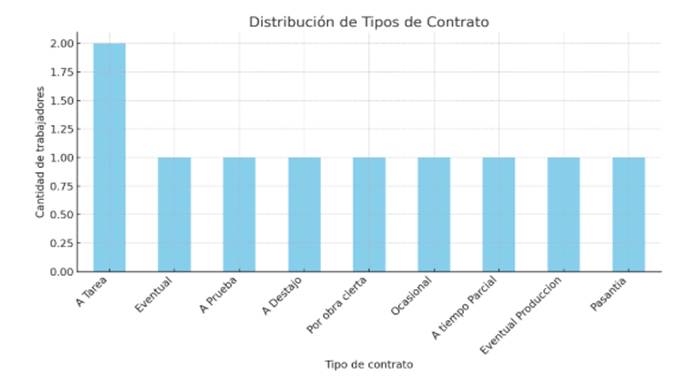
Figure 1 presents the distribution of the types of contracts identified in the study. The most frequent contract type identified was the task-based contract (A Tarea) (n = 2), followed by others such as temporary (Eventual), probationary (A Prueba), piecework (A Destajo), and specific project (Por obra cierta), each represented by one case. This variety indicates a mixed use of contractual modalities, possibly adapted to different operational needs. The low repetition of contract types suggests a lack of standardization in employment relationships, which may have implications for employee stability.
Figure 2. Most frequent grounds for the termination of employment relationships in the study.
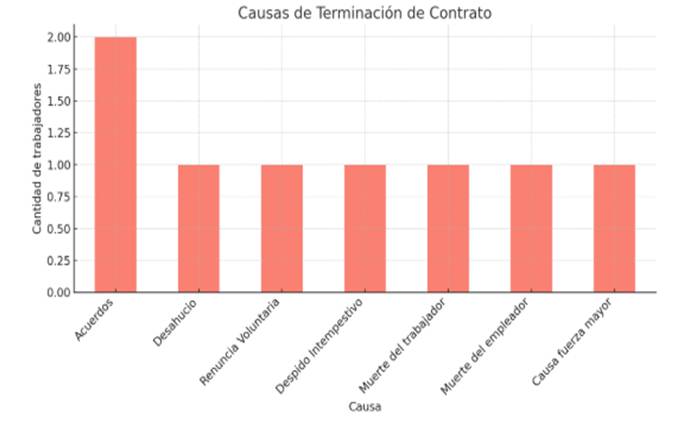
Figure 2 illustrates the reasons for which employment relationships were terminated. The most frequent ground identified was mutual agreement (n = 2), followed by causes such as voluntary resignation, wrongful dismissal, and other events including death of the employee or force majeure, each with one case. These results reflect a diversity of grounds of termination, with a predominance of consensual decisions, which may be interpreted as a negotiated approach to the management of contract termination.
DISCUSSION
The findings allow the conclusion that, although Ecuadorian labor legislation exhibits a robust legal architecture, its day-to-day application continues to reveal substantive limitations that hinder the effective enforcement of labor rights. This gap between positive law and its material implementation directly affects essential principles such as equity, legal certainty, and the protection of the right to work, which constitute the minimum framework required to ensure fair labor relations.
From an analytical perspective, a persistent contradiction can be observed between the formal protection of labor rights and their effective enforcement within administrative and judicial proceedings. Due process, a cornerstone of contemporary labor law, is undermined when administrative authorities fail to ensure adequate legal representation, impartial assessment of evidence, or properly reasoned justifications in the decisions. Latin American jurisprudence has highlighted this tension, emphasizing the importance of administrative oversight as a mechanism for effective protection (Gamonal, 2017; Plá Rodríguez, 2000).
Another critical aspect identified is the distorted use of legal mechanisms such as mutual agreement and the visto bueno procedure, which were originally designed to ensure legitimate and transparent contract termination. However, their misapplication demonstrates that the employee’s autonomy of will, may be conditioned by external factors, particularly in asymmetric relationships where the employer’s economic and organizational position introduces defects in consent. This phenomenon, widely documented in labor law scholarship, calls for a reexamination of the scope of consent in contexts of subordination (Montoya Melgar, 2019; Baylos, 2020).
A significant contribution of this study lies in demonstrating how the post-pandemic regulatory framework substantially altered labor dynamics, generating new scenarios of vulnerability. The accelerated incorporation of telework and emerging contractual modalities exposed legal gaps related to digital disconnection, state supervision, and employment termination, leading to ambiguous contractual cessations and limited legal protection for employees in remote work environments (ILO, 2021; García-Serna, 2022).
From a theoretical perspective, the findings confirm the hypothesis of a structural mismatch between law and reality, aligning with the postulates of critical legal theory. This approach warns that legal formalism may reproduce power relations that perpetuate inequalities in the labor sphere, particularly when institutional control mechanisms fail to operate effectively (Comelles, 2024).
In practical terms, the results highlight the urgent need to strengthen labor inspection and enforcement mechanisms, particularly through the implementation of agile judicial review procedures and the reinforcement of the Labor Inspector’s role as a neutral guarantor. Likewise, the institutionalization of labor mediation may constitute an appropriate avenue for resolving disputes, especially in situations where there are reasonable doubts regarding the voluntariness of termination agreements.
Finally, from an academic and professional perspective, this study provides a relevant analytical framework for the training of labor lawyers, public administrators, and human talent management specialists. The interdisciplinary nature of the phenomenon underscores that labor protection requires not only regulatory adjustments but also a cultural shift aimed at consolidating the effective enforcement of the right to work.
CONCLUSION
This research confirmed that although the Ecuadorian legal framework provides for various modalities of employment termination, its practical application reveals profound tensions between normative regulation and the realities of labor practice. Legal, jurisprudential, and comparative analyses showed that mechanisms such as mutual agreement and the visto bueno procedure, designed to ensure legal certainty, were, in multiple cases, applied in contexts where employees lacked genuine bargaining power or were unaware of the legal consequences of their decisions.
In line with the objective of analyzing termination modalities and their effectiveness within the Ecuadorian system, the study demonstrated that normative guarantees have not been sufficient to prevent practices contrary to the principle of job stability, particularly among vulnerable groups such as pregnant women, persons with disabilities, and older adults. This reveals structural weaknesses in both state supervision and the country’s legal culture.
From a critical perspective, it is confirmed that the imbalance inherent in the employer–employee relationship continues to condition the application and interpretation of labor regulations. This imbalance is particularly evident in the instrumental use of mutual agreement as a business strategy to terminate employment relationships in an apparently voluntary manner, thereby undermining its contractual essence. The findings confirm the initial hypothesis: there is a persistent gap between positive law and labor practice, particularly when procedures lack effective mechanisms of control and protection.
The research also validates the principles of the guarantee-based theory of labor law, which maintains that employment contracts cannot be analyzed under the same parameters as civil law due to the inherent element of subordination. In light of this approach, it was evidenced that the institutions responsible for overseeing contract termination do not always act as genuine guarantors of the right to work, as recognized in the Constitution and in various international instruments ratified by Ecuador.
REFERENCES
Asamblea Nacional del Ecuador. (2024). Labor Code (Updated to 2024). Official Gazette of Ecuador.
Baylos, A. (2020). Labor law: Crisis, social model, and labor reforms. Tirant lo Blanch.
Bedmar, M. (2024). Contract termination modalities in Latin American labor law. Revista Latinoamericana de Derecho Social, 38(2), 45–67.
Bonilla, A., & Flores, S. (2020). Transformations of the employment contract and job stability guarantees. Revista Jurídica de la Universidad Andina, 27(1), 89–112.
Cedeño, J. (2024). Critical analysis of the visto bueno procedure in Ecuador. Revista Ecuatoriana de Derecho Laboral, 12(1), 77–101.
Cordero, F. (2023). Legal validity of employment settlement agreements: Requirements and limits. Revista de Derecho Privado, 45(3), 212–229.
Comelles, M. (2024). Critique of formalism in contemporary labor relations. Revista Iberoamericana de Derecho Social, 31(1), 55–78.
Flores, R. (2023). Mutual agreement and autonomy of will in the employment contract. Anuario de Derecho del Trabajo, 8(2), 133–150.
Flores, R., Hidalgo, M., & Rivera, A. (2025). Due process and administrative labor protection in Ecuador. Revista de Derecho Constitucional y Laboral, 10(1), 35–60.
Galarza, D. (2022). The employment termination record and its legal effectiveness. Revista de Derecho Contemporáneo, 30(2), 145–162.
García-Serna, A. (2022). Telework, digital disconnection, and labor precariousness. Estudios Laborales y Sociales, 18(3), 201–220.
Garces Ponce, L. (2021). Alternative mechanisms for the termination of the employment relationship. Revista Jurídica del Trabajo, 15(1), 65–84.
Gamonal, S. (2017). Fundamental right to decent work. Fondo de Cultura Económica.
Jiménez, A., & Falcón, D. (2024). Comparison of employment termination systems between Chile and Ecuador. Revista Chilena de Derecho del Trabajo, 17(2), 98–122.
López, R. (2023). Confidentiality and duties of good faith in the employment contract. IusLabor, 29(1), 55–70.
Ministerio del Trabajo. (2025). Ministerial Agreement MDT-2025-043: Regulation of the visto bueno procedure. Official Gazette of Ecuador.
Montoya Melgar, A. (2019). Labor law (36th ed.). Tecnos.
International Labour Organization (ILO). (2021). Telework in Latin America: Challenges and perspectives. Regional Office for Latin America and the Caribbean.
Paredes, J. (2023). Guarantee-based theory and employee protection in comparative law. Revista Internacional de Derecho Laboral, 20(1), 33–52.
Plá Rodríguez, A. (2000). Principles of labor law. Depalma.
Prado Chicoma, J. (2022). Mutual agreement and risks of coercion in employment contract termination. Ius et Praxis, 28(2), 88–110.
Reyes, M. (2025). Evaluation of the effectiveness of the administrative visto bueno procedure. Revista Ecuatoriana de Derecho Laboral, 13(1), 101–125.
Robelly, F., & Salazar, V. (2025). Ineffective dismissal and enhanced protection for pregnant women in Ecuador. Revista de Derecho y Género, 9(1), 44–63.
Ruiz Mayancha, C. (2024). Negotiation and compensation in employment termination agreements. Derecho y Empresa, 7(1), 55–74.
Salamanca, A. (2021). Voluntariness in the termination of the employment contract: Limits and controls. Revista Iberoamericana de Derecho del Trabajo, 14(2), 112–130.
Sinchi, R. (2024). Legal effectiveness of settlement agreements in labor matters. Lex Laboral, 3(1), 93–107.
Soto, M. (2023). Defects of consent in the employment contract and their effects. Revista de Derecho Privado y Social, 52(4), 213–228.
Tapia Marañón, C. (2021). Confidentiality and disclosure of business information: Reform proposals. Cuadernos de Derecho Laboral, 18(2), 77–95.
Torrealva, P. (2025). Economic compensation as a balancing element in mutual agreement. Derecho & Sociedad, 57(1), 149–167.
CONFLICTS OF INTEREST
The authors declare no conflicts of interest.