INTRODUCTION
In recent decades, sports marketing has experienced remarkable growth, becoming an essential tool for promoting and strengthening brands within the sports sector. The integration of digital strategies and the extensive use of social media have enhanced a phenomenon that has transformed the way sports clubs interact with their followers. This has reinforced their presence in a highly competitive global market. The ability of social media to establish a direct and effective connection between teams and their fans has created new opportunities to strengthen and consolidate sports brands.
Sports marketing not only generates revenue from ticket and memorabilia sales but also establishes a unique and prominent identity for athletic entities (Analuisa, 2023). In Ecuador, as in other countries, the importance of sports promotion strategies has been evident in the sustainability and growth of indigenous athletic groups. Digital platforms are crucial for disseminating messages and maintaining audiences, contributing significantly to image management and, above all, to advertising efforts (Jiménez-Marín et al., 2021).
In sports promotion, “interaction” is key, reflecting the intensity of the emotional bond and the active participation of followers with the team or brand. Various studies suggest that greater engagement leads to stronger loyalty and support, both financially and emotionally (Woratschek, Horbel, & Popp, 2014). Consequently, social media empowers sports teams to create compelling stories that enhance fan affiliation, thereby strengthening their brand image (Pegoraro, 2010).
However, sports marketing is closely tied to value assessment theories, which indicate that customers evaluate products and services by weighing expected benefits against perceived costs (Zeithaml, 1988). In this context, promotional programs not only aid in the acquisition of authentic products but also reinforce perceptions of brand excellence and authenticity. This evaluative approach helps explain the stronger loyalty of fans to sports clubs through the promotion of preferential items and special offers (Bauer, Stokburger-Sauer, & Exler, 2008).
The importance of digital strategies in managing brand image and fan loyalty in the sports arena has been highlighted in several studies. For instance, the study by Bravo-Torres and Hinojosa-Becerra (2021) reported the positive impact that digital marketing strategies have had on the visibility and engagement of Ecuadorian football clubs with their audiences. Merchandising strategies have proven effective in attracting and retaining followers, positively impacting the brand image of football teams (Américo et al., 2023). These strategies range from the commercialization of official merchandise to the development of exclusive experiences for fans, aiming to strengthen their loyalty and commitment to the sports entity.
Despite these advances, there are notable gaps in the knowledge surrounding digital marketing, merchandising, brand positioning, and fan loyalty in Ecuador. Most studies focus on global contexts or more developed sports markets, leaving a knowledge gap in the Ecuadorian setting (Bravo-Torres & Hinojosa-Becerra, 2021). Additionally, interactions on social platforms and their impact on brand perception have not been sufficiently explored. The existing literature lacks an in-depth analysis of the specific impact of these strategies in the Ecuadorian context, leaving a significant gap in current knowledge.
To address these gaps, the research seeks to analyze the impact of merchandising strategies on the brand positioning of football teams in Ecuador, considering the mediating role of social media in this relationship. Additionally, it seeks to assess how interactions on these platforms influence fans’ perceptions of the teams’ brands. This strategy also aims to fill the existing gap in the literature, but also to align the study with an emerging line of research in sports marketing.
In order to tackle the disparities mentioned, the present study is designed to examine the influence of marketing tactics on the brand perception of football clubs in Ecuador, taking into account the intermediary role of social media platforms in this connection. The main objective is to analyze the impact of merchandising strategies and the use of social media on the brand positioning of football teams in Ecuador. This approach seeks not only to address the identified gap in the literature but also to contribute to a growing field of inquiry in sports marketing.
An extensive empirical analysis using current data and case studies will be carried out to achieve these objectives. The study is grounded in the concept of relationship marketing, which emphasizes the importance of long-term connections between brands and their target audiences. The underlying theory is that having positive and continuous interactions with consumers is essential for maintaining customer loyalty and satisfaction. Football teams can connect with their fans through merchandising and social media as part of sports marketing.
Based on current empirical data, the study builds on the idea of relationship marketing, which stresses the value of sustained relationships between brands and their intended audiences. The theory holds that continuous and positive consumer engagement is critical to customer satisfaction and loyalty. Football clubs, in this sense, can engage with their fans through merchandising and social media within the sports marketing framework.
Our research approach in the field of sports marketing in Ecuador is based on three key concepts that will support a deeper understanding of the topic. One of the primary hypotheses proposed (H1) suggests that the merchandising strategies developed by football teams in Ecuador are significantly related to the use of social media, as these platforms enable teams to broaden their reach and strengthen their connection with fans. In line with hypothesis H2, it is proposed that the strategic use of social media significantly enhances these merchandising strategies by facilitating their dissemination, generating greater interaction, and increasing their promotional impact. Finally, hypothesis H3 posits that the combination of merchandising strategies and social media use significantly influences the brand positioning of football teams by improving fan perception and consolidating the club's identity in the sports market.
To validate the theoretical propositions and better understand the impact of sports marketing on brand perception among the Ecuadorian public, an empirical investigation will be conducted based on real data. This research will specifically address differences in the perception of football teams and analyze the role of marketing strategies, with a focus on the influence exerted by social media.
This approach aims to bridge the gap in the current literature and establish connections with the latest research in the field of sports marketing. Accordingly, the proposed model summarizes the hypothetical relationships among the study’s key variables, integrating the roles of merchandising, social media, and brand perception (see Figure 1).
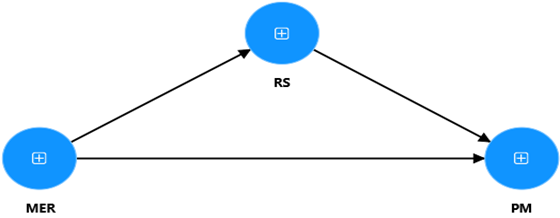
Figure 1. – Proposed Model
MATERIALS AND METHODS
This study employed a quantitative research design, which enabled the analysis of the impact of merchandising strategies and the use of social media on the brand positioning of football teams in Ecuador. For this purpose, a structured questionnaire based on a 5-point Likert scale was used to assess participants’ perceptions of the key variables. This approach was selected because it facilitates the collection of subjective data that can be statistically quantified.
The sample consisted of 384 football fans, selected through non-probability convenience sampling. This method was chosen for its practicality and its ability to provide access to a representative sample within the Ecuadorian context. Additionally, a 95% confidence level and a 5% margin of error were considered to ensure the robustness of the results.
Regarding data analysis, the statistical software SPSS v24 was used. This program enabled the execution of descriptive analyses, reliability and validity tests, and a mediation analysis using the Baron and Kenny method (1986). It is worth noting that, to validate the questionnaire, a pilot test was conducted with 30 participants. This pilot test allowed for adjustments to the questions and ensured their clarity. The pilot results yielded a Cronbach’s alpha above 0.85, indicating high internal consistency.
Finally, the data obtained were also subjected to correlation tests to confirm discriminant validity among the constructs. In summary, this empirical methodology enabled a rigorous identification of the mediating role of social media in the relationship between merchandising strategies and brand positioning.
RESULTS AND DISCUSSION
The sample of 384 individuals showed a slight predominance of male participants; 52.1% (200 individuals) were male, while 47.9% (184 individuals) were female. This distribution indicates a relatively balanced gender representation, although slightly skewed toward males. Similarly, the sample was mainly composed of young adults. A total of 77.1% of participants were between 18 and 34 years old, with 43.2% aged 18 to 24 and 33.9% aged 25 to 34. The representation of older age groups was lower: 14.1% were between 35 and 44, 7% between 45 and 54, and only 1.8% were over 54. According to the cumulative percentage, 98.2% of the sample was under the age of 55. This concentration of young individuals may affect the generalizability of the results to older populations.
As detailed in Table 1, the findings for the constructs used demonstrated high reliability and validity. Cronbach’s alpha reached values of 0.89 for both MER (Merchandising Strategies) and PM (Brand Positioning), while the composite reliability values exceeded 0.90, indicating strong internal consistency. This level of reliability was complemented by AVE values of 0.65 for MER and 0.66 for PM, which surpass the 0.5 threshold and confirm adequate explained variance. Discriminant validity was also demonstrated through robust correlation coefficients: 0.87 between MER and PM, 0.65 between MER and RS (Social Media), and 0.68 between PM and RS.
Regarding novel insights, the structural model revealed that merchandising strategies have a direct and significant impact on brand positioning (0.61; p < 0.001). Additionally, social media showed a relevant mediating effect in this relationship through a significant indirect path (MER → RS → PM = 0.17; p < 0.001). These findings highlight the innovative nature of integrating digital strategies with traditional promotional efforts to maximize brand positioning. In practical terms, this approach enables sports teams not only to strengthen fan loyalty but also to expand their reach in competitive markets.
Table 1.- Path Coefficients
|
Variables |
Sample Mean (M) |
Standard Deviation (STDEV) |
t-Statistics (|O/STDEV|) |
p-Values |
|
MER -> PM |
0,61 |
0,07 |
8,43 |
0,000 |
|
MER -> RS |
0,62 |
0,04 |
14,51 |
0,000 |
|
RS -> PM |
0,27 |
0,07 |
3,65 |
0,000 |
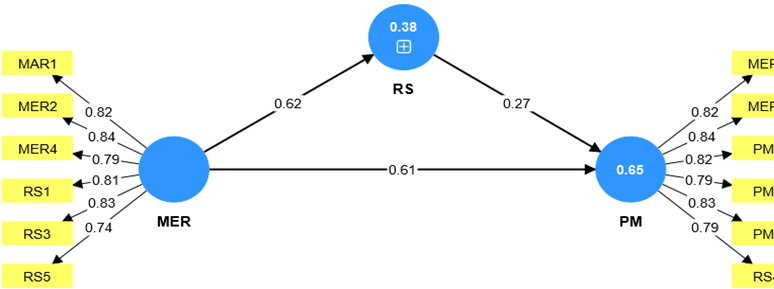
Figure 2. – Construct Loadings
The results obtained from the path coefficients and the statistical significance values of the tested model are presented below. The standardized loadings of the items on their respective constructs can be observed in Figure 2 – Structural Relationship of the Model. The relationship between MER (Merchandising Strategies) and PM (Brand Positioning) has a path coefficient of 0.61, a sample mean of 0.62, with a standard deviation of 0.07, t-statistics of 8.43, and a p-value of 0.000.
Thus, it is possible to affirm that the relationship between merchandising strategies and brand positioning is strong and significant (p < 0.001). Therefore, it can be considered that merchandising strategies have a significant and direct positive impact on the brand positioning of football teams. This research finding is consistent with previous studies suggesting that merchandising activities influence brand perception among spectators (Analuisa, 2023; González & Francisco, 2006). In addition, the relationship between MER and RS (Social Media) shows a path coefficient of 0.62, a sample mean of 0.62, a standard deviation of 0.04, a t-statistic of 14.51, and a p-value of 0.000.
Table 2 – Hypothesis Testing Summary indicates that the relationship between merchandising strategies and brand positioning is highly significant (H1: MER → PM; p < 0.001), suggesting that merchandising strategies directly influence how football teams build their market positioning. This finding reinforces the importance of integrating merchandising strategies with social media campaigns to maximize reach and engagement (Jiménez-Marín et al., 2021). Moreover, the relationship between social media use and brand positioning (RS → PM) presents a path coefficient of 0.27, a sample mean of 0.26, a standard deviation of 0.07, a t-statistic of 3.65, and a p-value of 0.000. While this relationship is somewhat weaker than the others, it remains statistically significant (p < 0.001). This result, combined with the indirect effect MER → RS → PM, with a coefficient of 0.17 (t = 3.85, p < 0.001), indicates that social media plays an important mediating role in the relationship between merchandising strategies and brand positioning. Finally, the validation of H3: RS → PM; p < 0.001 suggests that social media interactions strengthen brand perception, indicating that teams should continue investing in digital strategies to maintain and enhance their market position (Pilataxi Quillupangui, 2022).
Table 2. – Hypothesis Testing Summary
|
Hypothesis |
Path |
p |
Decision |
||
|
H1 |
MER |
→ |
PM |
0.000 *** |
√ |
|
H2 |
MER→RS |
→ |
PM |
0.000 *** |
√ |
|
H3 |
RS |
→ |
PM |
0.000 *** |
√ |
CONCLUSION
The study identified that football teams in Ecuador implement merchandising strategies such as the commercialization of official products, exclusive promotions, and the creation of digital content. These strategies are significantly related to the use of social media platforms that facilitate the promotion of products, stimulate interaction with fans, and reinforce the symbolic value of the brand. The statistically significant relationship (MER → RS; β = 0.62, p < 0.001) supports the existence of a strong connection between merchandising and social media in this context.
The results confirm that social media serves as a significant mediating variable, enhancing the effect of merchandising strategies on brand positioning. This mediating role is evidenced by the specific indirect effect MER → RS → PM (β = 0.17, p < 0.001), indicating that social platforms not only support marketing strategies but also channel their impact by enabling more effective dissemination, fostering emotional bonds with fans, and increasing brand exposure.
The research determined that the combination of merchandising strategies and social media has a positive, direct, and significant effect on brand positioning (MER → PM; total β = 0.78, p < 0.001). This strategic synergy enables clubs to consolidate their identity, improve perceived value among followers, and foster loyalty among their target audience. Taken together, both variables strongly explain the construction and reinforcement of the brand in a competitive digital environment.
Limitations and future lines of research
This study focused on a predominantly young sample of football fans in Ecuador, which limits the generalizability of the findings to other populations or sports contexts. Additionally, it employed a cross-sectional design, which does not allow for the analysis of changes over time. Future research could explore these dynamics in other sports disciplines, consider more diverse samples, and apply longitudinal designs.
Furthermore, it would be relevant to examine how other marketing strategies—such as augmented reality or the metaverse—may influence brand positioning and fan loyalty. These approaches would contribute to expanding the understanding of the impact of emerging technologies on sports marketing.
BIBLIOGRAPHIC REFERENCES
Américo, M., Sebastián, D., & Trujillo, F. (2023). Impacto social y mediático de la gestión de la comunicación en equipos de fútbol profesional masculino y femenino de Ecuador. Perio.Unlp.Edu.ArM Américo, DSF TrujilloQuestion/Cuestión, 3(76), e838. https://doi.org/10.24215/16696581e838
Analuisa, F. R. L. (2023). La importancia del marketing deportivo en el desarrollo de las instituciones deportivas de la ciudad de Ambato. Revistas.Utb.Edu.EcFRL AnaluisaJournal of Science and Research, 2023. https://doi.org/10.5281/zenodo.7733977
Baron, R., & Kenny, D.-J. (1986). The moderator–mediator variable distinction in social psychological research: Conceptual, strategic, and statistical considerations. Journal of Personality and Social Psychology, 51(6), 1173. https://psycnet.apa.org/journals/0022-3514/51/6/1173
Bauer, H. H., Stokburger-Sauer, N. E., & Exler, S. (2008). Brand image and fan loyalty in professional team sport: A refined model and empirical assessment. Journal of Sport Management, 22(2), 205-226. https://doi.org/10.1123/jsm.22.2.205
Bravo-Torres, D., & Hinojosa-Becerra, M. (2021). Evolución del marketing digital: caso de la marca ecuatoriana Forestea. Universitas, 35, 61–81. https://doi.org/10.17163/UNI.N35.2021.03
González, N., & Francisco, J. (2006). Estrategias de marketing en clubes deportivos. Revista Digital Deportiva, 2(3), 45–52. https://dehesa.unex.es/handle/10662/6269
Jiménez-Marín, G., Pérez Curiel, C. P., & desde, la publicidad y el audiovisual. (2021). Las redes sociales como herramienta de comunicación entre públicos: endorsement marketing como forma de publicidad. Reflexiones En Torno a La Comunicación Organizacional, La Publicidad y El. https://idus.us.es/handle/11441/106274
Pegoraro, A. (2010). Look who’s talking—Athletes on Twitter: A case study. International Journal of Sport Communication, 3(4), 501-514. https://doi.org/10.1123/ijsc.3.4.501
Pilataxi Quillupangui, A. E. (2022). El marketing deportivo y su función en los medios de comunicación digitales. Caso Direct Fútbol. Quito: UCE. http://www.dspace.uce.edu.ec/handle/25000/29913
Woratschek, H., Horbel, C., & Popp, B. (2014). The sport value framework – A new fundamental logic for analyses in sport management. European Sport Management Quarterly, 14(1), 6-24. https://doi.org/10.1080/16184742.2013.865776
Zeithaml, V. A. (1988). Consumer perceptions of price, quality, and value: A means-end model and synthesis of evidence. Journal of Marketing, 52(3), 2-22. https://doi.org/10.2307/1251446
CONFLICT OF INTERESTS
The authors declare no conflict of interest.