Jimmy Alexander Cruza, Christian José Mariño a
aFaculty of Engineering, Electronics and Industrial, Universidad Técnica de Ambato. Tungurahua, Ecuador
Corresponding author: jcruz9740@uta.edu.ec
Vol. 05, Issue 01 (2026): January-June
ISSN-e 2953-6634
ISSN Print: 3073-1526
Submitted: April 07, 2026
Revised: May 12, 2026
Accepted: May 18, 2026
Cruz, J. A. & Mariño, C. J. (2026). A Conceptual Model for Intelligent Urban Traffic Management Integrating Max Pressure and Industry 4.0 Technologies. EASI: Engineering and Applied Sciences in Industry, 5(1), 40-51. https://doi.org/10.53591/easi.V3i2.3248
Traffic congestion is one of the main challenges facing urban mobility, especially in medium-sized cities where road capacity tends to grow more slowly than demand. To address this, this study develops a conceptual model for intelligent urban traffic management in the city of Ambato, Ecuador, integrating MaxPressure as an adaptive control core, industrial engineering tools for performance monitoring, and Industry 4.0/CPS technologies to support data capture and integration. Methodologically, the research adopts a conceptual construction approach based on the structured integration of theoretical evidence, the identification of minimal constructs, and the formulation of a traceable functional architecture. As a result, a modular architecture is proposed that articulates observation, state estimation, decision-making, execution, and feedback. The main contribution of the study consists of combining a control algorithm, an operational evaluation, and digital enablers into a single functional proposal, addressing the fragmentation with which these components are typically treated in the literature. Although the model remains conceptual in scope, it offers an explicit basis for future stages of simulation, validation, and progressive implementation.
Keywords: Adaptive control, Industry 4.0, MaxPressure, Traffic management, Urban mobility.
La congestión vehicular representa uno de los principales desafíos de la movilidad urbana, especialmente en ciudades intermedias donde la capacidad vial crece más lentamente que la demanda. Este estudio desarrolla un modelo conceptual para la gestión inteligente del tráfico urbano en Ambato, Ecuador, integrando MaxPressure como núcleo de control adaptativo, herramientas de ingeniería industrial para el monitoreo del desempeño y tecnologías de la Industria 4.0 y Sistemas Ciberfísicos (CPS) para la captura e integración de datos. La investigación adopta un enfoque de construcción conceptual basado en la integración de evidencia teórica, la identificación de constructos clave y el diseño de una arquitectura funcional trazable. Como resultado, se propone una arquitectura modular que articula observación, estimación del estado, toma de decisiones, ejecución y retroalimentación. La principal contribución radica en integrar un algoritmo de control, mecanismos de evaluación operativa y habilitadores digitales en una propuesta funcional unificada, superando la fragmentación presente en la literatura. Aunque mantiene un alcance conceptual, el modelo proporciona una base para futuras etapas de simulación, validación e implementación progresiva.
Palabras clave: Control adaptativo, Industria 4.0, MaxPressure, Gestión del tráfico, Movilidad urbana.
Traffic congestion is one of the most serious challenges facing urban mobility, as it reduces the network’s operational efficiency, increases travel times, and generates social, economic, and environmental costs associated with recurring delays, especially during periods of high demand (Arnott et al., 1993; Huang & Loo, 2023). Similarly, recent data from Latin American contexts have highlighted the link between traffic congestion and deteriorating air quality, underscoring the need for management strategies aimed at mitigating congestion, traffic jams, and reduced traffic flow in urban networks (Bedoya-Maya et al., 2022). This issue is particularly important in medium-sized cities, where road capacity is often limited due to the growing number of vehicles, the concentration of activities in central corridors, and the limited possibilities for expanding infrastructure in the short term. In this regard, the city of Ambato (Ecuador) experiences recurring congestion at intersections and on strategic roads during periods of peak demand, making it a priority to strengthen traffic management through more efficient use of available infrastructure (García-de-la-Cruz & Chancay-García, 2024).
Within the urban network, signalized intersections serve as key control points, as they regulate the distribution of capacity among conflicting traffic flows and influence the formation, dissipation, and propagation of queues between intersections. Although traditional coordinated control schemes can deliver acceptable results under relatively stable conditions, their performance tends to deteriorate when demand fluctuates, congestion occurs, and a dynamic response is required to prevent blockages and cascading congestion effects; this has led to the development and refinement of more recent adaptive approaches based on pressure-based logic (Li et al., 2023; Wang et al., 2022). Among state-based control strategies, the MaxPressure method has established itself as one of the most significant approaches for the adaptive management of signalized intersections, as it selects signal phases based on pressures calculated from queue conditions (Varaiya, 2013). Its significance lies in the fact that it enables distributed and scalable decision-making with favorable analytical properties in urban networks modeled as queueing systems, and that recent developments have extended this logic to frameworks that address traffic coordination and smoothing in more complex urban networks (Wongpiromsarn et al., 2012; Xu et al., 2024).
The pressure logic is linked to backpressure-type policies, in which local decision-making relies on differences between upstream and downstream conditions to facilitate flow within the network (Wongpiromsarn et al., 2012). Under certain conditions, this principle achieves high performance in terms of served capacity; however, in real-world urban scenarios, the finite capacity of links and the risk of spillback can limit the effectiveness of the classical approach, which is why capacity-aware formulations have been proposed to preserve its advantages under more realistic physical constraints (Ahmed et al., 2025; Gregoire et al., 2015). In addition, variants of MaxPressure based on travel times have also been developed; these are useful when direct observation of queues is limited or when the state of the system must be represented using more readily available operational proxies (Mercader et al., 2020). In recent years, this approach has also been incorporated into hybrid strategies that incorporate learning, confirming that MaxPressure remains a key component in contemporary traffic signal control developments (Wei et al., 2019), where pressure can be used as a criterion for prioritizing phases, while other components adjust operational parameters such as green time (Agarwal et al., 2024).
However, the literature also shows that learning-intensive approaches face persistent limitations related to scalability, cross-domain coordination, data dependency, and the difficulty of generalization in complex urban networks (Li et al., 2023; Rasheed et al., 2020). These limitations underscore the need for design frameworks that maintain a clear structural foundation for linking the system’s state, control decisions, and performance evaluation—especially when the goal is not merely to optimize an algorithm, but to structure a comprehensive and traceable proposal for future implementation. Similarly, the shift toward smart cities has facilitated the adoption of technologies related to Industry 4.0 and cyber-physical systems including sensors, connectivity, edge or cloud computing, and data analytics to support the collection and processing of mobility data in near real time (Aslam et al., 2026). On the contrary, the adoption of these enablers does not in itself guarantee sustained improvements, as challenges remain regarding interoperability, security, the consistency of data flows, and the alignment between digital infrastructure and management objectives, as has also been noted in recent reviews of CPS in the context of Industry 4.0 (Oks et al., 2024).
In this context, a recurring gap in the literature is the fragmentation among three components that are often studied separately: control algorithms, performance metrics, and the technological architecture that supports the collection, processing, and use of data. In many cases, proposals prioritize algorithmic development or digital infrastructure in isolation, without sufficiently clarifying how data, decision rules, and performance indicators are integrated into implementable frameworks under heterogeneous urban conditions (Aslam et al., 2026; Elassy et al., 2024; Rasheed et al., 2020).
Given this gap, a conceptual model is particularly useful because it allows constructs, relationships, and assumptions to be organized in a coherent manner, defining components, inputs, outputs, and functional links prior to subsequent stages of simulation, validation, or implementation (Jabareen, 2009). In conceptual studies, this type of modeling does not replace empirical validation, but it does provide a methodological foundation for structuring complex proposals and making explicit the logic that links technology, control, and performance evaluation (Reyes et al., 2023). Considering the above, the objective of this study is to develop a conceptual model for intelligent urban traffic management in Ambato (Ecuador), integrating MaxPressure as an adaptive control core, industrial engineering tools for performance monitoring, and Industry 4.0/CPS technologies to facilitate data acquisition and processing (Aslam et al., 2026; Varaiya, 2013). The main contribution was the proposal of a traceable modular architecture that linked data, analysis, decision-making, action, and feedback. This provided a methodological foundation for future developments in urban contexts with varying levels of technological capability (Agarwal et al., 2024; Gregoire et al., 2015).
This study adopts a conceptual framework to develop a smart urban traffic management model for the city of Ambato, Ecuador. The methodological objective of the study is to formulate a conceptually coherent, structured, and traceable proposal that will serve as the basis for subsequent phases of calibration, verification, validation, and phased implementation (Jabareen, 2009; Reyes et al., 2023). This approach proved relevant because the primary objective was to integrate concepts, functional relationships, and design criteria drawn from different theoretical frameworks into a single analytical framework. In this regard, the methodological logic of the study was geared toward explicitly organizing the relationship between data, state estimation, control decisions, traffic signal control, and performance evaluation, so that the model would not merely describe isolated components but would integrate them into a coherent and replicable framework (Jabareen, 2009; Li et al., 2023).
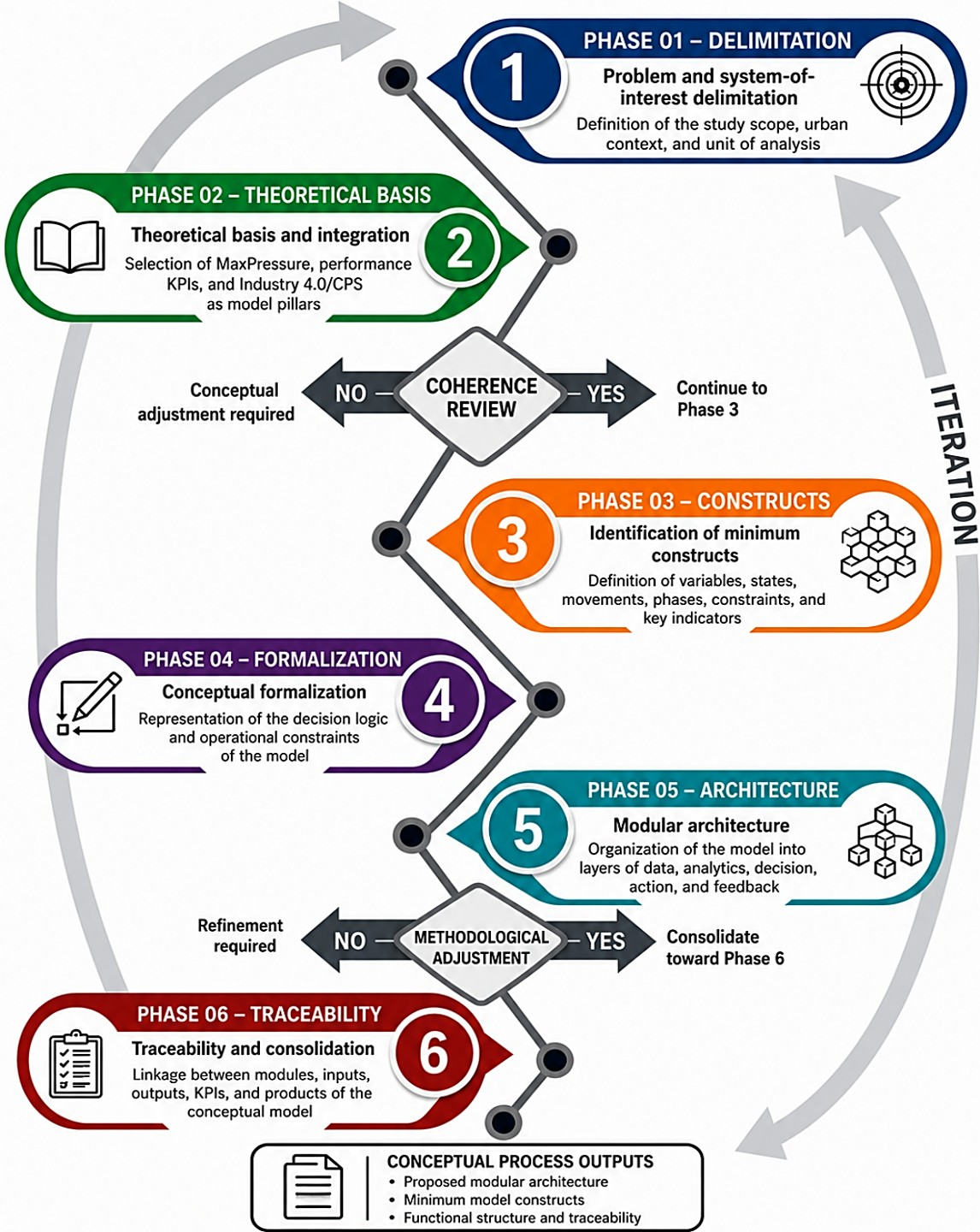
From a methodological standpoint, the study was designed as a structured conceptual synthesis based on three areas of evidence: (i) state-based adaptive traffic signal control, with a particular focus on “MaxPressure” and backpressure approaches; (ii) industrial engineering tools focused on performance measurement, indicator tracking, and operational improvement; and (iii) Industry 4.0 technologies, intelligent transportation systems (ITS), and cyber-physical systems (CPS) to support data acquisition, integration, and processing (Aslam et al., 2026; Elassy et al., 2024; Wongpiromsarn et al., 2012). The general procedure followed to structure the model is summarized in Fig. 1. These three domains were selected because they allow for the complementary integration of the system’s control logic, operational evaluation, and information infrastructure.
The model was developed using an iterative procedure consisting of six phases. First, the problem and the system under study were delineated, defining the urban network of intersections with traffic lights in the reference city as the unit of analysis. This network is characterized by temporal variability in demand and the occurrence of recurring congestion episodes in strategic corridors and nodes during peak hours (Bedoya-Maya et al., 2022). Second, the theoretical foundations of the model were established by selecting the approaches most relevant to the problem at hand. During this phase, MaxPressure was defined as the core of the decision-making mechanism, key performance indicators as the basis for the operational management level, and Industry 4.0/CPS technologies as enablers for data collection, connectivity, and information processing (Agarwal et al., 2024; Aslam et al., 2026; Varaiya, 2013).
Third, the minimum constructs necessary for the model to function were identified, including: traffic flow, congestion status, movements, traffic signal phases, operational constraints, performance indicators, and operational events. Fourth, the decision logic was formally defined, incorporating a simplified mathematical representation of the MaxPressure criterion and its operational constraints (Mercader et al., 2020; Varaiya, 2013). Fifth, the defined constructs and relationships were organized into a layered modular architecture that connected data capture, integration, state estimation, decision-making, actuation, and feedback. Finally, sixth, a traceability structure was established between modules, inputs, outputs, and indicators to ensure consistency between the control principle, system observation, and performance evaluation. (Jabareen, 2009; Reyes et al., 2023). This process provided the methodological basis for the resulting conceptual architecture, whose final representation, core constructs, and functional structure are presented and discussed in the Results and Discussion section.
The methodological approach is based on three complementary pillars. The first involves state-based adaptive control, in which MaxPressure is adopted as the central decision-making principle. This approach was chosen because it allows the network’s congestion state to be translated into a distributed control rule that is sensitive to differences between upstream and downstream conditions and is supported by analytical properties reported for traffic-light networks modeled as queuing systems (Varaiya, 2013; Wongpiromsarn et al., 2012). Furthermore, recent reviews of urban control have shown that state-based approaches remain relevant within more complex control frameworks, especially when it is necessary to coordinate observation, decision-making, and operation in heterogeneous networks (Li et al., 2023). Furthermore, subsequent developments have extended the pressure logic to adaptive and coordinated frameworks that maintain the relevance of the approach in urban environments with greater operational demands. In this vein, recent literature has shown that decentralized control principles can remain the methodological foundation even when additional coordination and adjustment mechanisms are introduced (Ahmed et al., 2025; Lioris et al., 2016).
The second pillar involved industrial engineering as a framework for evaluation and improvement. In this research, traffic signal control was not conceived solely as a problem of phase selection, but as an operational management problem that required continuous monitoring, evaluation, and adjustment. Therefore, the model incorporated an explicit performance layer aimed at linking the controller’s decisions to observable results through key indicators, prioritizing delay or travel time, queue length, throughput, and performance variability (Agarwal et al., 2024; Reyes et al., 2023).
The third pillar focused on Industry 4.0 technologies, ITS, and cyber-physical systems (CPS), which are considered enablers for the collection, transmission, integration, and processing of mobility data. Their inclusion in the methodology addressed the need to provide the model with a functional architecture capable of supporting the relationship between system observation, state analysis, control application, and indicator-based feedback. In this regard, recent literature on intelligent transportation systems has highlighted the role of connectivity, data analytics, and digital infrastructure as the foundation for smart and sustainable urban mobility schemes (Aslam et al., 2026; Elassy et al., 2024). However, the proposal did not assume a fully implemented infrastructure; rather, it considered scenarios involving varying levels of technological availability, including contexts with partial coverage and the use of state proxies.
In summary, MaxPressure provided the decision-making logic, Industrial Engineering provided the evaluation and improvement framework, and Industry 4.0/CPS provided the data architecture required to operate the system. The combination of these components formed the methodological basis of the proposed conceptual model.
The host city selected for the conceptual application of the model was Ambato, Ecuador. It was chosen because it provides a relevant urban context for developing a smart traffic management proposal, given its growing mobility pressures, operationally significant signalized intersections, and a road network suitable for illustrating problems related to congestion, vehicle accumulation, and traffic flow variability. In this regard, Ambato was adopted as a reference case for structuring the conceptual model, without this implying empirical validation or field implementation. This choice was consistent with recent approaches that highlight the need to integrate road infrastructure, operational data, and intelligent transportation systems within sustainable urban mobility strategies (Elassy et al., 2024).
The identification of critical points within the city was based on functional and operational criteria. In a subsequent implementation phase, these points could be selected based on the presence of intersections with high traffic volume, recurring traffic jams, long delay times, conflicts between traffic flows, their importance within urban corridors, and the potential availability of operational data. Under this logic, the selection did not depend solely on traffic volume, but also on the strategic importance of each intersection within the network and its ability to represent conditions significant for the conceptual evaluation of the model. This criterion is consistent with recent studies that have proposed the identification of congestion patterns and points based on operational indicators and spatiotemporal variations in performance within urban networks (Zang et al., 2023).
In addition, the prioritization of critical points could be supported by operational records, technical observations, traffic counts, municipal data, travel times, occupancy rates, evidence of congestion, and other proxy indicators of the system’s condition. Thus, the base city and its critical intersections were not considered an immediate empirical validation scenario, but rather a structured reference for organizing the model’s components, defining its inputs, delineating its processes, and planning future stages of simulation, calibration, and validation.
To make the model’s decision logic explicit, the traffic system is conceptually represented as a set of signalized intersections, links, movements, and permissible phases. Let x_a (t) be the state of link a at time t, where this state may correspond to a directly observed queue, an estimated queue, or an operational proxy for the level of congestion, such as occupancy or travel time. Let, (a,b) be a feasible movement from the upstream link a to the downstream link b (Mercader et al., 2020; Varaiya, 2013). Following the logic of MaxPressure, the pressure associated with a movement (a,b) can be conceptually expressed as:
wab(t) = xa(t) − xb(t) (1)
where wab(t) represents the difference between the upstream and downstream states. Under this formulation, high positive pressure indicates that it is more advantageous to accommodate the flow, as it reflects an imbalance that favors the discharge from the input link to an output link with greater relative receiving capacity (Varaiya, 2013; Wongpiromsarn et al., 2012).
For each traffic signal phase p∈P, the total phase pressure is obtained by summing the pressures of the traffic flows served by that phase.
Pp(t) = ∑(a,b)∈p sab wab(t) (2)
where sab represents a weighting term associated with the movement, which can be interpreted as operational relevance, a saturation effect, or relative priority within the control scheme. Based on this expression, the controller’s decision rule is defined as the selection of the phase with the highest aggregate pressure:
p*(t) = arg maxp∈P Pp(t) (3)
This formulation made it possible to express, in conceptual terms, the methodological role of MaxPressure within the model by translating the system’s state into an explicit adaptive decision rule that linked observation, analysis, and traffic-light-based action (Gregoire et al., 2015; Varaiya, 2013). Furthermore, recent developments have shown that the MaxPressure logic can be extended to schemes that incorporate signal coordination and the handling of more complex operating conditions without departing from its basic decision-making structure (Xu et al., 2024). However, the implementation of the controller must comply with basic safety and operational feasibility constraints. Therefore, the activation of the selected phase is subject to minimum green, maximum green, and clearance time limits, which can conceptually be represented as:
gpmin ≤ gp(t) ≤ gpmax (4)
where g_p (t) is the effective green time assigned to phase p. The inclusion of these constraints is methodologically significant because it prevents the adaptive control from being interpreted as an unrestricted selection of phases and places the model within realistic traffic signal operating conditions (Gregoire et al., 2015; Lioris et al., 2016). Furthermore, since it is not always possible to directly observe traffic queues in real-world urban environments, the model allowed for the use of an estimated representation of the state x ̂_a (t), derived from occupancy data, capacity limits, cameras, travel times, or simple operational inferences. This flexibility allowed the MaxPressure logic to continue functioning even with partial information availability, an aspect particularly important in contexts of gradual implementation and in recent developments where the pressure logic has been integrated with other adjustment or learning mechanisms (Agarwal et al., 2024; Xu et al., 2024).
The scope of the study is limited to the urban network of signalized intersections in the city under study, including approach roads, turning movements, signal phases, and variable demand conditions. The research focuses on formulating a conceptual baseline applicable to the city of Ambato; therefore, the model does not aim to demonstrate generalizable empirical results at this stage, but rather to establish a structured foundation for future applications and adaptations (Jabareen, 2009; Reyes et al., 2023).
To preserve the model’s internal consistency, the following minimum operational assumptions were established. First, it was assumed that the system’s state could be measured directly or estimated using reasonable proxies. Second, it was assumed that each intersection had a defined set of phases and basic, parameterizable operational constraints. Third, it was considered that vehicle demand exhibited temporal variability, including periods of high traffic volume. Fourth, it was assumed that the system architecture could functionally separate the stages of data capture, state estimation, control decision-making, traffic signal execution, and performance evaluation. Fifth, it was acknowledged that technological instrumentation could be partial, so the model had to remain conceptually operational even when there was no full sensing coverage (Agarwal et al., 2024; Aslam et al., 2026).
These assumptions define the scope of the study and prevent the model from being attributed capabilities that have not been validated at this stage. Consequently, the proposal should be understood as a methodological framework designed to guide future developments, rather than as a solution that has already been implemented or field-tested (Jabareen, 2009; Rasheed et al., 2020).
A distinctive feature of the proposed methodology is the explicit incorporation of a performance layer, with the aim of linking the control mechanism to operational evaluation criteria. From this perspective, the system does not merely determine signal phases but incorporates a monitoring and improvement logic based on observable indicators (Reyes et al., 2023). For this study, four performance KPIs (Key Performance Indicators) were prioritized: average delay or travel time, queue level, throughput, and performance variability. Delay and travel time are considered primary indicators, as they directly represent the perceived efficiency of the system and constitute the main benchmark for assessing the network’s operational quality. Queue length is included as an indicator of local congestion and the risk of saturation; throughput reflects the system’s effective service capacity; and variability allows for the evaluation of stability, consistency, and robustness in the face of demand fluctuations. This selection is consistent with the literature on adaptive intersection control, where the performance of the MaxPressure approach is typically assessed using queues, delays, and travel times, in addition to network service measures (Lioris et al., 2016; Rasheed et al., 2020; Varaiya, 2013).
The inclusion of these KPIs serves a key methodological purpose: to bridge the gap between control decisions and the evaluation of results. In this way, the performance layer transforms the model into a management tool, as it enables the review of system behavior, the detection of deviations from operational targets, and the guidance of future adjustments to both control parameters and instrumentation and analytics requirements (Aslam et al., 2026; Reyes et al., 2023).
After defining the theoretical foundations, minimum constructs, decision logic, operational assumptions, and performance indicators, the final methodological stage consisted of organizing these elements into a coherent conceptual architecture. This process followed a modular approach in which each component of the system was associated with a specific operational role within the traffic management cycle (Jabareen, 2009; Reyes et al., 2023). The methodological objective of this stage was to ensure consistency between data acquisition, state estimation, adaptive decision-making, traffic signal execution, and performance evaluation. The resulting architecture, core constructs, and functional structure derived from this process are presented and discussed in the Results and Discussion section.
The main outcome of the study was the development of an integrated conceptual model for intelligent urban traffic management. The proposal was structured as a modular architecture in which adaptive control, performance evaluation, and digital enablers were integrated within a single functional logic. Rather than formulating an isolated algorithm, the model was configured as a conceptual sequence of observation, state estimation, decision, execution, and feedback, organized as a traceable operational cycle (Jabareen, 2009).
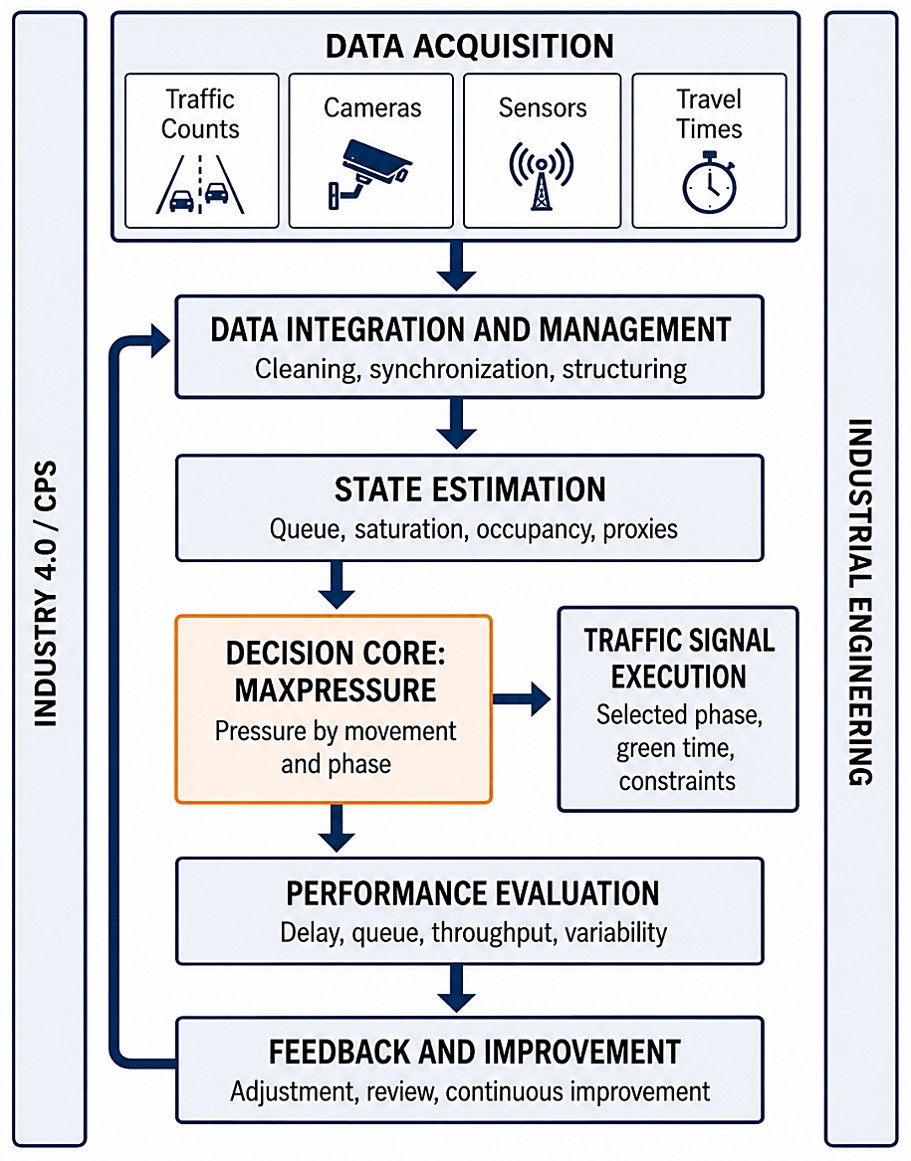
Figure 2 presents the functional architecture resulting from the conceptual development process. The proposed model is structured as a modular cycle that begins with data acquisition and integration, continues with state estimation and MaxPressure-based decision-making, and concludes with signal execution, performance evaluation, and feedback. This organization shows that the proposal is not limited to the isolated application of a traffic signal control algorithm, but rather integrates control logic, data infrastructure, and operational evaluation within a single traceable management framework (Gregoire et al., 2015; Jabareen, 2009; Lioris et al., 2016).
To support the internal consistency of the proposed model, a set of core constructs was defined. These constructs represent the minimum conceptual elements required for the operation of the architecture, including traffic demand, congestion state, movements, signal phases, pressures, operational constraints, control actions, performance indicators, data infrastructure, and feedback mechanisms (Jabareen, 2009; Reyes et al., 2023).
Table 1. Core constructs of the conceptual model for intelligent urban traffic management
| Construct |
Description |
Data Source / Acquisition |
Function |
|---|---|---|---|
| Traffic demand |
Flow per link or movement. |
Traffic counts, surveys, cameras, sensors. |
Characterize network load. |
| Congestion state |
Level of vehicle accumulation. |
Cameras, sensors, travel times, proxies. |
Represent the system state. |
| Traffic movement |
Path between entry and exit. |
Network geometry and operation. |
Define the unit of analysis. |
| Signal phase |
Set of compatible movements. |
Signal timing plans and configurations. |
Define decision alternatives. |
| Movement pressure |
Difference between upstream and downstream states. |
Internal calculation. |
Establish service priority. |
| Phase pressure |
Sum of pressures across movements. |
Internal calculation. |
Select the active phase. |
| Operational constraints |
Safety and feasibility limits. |
Parameters, regulations, operational criteria. |
Ensure real-world applicability. |
| Control action |
Activation of phase and green time. |
Controller output. |
Execute the adaptive decision. |
| Key performance indicators (KPIs) |
Delay, queue length, throughput, and variability. |
Data observation and processing. |
Evaluate performance and improvement. |
| Operational events |
Peaks, incidents, or failures. |
Monitoring and records. |
Contextualize system adjustments. |
| Data infrastructure |
Sensing, connectivity, and integration. |
ITS, cameras, sensors, databases. |
Support observation and decision-making. |
| Feedback |
System review and adjustment. |
KPIs and operational analysis. |
Close the improvement loop. |
As shown in Table 1, these constructs delineate the informational, functional, and operational elements that comprise the proposal. Their articulation allows a clearer definition of the model’s conceptual basis and specifies that the decision logic depends not only on control criteria, but also on the representation, processing, and updating of the system’s operational state (Aslam et al., 2026; Reyes et al., 2023). Based on these constructs, the functional structure of the conceptual architecture was organized into a sequence of modules. Table 2 summarizes the purpose, inputs, outputs, and contribution of each module within the proposed management cycle (Jabareen, 2009).
Table 2. Functional structure of the proposed conceptual architecture
| Module |
Purpose |
Input |
Output |
Contribution |
|---|---|---|---|---|
| Data acquisition |
Capture operational traffic information. |
Traffic counts, cameras, sensors, records. |
Raw data on flow, occupancy, or queues. |
Enables observation of the initial system condition. |
| Data management and integration |
Clean and structure the information. |
Field data and parameters. |
Consistent operational database. |
Reduces inconsistencies and improves data quality. |
| State estimation |
Represent the instantaneous network condition. |
Flow, occupancy, topology, and proxies. |
Estimated state per link or movement. |
Identifies accumulation, saturation, and service priority. |
| Pressure calculation |
Translating system state into operational priorities. |
Upstream and downstream states. |
Movement and phase pressures. |
Links congestion with adaptive decision logic. |
| Phase selection |
Select the most appropriate phase under constraints. |
Computed pressures and safety parameters. |
Selected phase and applicable green time. |
Aims to reduce delay, queues, and capacity loss. |
| Signal execution |
Apply the decision in the controller. |
Selected phase and operational rules. |
Implemented signal indication. |
Materializes the control action on the network. |
| Performance evaluation |
Measure operational effects using KPIs. |
Observed state, applied signal, and historical data. |
Performance indicators and alerts. |
Enables monitoring against operational targets. |
| Feedback and improvement |
Adjust system parameters and priorities. |
KPIs, events, and operational review. |
Adjustment and improvement recommendations. |
Closes the continuous improvement loop and supports gradual adoption. |
Table 2 describes the functional sequence of the proposed architecture in terms of modules, inputs, processes, and outputs. In this structure, data acquisition and integration are defined as the informational foundation of the system; state estimation represents the operational condition of the network; MaxPressure functions as the adaptive decision-making core; and the performance layer evaluates the effects of the control action through KPIs and feedback mechanisms. Consequently, the main contribution of the study is expressed through a conceptual architecture that integrates control, performance evaluation, and digital infrastructure into a single functional framework (Gregoire et al., 2015; Lioris et al., 2016).
From a conceptual standpoint, the model was described based on three main features. First, it explicitly integrated MaxPressure, operational evaluation, and digital infrastructure into a single framework (Agarwal et al., 2024; Aslam et al., 2026). Second, it organized the system’s logic through traceable components, from data input to feedback. Third, it incorporated the possibility of gradual adoption through partial observation of the system and the use of state proxies, a relevant aspect for an urban context such as Ambato, where the incorporation of technological capabilities could be approached progressively.
In relation to the literature, the proposal remained consistent with studies that have positioned MaxPressure as an adaptive control principle in traffic signal networks (Ahmed et al., 2025; Varaiya, 2013; Wongpiromsarn et al., 2012; Xu et al., 2024). However, the result of this study was not presented as a performance validation, but rather as a conceptual organization of the elements necessary to integrate this control principle into a broader operational management architecture. In this sense, the model was described as a structure that linked data acquisition, state estimation, decision-making, execution, and evaluation within a single operational logic. From a methodological perspective, the proposed architecture established a foundation for subsequent stages of simulation, calibration, and sensitivity analysis prior to any field implementation. In this vein, the proposal was not presented as evidence of empirical performance, but rather as a conceptual framework designed to explicitly organize the components, relationships, and assumptions necessary for future validation phases. Likewise, the eventual adoption of the model was contingent upon data availability, operational oversight, and institutional governance criteria (Agarwal et al., 2024).
The main limitation of the study was that the model was developed at a strictly conceptual level. Consequently, its internal consistency did not equate to an empirical demonstration of performance under real or simulated conditions. The proposal did not define calibrated parameters or specific intersection or corridor configurations, so its scope was limited to the structural formulation of the model. Even so, the conceptual result allowed for the explicit organization of the components, relationships, and assumptions necessary for future stages of simulation, validation, and progressive implementation.
Future research should follow a progressive validation pathway for the proposed conceptual architecture. First, the model should be implemented in microscopic or mesoscopic traffic simulation environments, such as SUMO, VISSIM, or Aimsun, in order to evaluate its behavior under different demand scenarios, intersection configurations, and levels of data availability. This stage would allow the analysis of key performance indicators such as delay, queue length, throughput, and operational variability, as well as the development of sensitivity analyses for the main control parameters and assumptions (Agarwal et al., 2024). Subsequently, the simulated model should be calibrated with local operational data, including traffic counts, travel times, queue observations, signal timing plans, and records from selected critical intersections. Before any full-scale field deployment, the architecture should also be tested in controlled or pilot environments, such as a limited corridor, a small group of signalized intersections, or a digital twin of the selected urban area. This gradual validation process would make it possible to assess technical feasibility, data reliability, operational safety, and institutional readiness before moving toward empirical field implementation under real traffic conditions (Li et al., 2023; Rasheed et al., 2020).
The study developed an integrated conceptual model for intelligent urban traffic management in the city of Ambato, Ecuador. Its main contribution was to bring together, within a single functional framework, the adaptive logic of MaxPressure, operational performance evaluation, and the data infrastructure necessary to support the cycle of observation, decision-making, action, and feedback.
Although the scope of the work was conceptual, its contribution lay in proposing an integrated architecture that positioned MaxPressure as the core of a broader, traceable, and performance-oriented management system. By integrating, within a single functional framework, adaptive control, operational evaluation, and informational support of Industry 4.0/CPS technologies, the model helped reduce the fragmentation with which these components had been addressed in the literature. Consequently, a necessary subsequent step will involve subjecting the proposal to simulation, calibration, and sensitivity analysis prior to any field implementation. Essentially, the study provided an explicit and transferable methodological foundation to guide future phases of validation and progressive implementation in urban contexts with heterogeneous technological capabilities.
Agarwal, A., Sahu, D., Mohata, R., Jeengar, K., Nautiyal, A., & Saxena, D. K. (2024). Dynamic traffic signal control for heterogeneous traffic conditions using Max Pressure and Reinforcement Learning. Expert Systems with Applications, 254, 124416. https://doi.org/10.1016/j.eswa.2024.124416
Ahmed, T., Liu, H., & Gayah, V. V. (2025). C-MP: A decentralized adaptive-coordinated traffic signal control using the Max Pressure framework. Transportation Research Part B: Methodological, 200, 103308. https://doi.org/10.1016/J.TRB.2025.103308
Arnott, R., de Palma, A., & Lindsey, R. (1993). A Structural Model of Peak-Period Congestion: A Traffic Bottleneck with Elastic Demand. American Economic Review, 83(1), 161–179. https://ideas.repec.org/a/aea/aecrev/v83y1993i1p161-79.html
Aslam, M. M., Shafik, W., Hidayatullah, A. F., Kalinaki, K., Gul, H., Zakari, R. Y., & Tufail, A. (2026). Intelligent Transportation Systems: A Critical Review of Integration of Cyber-Physical Systems (CPS) and Industry 4.0. Digital Communications and Networks, 12(1), 143–164. https://doi.org/10.1016/j.dcan.2025.06.014
Bedoya-Maya, F., Calatayud, A., & González Mejía, V. (2022). Estimating the effect of road congestion on air quality in Latin America. Transportation Research Part D: Transport and Environment, 113, 103510. https://doi.org/10.1016/j.trd.2022.103510
Elassy, M., Al-Hattab, M., Takruri, M., & Badawi, S. (2024). Intelligent transportation systems for sustainable smart cities. Transportation Engineering, 16, 100252. https://doi.org/10.1016/J.TRENG.2024.100252
García-de-la-Cruz, I., & Chancay-García, L. (2024). Semaforización Inteligente: Un Análisis a los Desafíos en la Implementación de Tecnologías y Algoritmos IoT. Revista Tecnológica - ESPOL, 36(E1), 80–96. https://doi.org/10.37815/rte.v36ne1.1189
Gregoire, J., Qian, X., Frazzoli, E., De La Fortelle, A., & Wongpiromsarn, T. (2015). Capacity-aware backpressure traffic signal control. IEEE Transactions on Control of Network Systems, 2(2), 164–173. https://doi.org/10.1109/TCNS.2014.2378871
Huang, Z., & Loo, B. P. Y. (2023). Urban traffic congestion in twelve large metropolitan cities: A thematic analysis of local news contents, 2009–2018. International Journal of Sustainable Transportation, 17(6), 592–614. https://doi.org/10.1080/15568318.2022.2076633
Jabareen, Y. (2009). Building a Conceptual Framework: Philosophy, Definitions, and Procedure. International Journal of Qualitative Methods , 8(4), 49–62. https://doi.org/10.1177/160940690900800406
Li, J., Yu, C., Shen, Z., Su, Z., & Ma, W. (2023). A survey on urban traffic control under mixed traffic environment with connected automated vehicles. Transportation Research Part C: Emerging Technologies, 154, 104258. https://doi.org/10.1016/J.TRC.2023.104258
Lioris, J., Kurzhanskiy, A., & Varaiya, P. (2016). Adaptive Max Pressure Control of Network of Signalized Intersections. IFAC-PapersOnLine, 49(22), 19–24. https://doi.org/10.1016/j.ifacol.2016.10.366
Mercader, P., Uwayid, W., & Haddad, J. (2020). Max-pressure traffic controller based on travel times: An experimental analysis. Transportation Research Part C: Emerging Technologies, 110, 275–290. https://doi.org/10.1016/j.trc.2019.10.002
Oks, S. J., Jalowski, M., Lechner, M., Mirschberger, S., Merklein, M., Vogel-Heuser, B., & Möslein, K. M. (2024). Cyber-Physical Systems in the Context of Industry 4.0: A Review, Categorization and Outlook. Information Systems Frontiers, 26(5), 1731–1772. https://doi.org/10.1007/S10796-022-10252-X
Rasheed, F., Yau, K. L. A., Noor, R. M., Wu, C., & Low, Y. C. (2020). Deep Reinforcement Learning for Traffic Signal Control: A Review. IEEE Access, 8, 208016–208044. https://doi.org/10.1109/ACCESS.2020.3034141
Reyes, J., Mula, J., & Díaz-Madroñero, M. (2023). Development of a conceptual model for lean supply chain planning in industry 4.0: multidimensional analysis for operations management. Production Planning and Control, 34(12), 1209–1224. https://doi.org/10.1080/09537287.2021.1993373
Varaiya, P. (2013). Max pressure control of a network of signalized intersections. Transportation Research Part C: Emerging Technologies, 36, 177–195. https://doi.org/10.1016/j.trc.2013.08.014
Wang, X., Yin, Y., Feng, Y., & Liu, H. X. (2022). Learning the max pressure control for urban traffic networks considering the phase switching loss. Transportation Research Part C: Emerging Technologies, 140, 103670. https://doi.org/10.1016/J.TRC.2022.103670
Wei, H., Chen, C., Zheng, G., Wu, K., Gayah, V., Xu, K., & Li, Z. (2019). Presslight: Learning Max pressure control to coordinate traffic signals in arterial network. Proceedings of the ACM SIGKDD International Conference on Knowledge Discovery and Data Mining, 19, 1290–1298. https://doi.org/10.1145/3292500.3330949
Wongpiromsarn, T., Uthaicharoenpong, T., Wang, Y., Frazzoli, E., & Wang, D. (2012). Distributed Traffic Signal Control for Maximum Network Throughput. IEEE Conference on Intelligent Transportation Systems, Proceedings, ITSC, 588–595. http://arxiv.org/abs/1205.5938
Xu, T., Barman, S., & Levin, M. W. (2024). Smoothing-MP: A novel max-pressure signal control considering signal coordination to smooth traffic in urban networks. Transportation Research Part C: Emerging Technologies, 166, 104760. https://doi.org/10.1016/J.TRC.2024.104760
Zang, J., Jiao, P., Liu, S., Zhang, X., Song, G., & Yu, L. (2023). Identifying Traffic Congestion Patterns of Urban Road Network Based on Traffic Performance Index. Sustainability 2023, Vol. 15, 15(2). https://doi.org/10.3390/SU15020948