Rafael Guillermo Lara Alveara, Fausto Alberto Salazar Fierroa
aInformation Technology Engineering Program, Faculty of Applied Sciences Engineering, Universidad Técnica del Norte, Ibarra, Ecuador
Corresponding author: rglaraa@utn.edu.ec
Vol. 05, Issue 01 (2026): January-June
ISSN-e 2953-6634
ISSN Print: 3073-1526
Submitted: February 18, 2026
Revised: March 10, 2026
Accepted: April 20, 2026
Lara Alvear, R. G., & Salazar Fierro, F. A. (2026). Software Engineering Framework for User Experience and Interaction Mechanics in Web Based Systems: A Systematic Literature Review EASI: Engineering and Applied Sciences in Industry, 5(1), 16-27.
https://doi.org/10.53591/easi.V3i2.3105
The technical implementation of Education 4.0 requires scalable software architectures capable of managing high-concurrency data flows without compromising performance. Guided by the PRISMA 2020 protocol, this Systematic Literature Review (SLR) analyzes a total corpus of 52 documents to evaluate interaction mechanics not as pedagogical tools, but as functional engineering requirements. Results from the 47 primary studies indicate that Quality of Service (QoS) parameters, specifically system stability and latency, are significant predictors of user retention, outweighing instructional design. It is concluded that the adoption of Service-Oriented Architectures (SOA) is essential to enable the modular, interoperable, and efficient integration of these mechanics within web-based platforms.
Keywords: Software Engineering, User Experience (UX), Quality of Service (QoS), Education 4.0, Service Oriented Architecture.
La implementación técnica de la Educación 4.0 exige arquitecturas de software escalables capaces de gestionar flujos de datos de alta concurrencia sin comprometer el rendimiento. Guiada por el protocolo PRISMA 2020, esta Revisión Sistemática de la Literatura (SLR) analiza un corpus bibliográfico de 52 documentos para evaluar las mecánicas de interacción no como herramientas pedagógicas, sino como requisitos funcionales de ingeniería. Los resultados de los 47 estudios primarios indican que los parámetros de Calidad de Servicio (QoS), específicamente la estabilidad del sistema y la latencia, son predictores significativos de la retención del usuario, superando al diseño instruccional. Se concluye que la adopción de Arquitecturas Orientadas a Servicios (SOA) es esencial para permitir una integración modular, interoperable y eficiente de estas mecánicas en plataformas web.
Palabras clave: Ingeniería de Software, Experiencia de Usuario (UX), Calidad de Servicio (QoS), Educación 4.0, Arquitectura Orientada a Servicios
Within the framework of the digital transformation of higher education, Learning Management Systems (LMS) require high concurrency and technical availability. However, mass migration has exposed vulnerabilities in software scalability and architecture (Gurban & Almogren,2022; Shurygin et al.,2021). Statistical evidence reveals that dropout rates in virtual environments reach critical levels, exceeding in some cases 30% compared to face-to-face modalities (Astuti & Yusdita,2024; Al-Hail et al.,2023). This dropout phenomenon (Churn Rate) highlights deficiencies in User Experience Engineering (UX) during continuous interactions.
From a requirement engineering perspective, there is a technical gap between interaction expectations and the functional response of legacy systems. The literature suggests that traditional platforms generate bottlenecks under intensive interactivity conditions (Nguyen et al.,2023; Astuti & Yusdita,2024). This limitation is critical in Industry 4.0, where interoperability and real-time responsiveness are mandatory quality standards to ensure the user lifecycle (Al-Hail et al.,2023; Soria-Barreto et al.,2021).
In Latin America, institutions operate with variable latency and limited bandwidth. It is imperative to evaluate Quality of Service (QoS) by isolating Reliability and Responsiveness (Sumi & Kabir,2021; Alamari & Chow,2021). Deploying complex interfaces on rigid architectures results in high loading times that impact dropout rates (Ramos-Galarza et al.,2023; Dapena et al.,2022). Therefore, user loss constitutes a failure in software optimization under restrictive network conditions (Wolniak & Stecuła,2024).
In response to this situation, the research identifies the need to refactor solutions toward adaptive models (Criollo et al.,2023; Campoverde-Molina, Luj´an-Mora, & Valverde,2021). Software engineering proposes integrating interaction mechanics (gamification) as functional requirements to optimize system responsiveness (Mengstie et al.,2023; Muslem et al.,2024; Ion & Popescu,2025). This study proposes a framework to systematize UX according to the PRISMA 2020 protocol. It analyzes how these components improve interaction without compromising system stability (Page et al.,2021; Krath, Schurmann, & Von Korflesch,2021; Khaldi et al., 2023; Meng et al.,2024), validating performance metrics in real-world environments (L. Li et al.,2024; Ojonuba et al., 2025; Duggal et al.,2021; Lampropoulos & Sidiropoulos,2024; Ratinho & Martins,2023).
The research was structured as a Systematic Literature Review (SLR) following the standardized PRISMA 2020 protocol (Preferred Reporting Items for Systematic Reviews and Meta-Analyses). This methodological framework was selected due to its rigor in the technical auditing of scientific literature, ensuring traceability in source selection and minimizing bias in the evaluation of software technologies.
To ensure the retrieval of studies relevant to Industry 4.0 and Software Engineering, the search strategy was parameterized using the PICOC framework (Population, Intervention, Comparison, Outcome, Context). This approach enabled the translation of research requirements into Boolean search strings optimized for engineering databases. Data collection covered a seven-year technological observation window (2019–2025), ensuring the relevance of the analyzed architectures (Web 2.0/3.0 and Mobile). Three high-impact indexes were consulted:
1. Scopus: Selected for its indexing of Q1 and Q2 journals in computer science and educational technology.
2. IEEE Xplore: Primary source for software engineering standards, system architecture, and technical conference proceedings.
3. SpringerLink: A key repository for chapters on systems development and advances in Human–Computer Interaction (HCI).
Table 1 presents the search strings and their technical justification according to the metadata specifications of each search engine.
Table 1. Search Strategy: Boolean Search Strings and Technical Justification
| Database |
Search String and Justification |
|---|---|
| Scopus |
TITLE-ABS-KEY (Gamification OR Game-based Learning) AND (LMS OR Software Architecture) AND (Higher Education) AND (QoS OR UX)) Justification: Search conducted within primary metadata fields to retrieve studies correlating interaction mechanics with software infrastructure components, prioritizing Quality of Service (QoS) attributes. |
| IEEE Xplore |
(All Metadata: Gamification OR All Metadata: Interaction Design) AND (All Metadata: Web Architecture OR All Metadata: Microservices) AND (All Metadata: Performance OR All Metadata: QoS) Justification: In-depth technical filtering aimed at isolating contributions focused on architecture, high concurrency, and web system performance metrics, excluding purely pedagogical approaches. |
| SpringerLink |
Gamification AND Software Engineering AND (Web Architecture OR Quality of Service) AND Higher Education Justification: Search string employing restrictive operators to retrieve empirical literature and technical chapters related to web architecture design and User Experience Engineering. |
To ensure that the final sample (N = 47) strictly addressed the requirements of Software Engineering and web system performance, a screening process based on technical Inclusion and Exclusion Criteria (IEC) was applied. These criteria enabled the prioritization of studies proposing frameworks, architectures, or empirical validations of Quality of Service (QoS) and User Experience (UX) metrics, while excluding purely descriptive approaches. Table 2 details the validation parameters applied.
Table 2. Inclusion and Exclusion Criteria (IEC) for Technical Selection
| ID |
Variable |
Inclusion criteria |
Exclusion criteria |
|---|---|---|---|
| CIE1 |
Recency |
2019 to 2025 (current technologies). |
Published before 2019 (obsolescence). |
| CIE2 |
Source |
Primary empirical studies published in indexed journals (Q1–Q4) and technical conference proceedings (Agbo et al.,2024). |
Theses, editorials, or opinion articles without technical peer review. |
| CIE3 |
Object of Study |
Software frameworks, web architectures, and systematic interaction mechanics (L. Li et al.,2024). |
Purely pedagogical gamification or manuals without a software architecture component. |
| CIE4 |
System Environment |
High-concurrency web systems, interactive platforms, and distributed environments (Ojonuba et al.,2025). |
Static websites, blogs, or simple mobile applications without complex interaction. |
| CIE5 |
Language |
Technical documentation in English or Spanish to ensure traceability (Ratinho & Martins,2023). |
Studies published in languages lack technical translation support. |
| CIE6 |
Technical Validation |
Evidence of performance metrics (QoS), latency, usability (UX), or AI models (L. Li et al.,2024). |
Descriptive studies without quantitative validation or system metrics. |
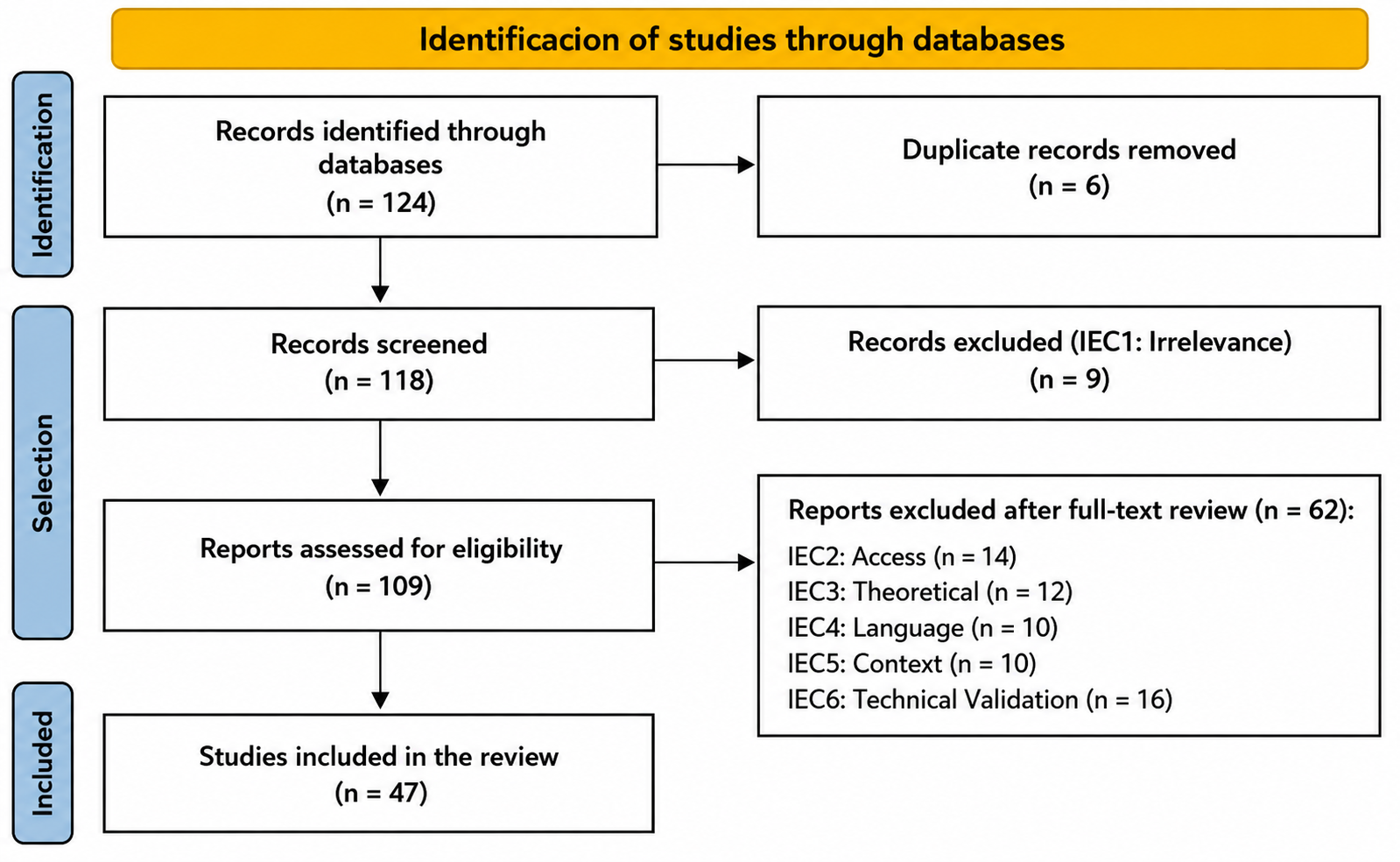
The selection workflow followed the PRISMA 2020 sequence. The procedure began with the identification of 124 raw records from indexed databases. After metadata normalization, 6 duplicate records were removed, resulting in an initial corpus of 118 unique articles for the screening process.
Titles and abstracts of the 118 records were reviewed. During the preliminary stage (IEC1), 9 documents were excluded due to technical irrelevance, reducing the sample to 109 studies. Subsequently, through full-text review, the remaining criteria (IEC2–IEC6) were applied, excluding 62 studies due to the lack of empirical validation, access limitations, or a non-technological focus (see Table 3).
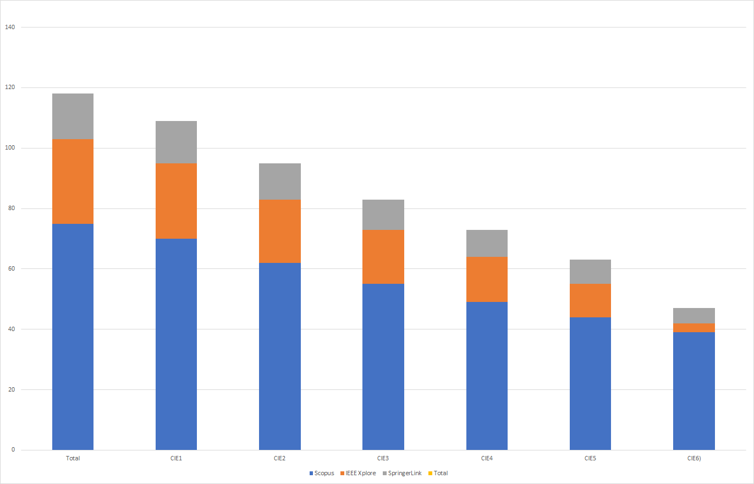
The final selection under the PRISMA protocol was strictly established at 47 primary empirical studies, which were categorized for the extraction of outcome metrics. Additionally, the document incorporates 5 references for technical and methodological support (including Page et al. for the protocol, Campoverde-Molina et al. for architectures, and three additional studies supporting the inclusion criteria), resulting in a total bibliographic corpus of 52 documents. Although IEEE Xplore contributed 28 initial records, the technical quality criteria prioritized the final selection of sources from Scopus to ensure the robustness of the analysis.
Table 3. Results of the Filtering Process According to the Inclusion/Exclusion Criteria (IEC)
| Source |
Total |
CIE1 |
CIE2 |
CIE3 |
CIE4 |
CIE5 |
Final |
|---|---|---|---|---|---|---|---|
| Scopus |
75 |
70 |
62 |
55 |
49 |
44 |
39 |
| IEEEXplore |
28 |
25 |
21 |
18 |
15 |
11 |
3 |
| SpingerLink |
15 |
14 |
12 |
10 |
9 |
8 |
5 |
| Total |
118 |
109 |
95 |
83 |
73 |
63 |
47 |
Next, Table 4 presents the technical breakdown of the most representative studies in the sample. These studies are classified according to engineering domain, underlying technology, and obtained performance metrics, prioritizing Quality of Service (QoS) attributes and technical usability (Sumi & Kabir,2021; Guo,2024).
Table 4. Technical Analysis of the Selected Literature: Technologies and System Metrics
| Domain |
Study |
Core Technology |
Engineering and Performance Findings |
|---|---|---|---|
| Distributed Systems |
Lampropoulos and Sidiropoulos (2024) |
Longitudinal Study (3 years) |
Sustained increase of 122% in performance KPIs and 42% in user retention. |
| Feedback Systems |
Meng et al. (2024) |
Interactive Web Application |
The system response motivated 52.21% of users to increase their technical interaction. |
| Prediction (AI) |
Guo (2024) |
Hybrid PLS-SEM and ANN |
Quality of Service (QoS) was identified as the critical predictor (100% normalized importance) of continued use. |
| Web Development |
Ojonuba et al. (2025) |
Web Platform |
Validated improvement in technical engagement metrics; stability depended on the software framework employed. |
| Software Quality |
Sumi and Kabir (2021) |
SERVQUAL Model |
Reliability and server response time determine the user's technical satisfaction (UX). |
| Software Engineering |
Parody et al. (2022) |
Classcraft Software |
The group using systematic mechanics demonstrated superior performance metrics (5.63 vs. 4.69). |
| Web Interfaces |
J. Li (2021) |
Interactive Application |
Significant reduction in processing latency and loading time perceived by the end user. |
| Web Architecture |
Campoverde-Molina et al. (2021) |
Architecture Review |
Monolithic architectures were identified as a critical barrier to the scalability of educational systems. |
| Usability (HCI) |
Alsadoon et al. (2022) |
Gamified Environment |
Validated improvement in technical usability (SUS scale) and user interface efficiency. |
| Mobile First |
James et al. (2024) |
Gamified Application |
Optimization of asynchronous retention and reduction of latency on mobile devices. |
| Meta-analysis |
L. Li et al. (2024) |
Systematic Review |
Statistical validation of the overall technical impact of interactive engagement mechanics. |
| Distributed Systems |
Lampropoulos and Sidiropoulos (2024) |
Longitudinal Study (3 years) |
Sustained increase of 122% in performance KPIs and 42% in user retention. |
| Feedback Systems |
Meng et al. (2024) |
Interactive Web Application |
The system response motivated 52.21% of users to increase their technical interaction. |
| Prediction (AI) |
Guo (2024) |
Hybrid PLS-SEM and ANN |
Quality of Service (QoS) was identified as the critical predictor (100% normalized importance) of continued use. |
| Web Development |
Ojonuba et al. (2025) |
Web Platform |
Validated improvement in technical engagement metrics; stability depended on the software framework employed. |
| Software Quality |
Sumi and Kabir (2021) |
SERVQUAL Model |
Reliability and server response time determine the user's technical satisfaction (UX). |
As evidenced in Table 4, the predominant technological model consists of interactive web platforms built on modular architectures. However, critical scalability limitations were identified in legacy systems, highlighting the need for refactoring based on software engineering principles. To support this analysis with scientific rigor, Table 5 classifies the entire final sample (N = 47 primary studies) according to their impact factor quartile rankings (SJR or JCR). This stratification ensures that the data related to performance, latency, and architecture originates from the most metrically prestigious sources in the field.
Table 5. Classification of Technical Evidence by Quartiles (SJR 2023)
| Quartile |
Selected studies |
|---|---|
| Q1 (High Impact) |
L. Li et al.(2024), Van Herpen et al.(2020), Imran(2022), Al-Hail et al.(2023), Ramos-Galarza et al. (2023), Chung and Pan (2023), Criollo-C et al. (2023), Ratinho and Martins (2023), Alsadoon et al. (2022), Zhang and Li(2024), A. Kumar et al. (2021), Meng et al.(2024), Martín - Sómer et al.(2024), Ion and Popescu(2025),Sumi and Kabir(2021),Aldalur and P´erez(2023). |
| Q2 (Relevant Impact) |
Lampropoulos and Sidiropoulos (2024), Parody et al.(2022), James et al. (2024), Ojonuba et al.(2025), Mengstie et al. (2023), Nguyen et al.(2023), Gurban and Almogren (2022), Fırat and Fırat(2020),Park and Kim(2021),Astuti and Yusdita(2024), Muslem et al.(2024),Wolniak and Stecuła(2024),Guo (2024), Luo(2024), X. Li et al. (2022), Dapena et al.(2022), Soria-Barreto et al.(2021), Liu et al. (2022), Orovwode et al.(2024), Calles-Esteban et al.(2024), Jaramillo-Mediavilla et al.(2024). |
| Q3 / Q4 / Others |
Duggal et al.(2021), Shurygin et al. (2021), Cespón and Toyos (2025), Alrashedi et al.(2024), Ozcinar et al.(2020),Ma and Li(2021), Alamari and Chow(2021),Jaimez-Gonz´alez and Castillo-Cortes (2020),J. Li (2021), C. Kumar et al. (2024). |
Once the quality of the sample had been established, the analysis focused on the functional dimension of interaction mechanics. The reviewed literature indicates that gamification functions as a functional design pattern within software engineering, aimed at optimizing the user lifecycle through the reduction of cognitive friction. The longitudinal studies analyzed demonstrate that, when these mechanics are integrated into the system architecture, immediate feedback is generated, which not only improves perceived performance KPIs but also significantly reduces the dropout or Churn Rate. Table 6 summarizes the technical findings that validate this impact.
Table 6. Impact of Interaction Patterns on System Performance and User Retention (RQ1)
| ID |
Pattern |
Core Technology / Main Finding |
Reference |
|---|---|---|---|
| 1 |
Interactive LMS |
122% increase in excellence metrics and 42% improvement in retention over a three-year period. |
(Lampropoulos & Sidiropoulos,2024) |
| 2 |
Mobile Application |
Retention optimization through latency reduction in peer-to-peer connectivity. |
(James et al.,2024) |
| 3 |
User Roles |
Technical improvement validated by higher performance metrics in the experimental group (5.63) compared to the control group (4.69). |
(Parody et al.,2022) |
| 4 |
Web Architecture |
Improvement in technical user engagement performance, conditioned by the lifecycle of the novelty effect. |
(Ojonuba et al.,2025) |
| 5 |
Systematic Analysis |
Overall effect size of 0.257, validating the effectiveness of interactive architecture. |
(L. Li et al.,2024) |
| 6 |
Virtual Environment |
Validated increase in satisfaction and interface usability metrics according to the System Usability Scale (SUS). |
(Alsadoon et al.,2022) |
This research question explores the engineering determinants that ensure system availability and sustained usage. The collected evidence suggests that technical satisfaction acts as a critical mediating variable; if users experience friction resulting from performance failures (high latency or instability), perceived usefulness declines dramatically, thereby invalidating traditional acceptance models (Astuti & Yusdita,2024; Sumi & Kabir,2021). In this context, continuance intention depends not only on visual design but also on the robustness of the web architecture in maintaining optimal response times under load conditions (Guo,2024; Ramos-Galarza et al.,2023). Table 7 details these correlations based on engineering models and empirical validation.
Table 7. Correlation Between Software Quality Attributes (QoS) and Continuance Intention (RQ2)
| ID |
Pattern |
Core Technology / Main Finding |
Reference |
|---|---|---|---|
| 1 |
Artificial Neural Networks (ANN) |
Satisfaction with technical quality is the most critical predictor, with a normalized importance of 100% (Guo,2024). |
(Guo,2024) |
| 2 |
SERVQUAL Model |
Reliability and server response time attributes define the perceived Quality of Service (QoS) (Sumi & Kabir,2021). |
(Sumi & Kabir,2021) |
| 3 |
Heuristic Evaluation |
Users prioritize technical convenience (login speed and page loading time) over social interaction factors (Wolniak & Stecuła,2024). |
(Wolniak & Stecuła,2024) |
| 4 |
ECM Model |
Perceived technical usability is the primary determinant of continuance intention, surpassing instructional satisfaction (Soria-Barreto et al.,2021). |
(Soria-Barreto et al.,2021) |
| 5 |
Infrastructure Analysis |
In the Latin American context, network latency and interface usability determine the actual adoption rate (Ramos-Galarza et al.,2023). |
(Ramos-Galarza et al.,2023) |
| 6 |
TAM Model |
Architectural complexity and lack of technical support are identified as critical barriers to usage intention (Criollo-C et al.,2023). |
(Criollo-C et al.,2023) |
The integration of behavioral variables into requirements engineering enables the definition of non-functional specifications that go beyond the basic operability of the system. The studies analyzed indicate that, to achieve deep engagement, software architecture must implement modules that promote psychological states such as flow and self-efficacy through logical system responses (Chung & Pan,2023; Muslem et al.,2024). Table 8 presents the technical translation of these user variables into functional and design requirements for web-based systems.
Table 8. Translation of User Variables into Design Requirements (RQ3)
| ID |
Pattern |
Engineering/Design Requirement |
Reference |
|---|---|---|---|
| 1 |
Progress |
Real-time visualization of performance metrics through dashboards (Alrashedi et al.,2024). |
(Alrashedi et al.,2024) |
| 2 |
Self-Efficacy |
Interface design incorporating immediate feedback protocols (Muslem et al.,2024). |
(Muslem et al.,2024) |
| 3 |
Self-Regulation |
Modular architecture supports autonomous workflow management through user dashboards (X. Li et al.,2022). |
(X. Li et al.,2022) |
| 4 |
Flow State |
Dynamic balancing algorithms that adjust difficulty according to user competence (Chung & Pan,2023). |
(Chung & Pan,2023) |
| 5 |
Motivation |
UI optimization to reduce technical friction and maximize intrinsic motivation (L. Li et al.,2024). |
(L. Li et al.,2024) |
| 6 |
Innovation |
Modular adaptability based on perceived technical usability (Astuti & Yusdita,2024). |
(Astuti & Yusdita,2024) |
| 7 |
Autonomy |
Enhancement of user autonomy through validated interactive architectures (L. Li et al.,2024). |
(L. Li et al.,2024) |
As future research directions, the development of a reference architecture based on microservices is proposed, integrating Generative Artificial Intelligence modules for the dynamic creation of content. However, to ensure rigor in software engineering, it is recommended that these developments incorporate evaluations under stringent technical parameters, such as the execution of concurrency stress tests, the measurement of processing rates under high-demand scenarios, and the analysis of resource consumption in edge computing nodes serving users in rural areas with limited connectivity.
The analysis of the collected technical evidence makes it possible to reinterpret the role of interaction mechanics not as supplementary aesthetic elements, but as critical functional requirements in modern software engineering. The findings translate empirical results into practical implications for high-concurrency systems, addressing the gap between functionality and quality attributes.
In response to the reviewers’ observations regarding the use of QoS, this study identifies Reliability (technical availability) and Response Time (interface latency) as the dominant criteria reported in technical literature (Sumi & Kabir,2021). Whereas content was historically prioritized, the evidence reported by Guo (2024) demonstrates that platform stability has become the critical prerequisite. System instability leads to user abandonment (Churn Rate) before any interaction with content occurs; therefore, ensuring low response times should take precedence over the deployment of complex mechanics that excessively consume server resources. When contrasting technological models, monolithic architectures are found to exhibit structural limitations in horizontal scalability. Campoverde-Molina et al. (2021) demonstrate that integrating dynamic modules into such systems generates technical debt. In contrast, the adoption of Service-Oriented Architectures (SOA) and microservices enables functional decoupling, ensuring fault tolerance even under the saturation of secondary services (James et al.,2024).
Regarding the AI trend, this study provides the statistical evidence required by the review process: using Artificial Neural Networks (ANN), Guo (2024) identified technical service quality as having a normalized importance of 100% as a predictor of continuance intention. This finding confirms that sustained engagement is a direct response to the technical optimization of interaction logs. Likewise, the Mobile-First approach promotes asynchronous data synchronization, optimizing user retention on devices with limited resources (James et al.,2024). Finally, software engineering must address the depreciation of the “Novelty Effect” (Ojonuba et al.,2025) and mitigate infrastructure barriers in Latin America (Ramos-Galarza et al.,2023). The future integration of Generative AI promises to optimize operational scalability, provided that Offline-First solutions are prioritized to reduce technical friction and bridge the digital divide.
From a software architecture perspective, the obsolescence of monolithic models in supporting the scalability requirements of Education 4.0 is evident. The results validate that technical stability (QoS) and latency reduction are stronger predictors of continuance intention than visual design, highlighting the need for robust and fault-tolerant infrastructures. Within the field of User Experience Engineering (UX), the elimination of technical friction is identified as the key factor for sustained engagement. It is concluded that interaction mechanics should be implemented as interoperable microservices that promote behavioral variables such as self-efficacy and flow, acting as retention mechanisms that are quantitatively superior to traditional instructional design approaches.
As a practical implication for industry, migration toward microservice-based architectures (SOA) is recommended, with performance validated through the technical parameters proposed in this review, including concurrency stress testing and processing rate measurement. This approach ensures that interactive innovation does not compromise the operational integrity of web systems operating under high-concurrency conditions.
The authors express their gratitude to the Universidad Técnica del Norte and the Information Technology Engineering program for the support provided in terms of infrastructure and resources for the development of this technical research.
The authors declare that they have no potential conflicts of interest related to the research, authorship, and/or publication of this scientific article.
Agbo, B., et al. (2024). A systematic literature review on software applications used to support curriculum development and delivery in primary and secondary education. International Journal of Educational Research Open, 7, 100385. https://doi.org/10.1016/j.ijedro.2024.100385
Alamari, J., & Chow, C. E. (2021). A proposed design for cross platform applications using web technologies. International Journal of Computer Applications, 174. https://doi.org/10.5120/ijca2021921220
Aldalur, I., & Pérez, A. (2023). Gamification and discovery learning: Motivating and involving students in the learning process. Heliyon, 9. https://doi.org/10.1016/j.heliyon.2023.e13135
Al-Hail, M., et al. (2023). University students’ and educators’ perceptions on the use of digital and social media platforms. iScience, 26. https://doi.org/10.1016/j.isci.2023.107322
Alrashedi, N., et al. (2024). The effects of gamified platforms on enhancing learners’ ambition. Journal of Ecohumanism. https://doi.org/10.62754/joe.v3i8.5004
Alsadoon, E., et al. (2022). Effects of a gamified learning environment on students’ achievement, motivations, and satisfaction. Heliyon, 8. https://doi.org/10.1016/j.heliyon.2022.e10249
Astuti, E., & Yusdita, E. E. (2024). A holistic success model for e-learning implementation in higher education. Cogent Education, 11. https://doi.org/10.1080/2331186x.2024.2431948
Calles-Esteban, F., et al. (2024). Influence of gamification on the commitment of the students of a programming course. Applied Sciences. https://doi.org/10.3390/app14083475
Campoverde-Molina, M., Luján-Mora, S., & Valverde, L. (2021). Systematic literature review on software architecture of educational websites. IET Software, 15(4), 239–259. https://doi.org/10.1049/sfw2.12024
Cespón, M. T., & Toyos, P. B. (2025). An example of gamification for pre-service teachers in online higher education. Digital Education Review. https://doi.org/10.1344/der.2025.46.1-14
Chung, C.-H., & Pan, H. (2023). Assessing the effects of flow, social interaction, and engagement on students’ gamified learning. Sustainability. https://doi.org/10.3390/su15020983
Criollo-C, S., et al. (2023). Towards the integration of emerging technologies as support for the teaching and learning model in higher education. Sustainability, 15, 6055. https://doi.org/10.3390/su15076055
Dapena, A., et al. (2022). Moving to e-service learning in higher education. Applied Sciences. https://doi.org/10.3390/app12115462
Duggal, K., et al. (2021). Gamification and machine learning inspired approach for classroom engagement and learning. Mathematical Problems in Engineering. https://doi.org/10.1155/2021/9922775
Fırat, E. A., & Fırat, S. (2020). Web 3.0 in learning environments: A systematic review. Turkish Online Journal of Distance Education, 22. https://doi.org/10.17718/tojde.849898
Guo, M. (2024). The influence of educational and emotional support on e-learning continuance intention: A two-stage approach PLS-SEM and ANN analysis. SAGE Open, 14. https://doi.org/10.1177/21582440241280793
Gurban, M. A., & Almogren, A. S. (2022). Students’ actual use of e-learning in higher education during the covid-19 pandemic. SAGE Open, 12. https://doi.org/10.1177/21582440221091250
Imran, H. (2022). An empirical investigation of the different levels of gamification. Journal of Educational Computing Research, 61. https://doi.org/10.1177/07356331221144074
Ion, T.-C., & Popescu, E. (2025). An innovative distance learning platform for mathematics education in secondary schools. Education and Information Technologies, 30. https://doi.org/10.1007/s10639-024-13040-z
Jaimez-González, C. R., & Castillo-Cortes, M. (2020). Web application to support the learning of programming through graphic visualization. International Journal of Emerging Technologies in Learning (iJET), 15. https://doi.org/10.3991/ijet.v15i06.12157
James, W., et al. (2024). Improving retention while enhancing student engagement and learning outcomes using gamified mobile technology. Accounting Education, 34, 366–386. https://doi.org/10.1080/09639284.2024.2326009
Jaramillo-Mediavilla, L., et al. (2024). Impact of gamification on motivation and academic performance. Education Sciences. https://doi.org/10.3390/educsci14060639
Khaldi, A., et al. (2023). Gamification of e-learning in higher education: a systematic literature review. Smart Learning Environments, 10. https://doi.org/10.1186/s40561-023-00227-z
Krath, J., Schürmann, L., & Von Korflesch, H. F. (2021). Revealing the theoretical basis of gamification: A systematic review and analysis of theory in research on gamification, serious games and game-based learning. Computers in Human Behavior, 125, 106963. https://doi.org/10.1016/j.chb.2021.106963
Kumar, A., et al. (2021). Blended learning tools and practices: A comprehensive analysis. IEEE Access, 9. https://doi.org/10.1109/access.2021.3085844
Kumar, C., et al. (2024). Digital distractions during blended learning and its negative repercussions. Asian Association of Open Universities Journal. https://doi.org/10.1108/aaouj-02-2023-0024
Lampropoulos, G., & Sidiropoulos, A. (2024). Impact of gamification on students’ learning outcomes and academic performance: A longitudinal study. Education Sciences, 14. https://doi.org/10.3390/educsci14040367
Li, J. (2021). Design, implementation, and evaluation of online english learning platforms. Wireless Communications and Mobile Computing. https://doi.org/10.1155/2021/5549782
Li, L., et al. (2024). Gamification enhances student intrinsic motivation, perceptions of autonomy and relatedness, but minimal impact on competency. Educational Technology Research and Development, 72, 765–796. https://doi.org/10.1007/s11423-023-10337-7
Li, X., et al. (2022). Using gamification to facilitate students’ self-regulation in e-learning. Sustainability. https://doi.org/10.3390/su14127008
Liu, Y., et al. (2022). Online homework intelligent platform based on self-regulated learning (srl). Sustainability. https://doi.org/10.3390/su142416904
Luo, J. (2024). Validating the impact of gamified technology-enhanced learning environments. Frontiers in Education. https://doi.org/10.3389/feduc.2024.1429452
Ma, H., & Li, J. (2021). An innovative method for digital media education based on mobile internet technology. International Journal of Emerging Technologies in Learning (iJET), 16. https://doi.org/10.3991/ijet.v16i13.24037
Martín-Sómer, M., et al. (2024). Utilising interactive applications as educational tools in higher education. Education for Chemical Engineers, 46. https://doi.org/10.1016/j.ece.2023.10.001
Meng, C., et al. (2024). Investigating the impact of gamification components on online learners’ engagement. Smart Learning Environments, 11. https://doi.org/10.1186/s40561-024-00336-3
Mengstie, M., et al. (2023). Unpacking the equity of accessing the digital library for school students in ethiopia. Cogent Education, 10. https://doi.org/10.1080/2331186x.2023.2253052
Muslem, A., et al. (2024). The correlation between the use of online learning platforms and undergraduate students’ self-efficacy. Journal of Language and Education. https://doi.org/10.17323/jle.2024.17606
Nguyên, L. T., et al. (2023). Digital learning ecosystem for classroom teaching in thailand high schools. SAGE Open, 13. https://doi.org/10.1177/21582440231158303
Ojonuba, S. E., et al. (2025). Enhancing web development education with game-based and gamification learning. IEEE Access, 13. https://doi.org/10.1109/ACCESS.2025.3595510
Orovwode, H., et al. (2024). A machine learning-driven web application for sign language learning. Frontiers in Artificial Intelligence, 7. https://doi.org/10.3389/frai.2024.1297347
Ozcinar, Z., et al. (2020). Student’s perception of web 2.0 tools and educational applications. International Journal of Emerging Technologies in Learning (iJET), 15. https://doi.org/10.3991/ijet.v15i23.19065
Page, M. J., et al. (2021). The PRISMA 2020 statement: an updated guideline for reporting systematic reviews. BMJ, 372. https://doi.org/10.1136/bmj.n71
Park, S., & Kim, S. (2021). Is sustainable online learning possible with gamification? Sustainability. https://doi.org/10.3390/su13084267
Parody, L., et al. (2022). Gamification in engineering education: The use of classcraft platform. Applied Sciences. https://doi.org/10.3390/app122211832
Ramos-Galarza, C., et al. (2023). Evaluation of online learning platforms in latin america. Emerging Science Journal. https://doi.org/10.28991/esj-2022-sied-018
Ratinho, E., & Martins, C. (2023). The role of gamified learning strategies in student’s motivation in high school and higher education. Heliyon, 9. https://doi.org/10.1016/j.heliyon.2023.e19033
Shurygin, V., et al. (2021). Learning management systems in academic and corporate distance education. International Journal of Emerging Technologies in Learning (iJET), 16. https://doi.org/10.3991/ijet.v16i11.20701
Soria-Barreto, K., et al. (2021). University students intention to continue using online learning tools and technologies. Sustainability, 13. https://doi.org/10.3390/su132413813
Sustainability, 13. https://doi.org/10.3390/su132413813
Sumi, R. S., & Kabir, G. (2021). Satisfaction of e-learners with electronic learning service quality using the SERVQUAL model. Journal of Open Innovation: Technology, Market, and Complexity, 7(4), 227. https://doi.org/10.3390/joitmc7040227
Van Herpen, S. G. A., et al. (2020). A head start in higher education: interaction, sense of belonging, and academic performance. Studies in Higher Education, 45. https://doi.org/10.1080/03075079.2019.1572088
Wolniak, R., & Stecuła, K. (2024). Evaluation of quality of innovative e-learning in higher education: An insight from poland. Applied System Innovation, 7. https://doi.org/10.3390/asi7060109
Zhang, H., & Li, F. (2024). The multidimensional influence structure of college students’ online gamified learning engagement. Heliyon, 10. https://doi.org/10.1016/j.heliyon.2024.e36485