Byron José Loor Alcívara, Ronny Pedro Carriel Sevillanoa, Betsy Mabel Olvera Morána Sonia Melissa Rodríguez Merchána
aFaculty of Industrial Engineering, University of Guayaquil. Guayaquil, Ecuador, 090112
Corresponding author: sonia.rodriguezm@ug.edu.ec
Vol. 04, Issue 02 (2025): October
ISSN-e 2953-6634
ISSN Print: 3073-1526
Submitted: October 9, 2025
Revised: October 9, 2025
Accepted: October 9, 2025
Loor-Alcívar, B. et al. (2025). Simulation as a tool for production optimization, in the case of plastic pipe manufacturing. EASI: Engineering and Applied Sciences in Industry, 4 (2), 25-33. https://doi.org/10.53591/easi.v4i2.2619
Simulation is a method that allows creating a scenario like the real one to predict specific events. The objectives was determined by how simulation has become an essential tool to optimize production and estimate its decisive contribution to industrial development. Methodology quantitative, descriptive study, use of indirect observation in a plastic pipe processing plant, grinding area, extrusion-injection. The results obtained expressed that the application of the Arena software facilitated the development of the simulation of the production process, whose positive impact on the decision to increase the number of mills from 3 to 4, eliminated the existing bottleneck, increasing the installed capacity in the next five years in 22%. It was concluded that simulation has become an essential tool in manufacturing organizations, which must be integrated into all areas of the production process, to guarantee successful decision-making in terms of supply, design, development, manufacturing, marketing, and after-sales service.
Keywords: simulation, optimization, production, plastic pipes.
Simulation is an essential tool for managerial decision-making. Its concept refers to the imitation of a reality-based scenario to estimate the performance of a process over time. (Zarza, 2023). For this reason, Chica et al. (2024) It expresses that this mechanism is of vast importance for productive systems, because this area of economics and engineering requires designing models that, when simulated, can guide management to efficiently resolve a specific problem and generate continuous improvement in each context. They agreed with this assessment Ynzuza et al. (2017), They pointed out that smart manufacturing is moving toward the virtual or digital representation of production systems, imitating their real-life operation to predict their success or failure, where simulation is one of the essential tools for adding value to processes and products. In the same way, Guzmán e Hincapié (2024) They considered that simulation is an appropriate mechanism for optimizing manufacturing activities in any of its specific areas. For your part, Castro et al. (2020) It states that simulation should be a phenomenon analyzed in the training of workers in manufacturing industries, due to its broad scope of production systems and the advantages it offers for economic development. Another investigation carried out by Lira et al. (2023), It points out that manufacturing companies need to apply simulation methods, which constitute a great support in the design, development and continuous improvement of infrastructure, products, services, including logistics, complementary and after-sales activities, whose benefits are linked to the maximization of efficiency, precision, safety and economy, also contributing to the continuous improvement of quality through compliance with standards and guaranteeing the maximization of customer and stakeholder satisfaction. In Ecuador, in accordance with Izurieta et al. (2024) Greater use of simulation systems is required by production managers, because the industry and the application of these intelligent digital mechanisms are closely related. In the same way Moposita et al. (2024), has highlighted the need to incorporate the Lean Manufacturing model in modern factories, where simulation is included as a method referenced to the optimization of indicators of production systems and the continuous improvement of quality and organizational competitiveness. Given this situation, it is worth highlighting the problem that Ecuadorian productive systems are currently facing, which are struggling with instability in their growth, generating negative repercussions on national development, because the manufacturing sector is one of the sectors considered a cornerstone in the progress of nations, therefore, its weakening is a phenomenon that requires rapid and successful solutions for the well-being of the community. (Vallejo & Sarmiento, 2023). In this context, the simulation method emerges as an essential tool to guarantee the progress of productive systems, effectively contributing to managerial decision-making, minimizing process times and promoting the improvement of productivity and competitiveness, which can greatly impact the generation of sources of work. It is also noteworthy that, according to Villarreal et al. (2021), waiting lines can not only cause production delays, but also directly affect organizational productivity and competitiveness. It is necessary to establish mechanisms to measure this delay and prevent its occurrence, with queuing theory being an essential method that can be included in simulation techniques. Regarding queuing theory, Burbano et al. (2024) have recognized that it is part of the management of production and service systems, where the use of mathematical models can contribute to the optimization of production processes and the minimization of operating costs. Indeed, according to Loor et al. (2022), queuing theory is one of the methods used in simulations to optimize production lines and directly improve customer satisfaction. In this context, the simulation method emerges as an essential tool for ensuring the progress of production systems, effectively contributing to managerial decision-making, minimizing process times, and fostering improved productivity and competitiveness, which can significantly impact job creation. For this purpose, the article of Bernal y Bernal (2021) showed that simulation is an important and essential tool for processes, since it allows for the promotion of new capabilities, strengthening technological advancement and sustainability. Furthermore, companies benefit from reduced scrap costs and even the minimization of time-consuming work activities, as well as from the use of resources in the social, economic, and environmental sense. Similarly, the article by Peña y Felizzola (2020), He highlighted that the application of simulation in discrete activities had an improvement in the capacities of the production process, these being the findings obtained by the Throughput performance indicators, which demonstrates that the reprogramming in production increased by 38.7%, 9.57% and 56.62% in the production of corn tortillas, tortillas of promise and wheat flour tortillas, in addition their use increased and the waiting time of each of the actions was reduced, obtaining efficiency and increase in production capacity. Another article taken from the literature review was from Mendoza et al. (2022), who carried out 10 replicas of an industrial process for 30 consecutive days, in 8-hour shifts daily, expressing the simulation with the Arena software that it is necessary to hire another operator, because the current ones work more than 90% of the available time, without rest and this constitutes a restriction to achieve improved productivity. Added to this is the study of López (2019), Through several experiments, it was identified that racks must be delivered in a timely manner to reduce additional costs due to delays. From this, it was established that simulation can be used to detect delays that affect the manufacturing of the company's products. Therefore, it is important to implement simulations that are close to reality and ensure the manufacturing process. Similarly, the research carried out by Mares et al. (2024) Regarding the evaluation of whether the footwear process through simulation is efficient, it was shown that the implementation of strategies to improve productivity significantly reduces transfer times and the sequence of operations. In this particular case, the Lean approach was applied to optimize employment times. Therefore, the integration of simulation was effective in footwear manufacturing. Also, Hernández et al. (2023) He expressed among his findings that the digital simulation tool was essential to establish the most convenient material for the interests of the business in the manufacturing sector, including the use of the physical prototype and the design and development of the article, according to its performance and the improvement that is intended over time. Furthermore, the objective of this article has been to determine how simulation has become an essential tool for production optimization, taking the case of plastic pipe manufacturing to estimate its decisive contribution to industrial and economic development. The scope of the article is associated with the production plant of a plastic pipe factory in the Durán-Guayas-Ecuador canton. The investigative novelty lies in the investigative approach of queuing theories, generally carried out in service companies, however, in the case of this article it is carried out in a manufacturing company to estimate bottlenecks and their possible solution by applying simulation as an engineering technique, supported using Arena software, to take advantage of the available technological resources.
The approach applied in the present study corresponds to the quantitative one, which focuses on the description and explanation of phenomena through numerical data, so that the information can be interpreted more accurately and the results are presented impartially (Calle, 2023). In the research context, the quantitative approach allows us to demonstrate the impact that simulation has on optimizing the manufacturing of plastic pipes. For its part, descriptive research was used, which, according to Guevara et al. (2020), It details the behaviors of a specific situation in their form and how they manifest. Through this type of research, the key components in the manufacturing process of plastic pipes were described prior to the implementation of the simulation. In addition, documentary research was used which, according to the criteria of (Sandoval, 2022) consists of gathering information supported by scientific evidence or in the context where the events occur, to substantiate the research phenomenon. For this purpose, the data for this study were collected in the plastic pipe manufacturing industry. Similarly, the population that, according to Mucha, was taken et al. (2021), corresponds to the total number of cases or elements that share a common characteristic with the subject of study. Thus, the universe of this research consists of three mills, 30 injection molding machines, and 20 extruders from a plastics manufacturing company. In relation to the collection of information in this, the indirect observation technique was used, which was based on the perception of Feria et al. (2020), It consists of the researcher analyzing evidence of the phenomenon under study, that is, based on secondary information. In turn, the report or record of a plastic goods producing company was used as a research instrument. According to Gary et al. (2025), the simulation carried out at the plastic pipe production plant required the use of Arena software. This software used a random number distribution with exponential probability to calculate the queue formed in each of the plant's machines, recognizing that the exercise was only performed in the grinding, extrusion, and injection areas. The methodological procedure was carried out in stages, as presented in the following items:
- Monthly records were taken of current and expected production at the plastic pipe production plant, both in the milling area and in the extrusion and injection molding sections. Based on these results, statistical graphs were created indicating their behavior.
- Using these results, the production averages were calculated for the milling, extrusion, and injection molding areas.
- Next, the Arena software was used, assuming exponential probability distribution. To do this, the first step is to use the create button, where the extrusion and injection molding areas are specified.
- Subsequently, the simulation was linked to the chosen decision symbols, which were Decide and Hold.
- The plastic pipe production process was then simulated, demonstrating the three mills. These process raw materials are used to supply 30 injection molding machines and 15 extruders. Therefore, each mill must supply 15 machines, given that the total number of machines is 50.
- When the Arena software is run, a report is automatically generated in the Crystal Report program with the results of the plastic pipe queue that is typically generated from the grinding area to the extrusion and injection section.
- It is necessary to repeat the process of calculating the tail in the plastic pipe production system using Arena software, adding a greater number of mills, until the production capacity of grinding and extrusion or injection is balanced.
Regarding the main parameters of the simulation model, it is indicated that if the result of the exercise <60 minutes, then the assumption is that the finding is acceptable, otherwise, there is a bottleneck.
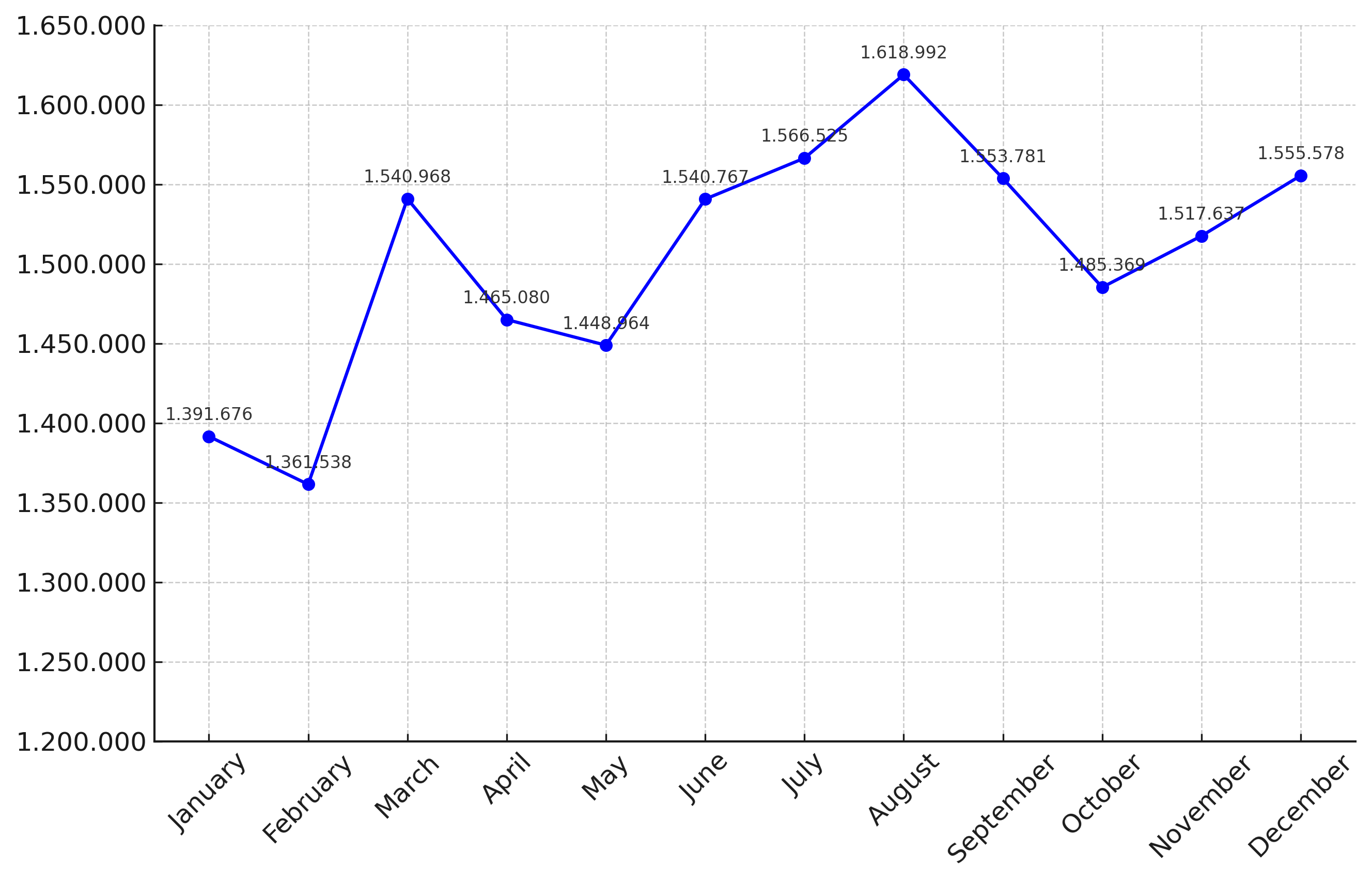
The first step in the methodological procedure consisted of collecting information on the production of plastic pipes. The data collected was then processed to statistically outline the manufacturing behavior of these goods, as shown in Table 1 and Figure 1.
Table 1. Monthly Variation in the Plastic Pipe Production Process
| Months | Shipping in Kg. | Variation % |
|---|---|---|
| January |
1.391.676 |
|
| February |
1.361.538 |
-2,17% |
| March |
1.540.968 |
13,18% |
| April |
1.465.080 |
-4,92% |
| May |
1.448.964 |
-1,10% |
| June |
1.540.767 |
6,34% |
| July |
1.566.525 |
1,67% |
| August |
1.618.992 |
3,35% |
| September |
1.553.781 |
-4,03% |
| October |
1.485.369 |
-4,40% |
| November |
1.517.637 |
2,17% |
| December |
1.555.578 |
2,50% |
| Total |
18.046.875 |
Note. Record provided by the plastic pipe manufacturing company.
The monthly production trend for plastic pipes has been uneven, peaking in August and declining in January. The following average daily production results in the grinding, extrusion, and injection molding areas are noteworthy:
Grinding:
Average daily production = Annual production x 1 Working days of the year No. Mills
Average daily production = 18.046.875 Kg. x 1 311 days 3 mills
Average daily production = 58.028 Kg/day = 58,03 Ton/day = 2,42 Ton/hour
Extrusion and injection:
Average daily production = Annual production x 1 Ton. x 1 Working days of the year 1.000 Kg. 15 machines
Average daily production = 18.046.875 Kg. x 1 Ton. x 1 311 days 1.000 Kg. 15 machines
Average daily production = 3,86 Ton/day
From these results, the Arena software is applied, using the Create, Decide and Hold buttons, as seen in the annexes section and when running the program, the following report is obtained in figure 2:

The report obtained from Crystal Report shows some specifications in detail, such as the average time required by the mills, which in this case are 3, to supply 3.13 tons per hour, which is required by the 30 injection molding machines and 15 extruders. Therefore, it would take approximately 72 to 80 minutes maximum. Therefore, if one of the mills is delayed, this should be at least 12 minutes per hour. In fact, when these delays occur, the machinery cannot carry out the process normally, thus creating a bottleneck. With the proposed addition of an additional mill to the existing three, the exercise varies. After operating with the Arena software (see appendixes), running this program, the following report is obtained in Figure 3:

This report shows that the lead time of the linked mills must be sufficient to meet the extruders and injection molding machines. Therefore, this should be reduced from approximately 72 to 56 minutes, with the maximum time being only 61 minutes per hour of production, although the increase in the mill makes it important to cover capacity. The results obtained allow the operator to analyze the delay time, which is a maximum of 2.22 minutes per hour from the mills and then moving to the extruder and injection molding machine. This contributes to a 10-minute reduction in the process. Indeed, it is highlighted that, through this computer system, the process can be improved, reducing production time from the mill machine to the extruders and injection molding machines, as shown in the following figure 4:
 >
>
Indeed, the execution of the three mills using the Sand system contributed to the identification of the number of machines, thereby optimizing the process. Therefore, the waiting time can be reduced to 20 minutes for three to four mills. These findings demonstrate the viability of the tool through the implementation of queuing theory, resulting in the following Table 2:
| Description |
With 15 extrusion machines, 30 injection machines and 3 mills |
With 20 extrusion machines, 30 injection machines and 4 mills |
|---|---|---|
| Minimum waiting time for products in the queque |
72 minutes |
56 minutes |
| Minimum waiting time for products in the queque |
80 minutes |
61 minutes |
| Tail length (Lq) |
0,55 |
0,16 |
| Service rate or wainting time (Wq) |
12 to 20 min. Waiting/every hour of production |
1 to 2,22 min. Waiting/every hour of production |
By applying the queuing theory model, it was found that the wait time for the material extraction and injection machine with the four mills in production was minimized from 12 minutes to 1 minute, which contributes to optimizing the production of these items. Therefore, by increasing the fourth mill in the production plant, this will contribute to reducing the time from 11 minutes to 17.6 minutes, eliminating the bottleneck, which until now has been considered a negative factor in the production of these pipes, increasing costs for the company. The results demonstrated that it was possible to optimize the production process in a plastic pipe manufacturing plant by increasing the number of mills to eliminate the restriction in the supply of material from the grinding area to the extrusion and injection areas. This data was obtained through the application of Arena software and the development of a simulation. In the production plant, a restriction in the manufacturing system was evident because the grinding area did not meet the supply required by the extrusion and injection machines. Therefore, the decision taken when simulating this manufacturing activity was to increase the number of mills from three to four to eliminate the existing bottleneck and optimally supply the next extrusion and injection sections, even increasing the company's installed capacity in the next five years to support projected growth in demand in that latter time. In addition, a reduction in the production process time was calculated from 72 to 56 minutes, also reducing the waiting time by 16 minutes (22%), with the suggestion of implementing one more mill in the grinding area, justifying this measure because these machines have more than 10 years of useful life and the execution of the maintenance of the existing ones will not be able to ensure compliance with the expected objective of balancing the production lines. A comparison of these findings with those obtained by Peña and Felizzola (2020) corroborates the contribution of simulation methods to optimal decision-making in a manufacturing plant, observing time reductions of 38.7% in the production process and production increases of 9.57%, as reported by the authors of this study. Also, in the study by Mendoza et al. (2022), results showed a 20% optimization of production, with a reduction in downtime and the elimination of constraints. Their problem-solving method used Arena software and product queue simulation. Another study, taken as a comparative reference in this section by López (2019), showed that the application of simulation mechanisms not only identified delays in order delivery and downtime in the production process, but also ensured a 15% to 20% increase in productivity in a plastics manufacturing plant. Furthermore, Bernal and Bernal (2021) indicated that, through simulation, scrap costs were minimized in a factory producing items made from plastic resin, thereby contributing to the application of sustainability principles in this industry. Similarly, Mares et al. (2024) demonstrated that the application of the Lean Manufacturing approach was decisive in integrating the results of industrial simulation into the production process, achieving significant productivity increases of over 10%. Given these results, Hernández et al. (2023) highlighted the need to enhance the use of simulation as a method to foster continuous improvement in industry and thus generate the expected economic development of the nation.
It was concluded that, with the addition of a mill, it was possible to adequately supply the extrusion and injection sections, even projecting an increase in the demand for plastic pipes in the company where the case was presented, with direct repercussions for this productive sector. This demonstrates the importance of the simulation method in the optimization of manufacturing systems, as well as its decisive contribution to decision-making that firmly contributes to improving the productivity and competitiveness of organizations belonging to the manufacturing area. In other words, it is necessary to apply methods that contribute to the elimination of restrictions in production systems and the improvement of business competitiveness. In this case, in the plastic pipe manufacturing sector, simulation techniques have become an essential tool in manufacturing organizations. Simulation techniques must be conveniently integrated into all areas of the production process to ensure successful decision-making in the supply, design, development, manufacturing, marketing, and after-sales service of the different products produced in these industries. Finally, the interest of industrial sector experts in welcoming the results of this research was expressed, as it demonstrates the optimization of production systems in a plastic pipe manufacturing plant. This situation can be adapted not only to this business context but also to any economic sector in the manufacturing sector. The use of simulation constitutes a mechanism that contributes to the economic development of this productive sector and has positive repercussions for the progress of the nation and for promoting technological development in Ecuador. Therefore, the projection of the future line is linked to the application of simulation in logistics areas, where products such as plastic pipes or other types of goods are shipped, in addition to potential cost savings and the value of conducting periodic simulations, considering limitations such as demand variability.
Bernal, J., & Bernal, M. (2021). La simulación como herramienta para la mejora en el uso de recursos empresariales: Caso pruebas destructivas de calidad. Ciencia y Tecnología, 15, 41–54.
Calle, S. (2023). Diseños de investigación cualitativa y cuantitativa. Ciencia Latina Revista Científica Multidisciplinar, 7(4), 1865–1879. https://doi.org/10.37811/cl_rcm.v7i4.7016
Castro, J., Bedoya, K., & Pino, A. (2020). La simulación como aporte para la enseñanza y el aprendizaje en épocas de COVID-19. Revista de Investigación Administración e Ingeniería, 8(S1), 1–15. https://doi.org/10.15649/2346030X.2475
Chica, J., Muñoz, C., Mera, M., Tuárez, G., & Macías, J. (2024). Optimización de la cadena de suministro en la agroindustria de servicio alimentario. G-nerando, 1(2), 458–485. https://revista.gnerando.org/revista/index.php/RCMG/article/view/282/255
Feria, H., Matilla, M., & Mantecón, S. (2020). La entrevista y encuesta: ¿Métodos o técnicas de indagación empírica? Didasc@lia: Didáctica y Educación, 11(3), 18. https://revistas.ult.edu.cu/index.php/didascalia/article/view/992
Guevara, G., Verdesoto, A., & Castro, N. (2020). Metodologías de investigación educativa: Descriptivas, experimentales, participativas y de investigación-acción. Recimundo, 4(3), 15. https://www.recimundo.com/index.php/es/article/view/860
Guzmán, J., & Hincapié, E. (2024). Gemelos digitales, metaverso y cognición mediada: Sistemas de captura para el desarrollo de ambientes digitales. Centro de Estudios en Diseño y Comunicación, 1(2), 217–236. https://dspace.palermo.edu/ojs/index.php/cdc/article/view/11297/19441
Hernández, L., Hernández, B., & Arroyo, C. (2023). Simulación y procesamiento de algunos materiales al momento de someterlos a análisis estático. PADI, 11(5), 83–87. https://doi.org/10.29057/icbi.v11iEspecial5.11838
Izurieta, C., Buenaño, S., & Rivera, M. (2024). El diseño industrial y la simulación como herramienta para mejorar los procesos. Polo del Conocimiento, 9(3), 695–706. https://www.polodelconocimiento.com/ojs/index.php/es/article/view/6674
Lira, I., Barrientos, F., & Arroyo, C. (2023). Simulación y procesamiento de algunos materiales al momento de someterlos a análisis estático. PADI Boletín Científico de Ciencias Básicas, 11(5), 83–87. https://doi.org/10.29057/icbi.v11iEspecial5.11838
López, A., Gonzalez, A., & Alcaraz, S. (2019). Simulación para la optimización de la producción de ejes en la línea de ensamblaje de una empresa de manufactura. Ingeniería, Investigación y Tecnología, 20(1), 1–9. https://doi.org/10.22201/fi.25940732e.2019.20n1.005
Mares, A., Guevara, J., Verdín, M., & Malacara, C. (2024). Evaluación de eficiencia en proceso de calzado por medio de simulación y análisis de métodos. Reaxion, 12(1), 1–10. http://reaxion.utleon.edu.mx/Art_Evaluacion_de_eficiencia_en_proceso_de_calzado_por_medio_de_simulacion_y_analisis_de_metodos.html
Mendoza, E., De La Asunción, A., Mejía, I., Triana, J., & Troncoso, A. (2022). Análisis de restricciones a través del software Arena: Caso empresa de fabricación de calzado. Boletín en Innovación, Logística y Operaciones (BILO), 4(1), 8–15. https://dialnet.unirioja.es/servlet/articulo?codigo=8931419
Moposita, K., Guillén, I., Herrera, H., Valencia, E., & Vélez, I. (2024). Una exploración bibliométrica del lean manufacturing: Tendencias actuales en la investigación. Arandu UTIC, 11(1), 420–437. https://doi.org/10.69639/arandu.v11i1.225
Mucha, L., Chamorro, R., Oseda, M., & Alania, R. (2021). Evaluación de procedimientos empleados para determinar la población y muestra en trabajos de investigación de posgrado. Revista Científica de Ciencias Sociales y Humanidades, 12(1), 15. https://doi.org/10.37711/desafios.2021.12.1.253
Peña, L., & Felizzola, H. (2020). Optimización de la capacidad de producción en una empresa de alimentos usando simulación de eventos discretos. Ingeniare. Revista Chilena de Ingeniería, 28(2).
Sandoval, E. (2022). El trabajo de campo en la investigación social en tiempos de pandemia. Espacio Abierto. Cuaderno Venezolano de Sociología, 31(3), 10–22. https://ve.scielo.org/scielo.php?script=sci_arttext&pid=S1315-00062022000300010
Vallejo, M., & Sarmiento, L. (2023). Estimación de las brechas de productividad en el Ecuador del sector de producción de madera y fabricación de productos de madera (2012–2021). INNOVA, 8(3.1), 152–172. https://doi.org/10.33890/innova.v8.n3.1.2023.2318
Ynzuza, C., Izar, J., Bocarando, J., Aguilar, F., & Larios, M. (2017). El entorno de la industria 4.0: Implicaciones y perspectivas futuras. Conciencia Tecnológica, 1(54), 1–15. https://www.redalyc.org/journal/944/94454631006/html/
Zarza, R. (2023). Simulación de eventos discretos desde la ingeniería industrial. Pädi, 10(20), 110–121. https://doi.org/10.29057/icbi.v10i20.10207