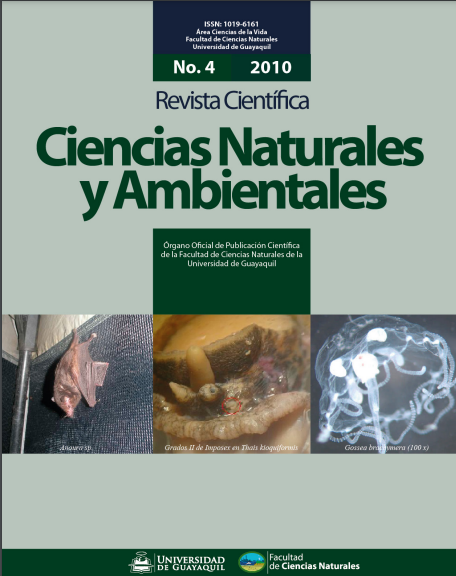
The Systematics and Ecology of jellyfish (cnidarians: Hydrozoa) in the South Coast area of Santa Elena Bay During the Period (October 2004 - October 2005)
DOI:
https://doi.org/10.53591/cna.v4i1.275Keywords:
Hydromedusae, diversity indices, population change, AbundanceAbstract
This study was conducted in the South area of St. Elena Bay from October 2004 to October 2005, Tewnty for species were identified, classified into six orders: five of the class Hydrozoa, with 16 families, 22 genera and 22 species, and 2 classes: Class Scyphozoa with a kind and class Cubozoa with 1 species. With a confidence interval of 95% there were few changes at the jelly fish distributiobn. At the rainy season, there was a positive correlation between the distribution of Jelly fish species (Euphysa aurata, Eucheilota nemoni y Solmundella bitentaculata, etc.) and temperature. While to the dry season temperature was negatively correlated (-0.77) with the general distribution of Jellyfish species (Eucheilota nemoni, Clytia hemisphaerica y Provoscidactyla ornata). A high diversity was reported to the dry season in October and September with 2.58 bits in the morning and, 2.71 bits at evening respectively. To the rainy season a maximum value was reported to January with 2.74 bits (morning), while in February with 2.72 bits. In August there was a value of uniformity of 0.92 bits (higest value at the afternoon) while June and September the average value was 0.90 bits. At the rainy season the highest values of uniformity were 0.89 bits and 0.87 bits to the morning and to the afternoof respectively.
Downloads
Published
Issue
Section
License
Esta obra está bajo una licencia Creative Commons: No comercial-Sin Derivadas- 4.0. Los autores mantienen los derechos sobre los artículos y por lo tanto son libres de compartir, copiar, distribuir, ejecutar y comunicar públicamente la obra.