
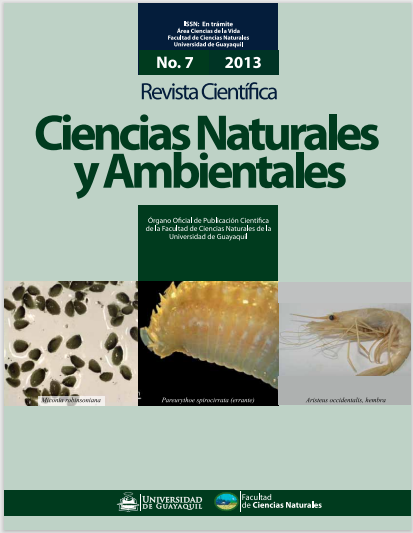
LOS CRUSTÁCEOS DECÁPODOS DE AGUAS PROFUNDAS DEL MAR ECUATORIANO
DOI:
https://doi.org/10.53591/cna.v7i1.205Palabras clave:
Dendrobranchiata, Pleocyemata, Talud continental, distribución vertical y horizontalResumen
Se analizaron 63 muestras de crustáceos decápodos, colectados entre las latitudes 1º18’N y 3º12’S, en el talud continental, entre 500 a 1500 metros de profundidad. Identificándose 44 especies ubicadas así: del Suborden Dendrobranchiata, Superfamilia Penaeoidea 4, del Suborden Pleocyemata están los infraórdenes: Caridea con 18 especies, Astacidea 1, Palinura 3, Anomura 11 y de Brachyura 7. Se elaboró una clave para las familias encontradas; así como, para las especies identificadas. El análisis de los resultados en relación al aspecto zoogeográficos encontramos: 5 especies de la subprovincia de Galápagos presentes en el talud continental como: Aristeus occidentalis, Munida hispida, Lithodes galapagensis, Rochinia cornuta y Tricopeltarium corallinus; dos especies consideradas restringidas para la provincia Perú- Chile como Glyphus marsupialis y Neolithodes diomedeae que amplían su distribución al Golfo de Guayaquil. En relación a las especies de alto potencial económico se encuentran los camarones: Haliporoides diomedeae, Nematocarcinus agassizii, Benthesicymus tanneri y Heterocarpus hostilis, otro de los grupos importantes tanto desde el punto vista alimenticio como económico son los cangrejos litodides como Neolithodes diomedeae, Paralomis papillata y Paralomis otsuae que soportan una pesquería en los países del cono sur. Debido a estos aspectos se recomienda que se continué con este tipo de estudio para conocer nuestra fauna, realizar estudio biológico de las especies para saber si pueden soportar una extracción sin afectar a las poblaciones que por siglos se encuentra en esta área.
Publicado
Número
Sección
Licencia
Esta obra está bajo una licencia Creative Commons: No comercial-Sin Derivadas- 4.0. Los autores mantienen los derechos sobre los artículos y por lo tanto son libres de compartir, copiar, distribuir, ejecutar y comunicar públicamente la obra.