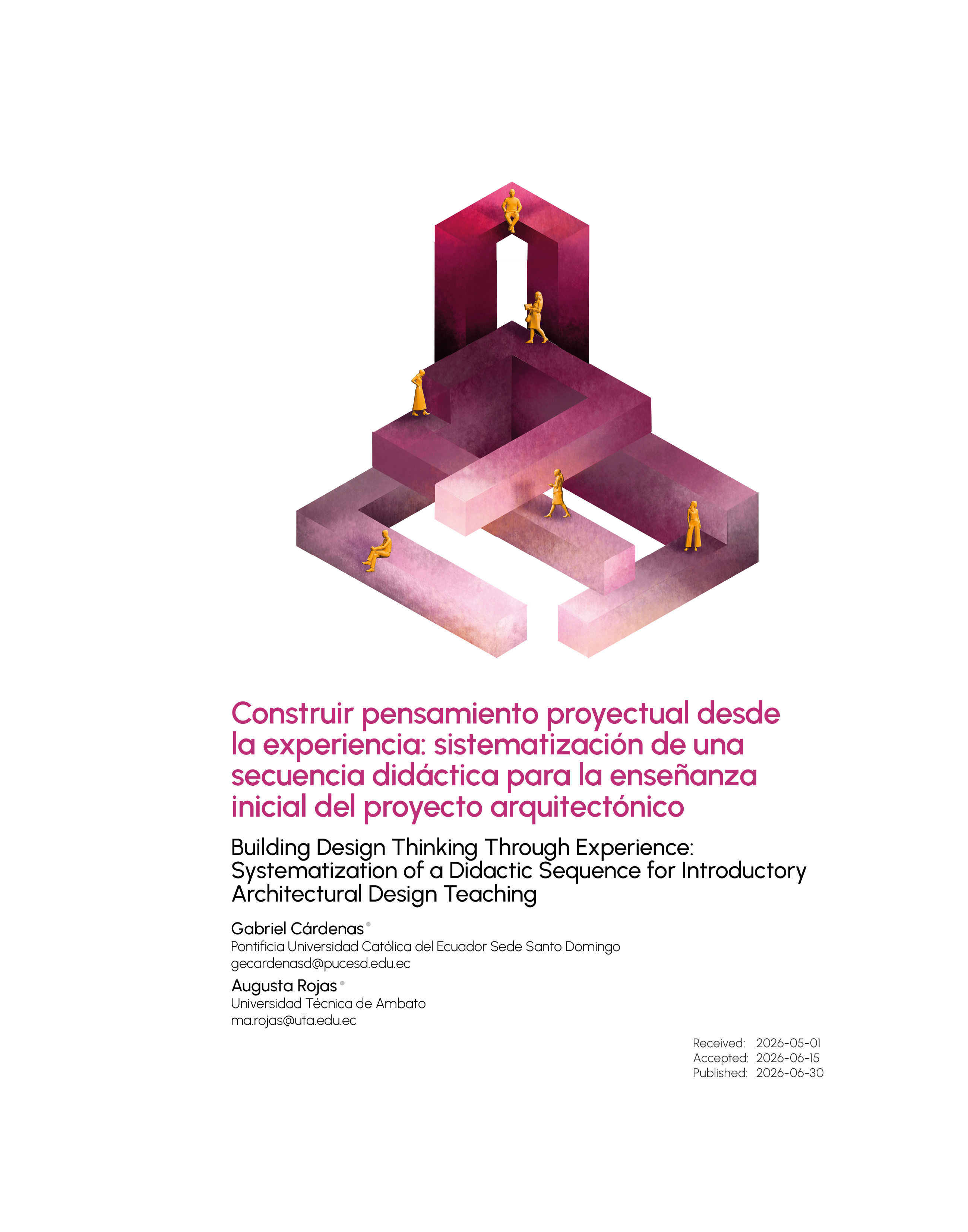
Building Design Thinking Through Experience:Systematization of a Didactic Sequence for IntroductoryArchitectural Design Teaching
DOI:
https://doi.org/10.53591/hxg2ez42Keywords:
design thinking, architectural education, design pedagogy, experiential learning, architectural designAbstract
Introductory architectural design education requires teaching strategies that foster the development of design thinking from the earliest stages of architectural training. This study systematizes a didactic sequence implemented with first-semester Architecture students through three progressive stages: observation (Three Perspectives), interpretation (Folds), and experimentation (Chalk Laboratory). The research is based on the systematization of teaching experience and adopts a qualitative approach, using students’ physical models, photographic records, and oral presentations of their work as the primary sources of analysis. The findings reveal progression from descriptive representations to well-founded volumetric compositions. The proposed methodological sequence constitutes a transferable pedagogical strategy for developing design thinking in the early stages of architectural education.
References
Blázquez Jesús, P. (2019). Laboratorio de tizas: forma “abierta” y pedagogía experimental. Antonio Juárez Chicote (Ed.). BAc Boletín Académico. Revista de investigación y arquitectura contemporánea, 9, 167–168. https://doi.org/10.17979/bac.2019.9.0.3591
De Souza, P. (2017). El pliegue en la arquitectura [Universidad Politécnica de Madrid]. https://doi.org/10.20868/UPM.thesis.47994
De Souza Sánchez, P. M. (2021). Taller vertical y metodología ABP en la realización de proyectos de arquitectura cinética e interactiva con patrones de pliegue estructurales. En: INNOVACIÓN DOCENTE E INVESTIGACIÓN EN CIENCIAS, INGENIERÍA Y ARQUITECTURA: NUEVOS ENFOQUES EN LA METODOLOGÍA DOCENTE.
Guerri, C. F., & Huff, W. S. (2019). LA ENSEÑANZA DEL DISEÑO BÁSICO EN LA BAUHAUS. Ene.
Hejduk, J. (1999). The nine square problem. In Education of an architect: A point of view. The Cooper Union School of Art & Architecture 1964-1971. The Monacelli Press., 23–38.
Juárez Chicote, A., Fernández Rodríguez, A., & Blanco Herrero, A. (2015). Dimensiones Pedagógicas del Laboratorio de Tizas de Jorge Oteiza. Actas publicadas del I Congreso Internacional Critic All | Actas publicadas del I Congreso Internacional Critic All | 2015 | Madrid.
Kolb, D. (1984). Experiential learning. Experience as the Source of Learning and Development, 41.
Koolhaas, R. (1978). Delirious New York: a retroactive manifesto for Manhattan. Oxford University Press.
Morán, R. G., Ferri, S. B., & Schuster, A. (2015). La maqueta como herramienta de diseño experiencias realizadas en la cátedra construcción de edificios II.
Schön, D. A. (1983). The reflective practitioner: How professionals think in action. Basic Books.
Schön, D. A. (1987). Educating the reflective practitioner.
Ventura Blanch, F. (2021). Consideraciones críticas del fenómeno delirante inicial en el Método Paranoico Crítico de Salvador Dalí y el edificio CCTV de Rem Koolhaas. Boletín de Arte, (42), 201–212. https://doi.org/10.24310/BoLArte.2021.vi42.7978
Downloads
Published
Issue
Section
License
Copyright (c) 2026 Gabriel Cárdenas, Augusta Rojas

This work is licensed under a Creative Commons Attribution-NonCommercial-NoDerivatives 4.0 International License.