1José Geovanny Boza-Mendoza
Universidad de Guayaquil
https://orcid.org/0000-0001-8797-0162
Ecuador, Guayaquil
1Bachelor's degree in Physical Culture from the University of Guayaquil (Ecuador) with 10 years of work experience. Master's in Physical Education and Sports from the University of Guayaquil (Ecuador); Doctoral candidate in Physical Education, CECEIC, (Mexico).
Date of receipt: 01-04-2026
Date of acceptance: 01-06-2026
Publication date: 01-07-2026

The works published in STAR are licensed under CC BY-NC-ND 4.0
DOI: https://doi.org/10.53591/star.v1i2.3422
Abstract
Introduction: Aerobic capacity is a crucial physical fitness component in youth football, as it influences the maintenance of performance during the game and the sustained execution of technical-tactical actions. In this sense, the creation of evidence-based training programs is essential to maximise the physical development of football players in formative ages.
Objective: To evaluate the functionality of a comprehensive training program for the development of aerobic endurance in U-14 football players at the German School Humboldt Samborondón campus.
Methodology: A study was conducted with a quantitative approach and a non-randomized experimental design. The sample consisted of 22 under-14 category football players. Aerobic endurance was evaluated before and after the intervention using the Cooper and Course Navette tests. Given the non-normality of the data, the Wilcoxon signed-rank test was used to determine the differences between the measurements.
Results: The analyses showed statistically significant improvements in the participants' aerobic endurance. The p-values obtained for the Cooper test and the Course Navette test were 0.006 and 0.004 respectively, both below the established significance level (p < 0.05), which confirms the positive effect of the comprehensive training program.
Conclusions: The comprehensive training program proved to be effective in improving aerobic endurance in under-14 football players, constituting a relevant methodological strategy to enhance physical preparation in youth football.
Keywords: Adolescence; sports training; developmental soccer; physical endurance; sports performance.
Resumen
Introducción: La capacidad aeróbica es una aptitud física determinante en el fútbol de formación, ya que influye en el mantenimiento del rendimiento durante el juego y en la ejecución sostenida de acciones técnico-tácticas. En este sentido, la creación de programas de entrenamiento basados en evidencia es fundamental para maximizar el desarrollo físico de los futbolistas en edades formativas.
Objetivo: Evaluar la funcionalidad de un programa de entrenamiento integral para el desarrollo de la resistencia aeróbica en futbolistas sub-14 del Colegio Alemán Humboldt sede Samborondón.
Metodología: Se elaboró un estudio con enfoque cuantitativo y diseño experimental no aleatorizado. La muestra estuvo conformada por 22 futbolistas de la categoría sub-14. Se evaluó la resistencia aeróbica antes y después de la intervención mediante los test de Cooper y Course Navette. Ante la no normalidad de los datos se empleó la prueba de rangos con signo de Wilcoxon para determinar las diferencias entre las mediciones.
Resultados: Los análisis mostraron mejoras estadísticamente significativas en la resistencia aeróbica de los participantes. Los valores de p obtenidos para el test de Cooper y para el test de Course Navette fueron de 0,006 y 0,004 respectivamente, ambos por debajo del nivel de significancia establecido (p < 0,05), lo cual confirma el efecto positivo del programa de entrenamiento integral.
Conclusiones: El programa de entrenamiento integral demostró ser eficaz para mejorar la resistencia aeróbica en futbolistas sub-14, constituyéndose en una estrategia metodológica pertinente para reforzar la preparación física en el fútbol formativo.
Palabras clave: Adolescencia; entrenamiento deportivo; fútbol formativo; resistencia física; rendimiento deportivo.
Introduction
The increase in endurance in young footballers is a topic of great research importance, due to its impact on overall performance and injury prevention. At the international level, it has been proven that adequate aerobic capacity is crucial for maintaining optimal performance throughout the match and for allowing effective recovery between training sessions and competitions (Diker et al., 2021; Bahtra et al., 2024). Footballers with good aerobic capacity tend to experience less fatigue and a lower incidence of injuries, allowing them to maintain a high level of performance throughout the season (Pulido et al., 2022).
Despite this evidence, much of the research focuses on professional adult footballers, leaving a significant gap in the training of aerobic endurance in young footballers. This gap is crucial, as the adolescent stage shows a very significant physical-technical growth in which proper training can have a lasting impact on their future performance. (López-Revelo & Cuaspa-Burgos, 2018) Recent research highlights the need to design training programs that consider not only the development of aerobic endurance but also fundamental technical and tactical elements for the holistic growth of young footballers (Rivera et al., 2022).
In Latin America, there are several problems for the development of young footballers. Young athletes see their performance negatively affected by limitations in sports infrastructure, adverse weather conditions, and disparities in the quality of training (Velázquez-Naranjo et al., 2020). Although soccer is a very popular sport in the region, the implementation of science-based training proposals tailored to the specific needs of young players is often limited by these factors (Castro et al., 2023). The absence of specific local research on the characteristics and needs of youth footballers highlights the urgency of generating interventions adapted to the sociocultural and physical context of Latin America (Almeida, 2022).
In Ecuador, the situation is similar. The infrastructure and resources to train young footballers are often scarce, which limits the clubs' ability to offer evidence-based training programs (Quelal-Paredes & Bravo-Navarro, 2024). Although football is one of the most popular sports in Ecuador, the lack of materials and specialized professionals hinders the comprehensive development of young athletes. This gap between research and the application of effective training methods highlights the need to develop models adapted to local conditions (Rivera, 2023).
The German School Humboldt Samborondón faces the challenge and opportunity to design and implement a comprehensive training program that addresses these deficiencies. A program is sought that improves aerobic endurance, but also includes technical and tactical components, essential for the development of under-14 football players. This work aims to fill a significant gap in the literature by presenting a model tailored to the Ecuadorian reality, which can serve as a reference to be replicated in similar contexts.
The motivation for conducting this research arises from the limited number of specific studies on aerobic endurance training in youth football players in Latin America, and particularly in Ecuador. There are studies on training for adult footballers, but little research has been conducted on the development of endurance in sub-14 athletes (Ayala-Obando et al., 2021; Mero & Zambrano, 2023). This phase of development is crucial for young footballers, who need interventions tailored to their specific needs in terms of training intensity and the combination of physical and technical-tactical exercises. The present study, in addition to aiming to fill this gap, aims to propose a replicable model that can serve as a guide for other analogous situations.
The study methodology includes an initial assessment of the athletes' physical condition, the planning of progressive training sessions, and evaluation thru standardized tests of endurance and performance in real game situations. The proposed program includes specific endurance exercises, high-intensity interval training (HIIT) sessions, and playful activities that promote physical development, team cohesion, and psychological motivation. The most recent studies state that this methodology not only improves physical endurance but also the ability to make decisions under pressure and maintain a high level of concentration on the field (Hincapié et al., 2022; Erazo et al., 2022), which supports this approach to structured and well-planned programs.
The study will be conducted over a 12-week training cycle, which will allow for a thorough evaluation of the program's impact on the performance of the under-14 football players at the German School Humboldt Samborondón campus. The aim is for the young athletes to have a positive attitude toward training thru the inclusion of a playful component, essential for sustained development and enjoyment of the sport.
The expected results offer a comprehensive view of the physical improvements achieved and will validate the importance of a holistic approach in the training of young footballers. The application of this model in other contexts could help training programs adapt to local realities, which in turn will contribute to the development of young footballers worldwide. The objective set was to evaluate the functionality of a comprehensive training program for the development of aerobic endurance in under-14 football players at the German School Humboldt Samborondón branch, to improve their physical, technical, and tactical performance on the field.
Method
The research was conducted using a quantitative approach, as it allowed for the objective measurement of the changes produced by the intervention thru numerical indicators and inferential statistical procedures. This approach allows for hypothesis testing and determining the extent to which a training program affects physiological variables related to sports performance (Hernández-Sampieri & Mendoza, 2018).
A pre-experimental design with a single group and pre-intervention (pretest) and post-intervention (posttest) measurements was used. This design allowed for the evaluation of changes in aerobic endurance due to the comprehensive training program, comparing the performance of the same participants at two evaluation points (Campbell & Stanley, 1963). The intervention was carried out during the team's usual training period, respecting the sports planning established by the institution.
Variables
The elements evaluated in the study were aimed at establishing the behavior of aerobic endurance in under-14 category footballers, both before and after implementing the comprehensive training program. This physical skill is an essential element of performance in football because it facilitates recovery between intense actions, enables maintaining effective physical performance throughout the game, and allows sustaining prolonged efforts.
The evaluation was conducted on two indicators of aerobic endurance: the ability to sustain a constant effort over a specific period and the capacity to endure intermittent efforts with increasing intensity. To determine the changes that occurred after the intervention and to evaluate the effectiveness of the comprehensive training program in developing the participants' aerobic endurance, both indicators were documented during two measurement periods: the pretest and the posttest.
Participants
The population consisted of the 22 players of the under-14 category of the German School Humboldt team, Samborondón branch, during the sports season corresponding to the research period. Since the population was small and fully accessible, a population census was conducted, incorporating all the athletes, so sampling techniques were not required.
The inclusion criteria were the players officially registered in the under-14 category, who regularly attended training sessions, participated in all program sessions, and completed the initial and final assessments. Athletes with musculoskeletal injuries, diseases that limited sports practice, or absences during the intervention process were excluded.
The research was conducted respecting the ethical principles for research on human beings established in the Declaration of Helsinki. Participation was voluntary, informed consent was obtained from the legal representatives, and the corresponding institutional authorization was secured.
Procedure
A diagnostic evaluation of aerobic endurance was conducted using the Cooper Test and the Course-Navette Test. Then, a comprehensive training program was implemented, designed to improve aerobic endurance thru continuous exercises, interval training, and small-sided games with a ball, combining physical and technical-tactical components specific to football training. In the development of the program, the methodological principles of sports training were taken into account, such as the gradual progression of loads, the specificity of effort, and recovery times.
At the end of the intervention, a post-test evaluation was conducted using the same instruments and under similar conditions of space, schedule, sports surface, and technical supervision, with the intention of reducing possible biases arising from the measurement procedure.
Comprehensive training program
The intervention was carried out with a comprehensive training program that lasted three months (12 weeks) and was aimed at under-14 football players from the German School Humboldt, at the Samborondón campus. The program was conducted three times a week, totaling 36 training sessions, each lasting approximately between 75 and 90 minutes. Each session was divided into three phases: warm-up (15 to 20 minutes), main phase (50 to 60 minutes), and cool-down (10 to 15 minutes). The planning of the loads was done gradually, increasing the volume and intensity of the training based on the athletes' physiological adaptation to avoid drastic changes that could impair performance or increase the risk of injuries.
The functional adaptation phase was carried out during the first four weeks with the purpose of forming an aerobic base. Moderate-intensity continuous runs, lasting 15 to 25 minutes, were employed during this period. These were combined with extensive interval training, which includes repetitions of running at a medium-high intensity for 30 seconds and jogging to recover for one minute afterward; each session consisted of between 8 and 10 repetitions. Simultaneously, bodybuilding circuits were carried out thru five stations, which included zigzag paths between cones, coordinated jumps over agility ladders, ball handling between obstacles, and sit-ups and push-ups. Each station lasted two minutes, with 30 seconds of transition between exercises and two minutes of recovery at the end of each round, totaling three circuits per session. Additionally, small-sided games of 4 against 4 and 5 against 5 were incorporated for a period of 10 to 15 minutes, which fostered the concurrent development of aerobic endurance and decision-making ability in real game contexts.
The training load progressively increased between the fifth and eighth week, thru more intense interval exercises. The intervals were carried out with 45 seconds of running followed by another 45 seconds of active recovery, doing between ten and twelve repetitions; continuous runs increased to twenty-five or thirty minutes. To ensure the quality of the work, acceleration and deceleration exercises were carried out with 10, 15, and 20-meter sprints, with between 8 and 12 repetitions each, allowing for a full recovery between each effort. Additionally, 40-meter uphill sprints were performed, with 6 to 8 repetitions and two minutes of rest between each repetition. The physical circuits extended their duration to three minutes per station, maintaining the alternation of technical exercises with the ball, functional strength, coordination, and endurance. Reduced matches of 5 against 5 and 6 against 6 were carried out in this stage, gradually increasing the effective playing time to 20 minutes to simulate the physiological demands of the tournament.
In the last four weeks, the maximum load was reached according to the program, prioritizing the specific development of aerobic endurance thru tasks involving the use of the ball. High-intensity interval training sessions were conducted, which included one-minute efforts alternated with 30 seconds of active recovery, until completing between 10 and 12 repetitions. The functional circuits included ball control exercises, accelerations, changes of direction, passing on the move, and finishing at the goal. They were carried out for four complete laps, with two-minute recovery intervals between each circuit. On the other hand, the continuous runs were extended to a maximum of 35 minutes. The small-sided games are being conducted in 7-a-side formats, with larger playing spaces and effective times ranging from 25 to 30 minutes, which stimulates high motor participation and greater cardiovascular demand. Additionally, group tasks were carried out, including competitive relays, races with opposition, and mixed defensive and offensive exercises, incorporating strategic and technical movements under fatigue conditions similar to those experienced in official competition.
The physical load was regulated by controlling the volume, intensity, density, and recovery periods. The volume was gradually increased by extending the effective work time and the repetitions. The intensity was controlled thru the speed of execution, the reduction of recovery periods, and the increase in the complexity of the activities. The density was modified by altering the relationship between the time spent exerting effort and the time taken for a break, without changing the frequency with three sessions per week throughout the total intervention period. Thanks to the methodological progression, the football players were able to develop neuromuscular and cardiovascular adaptations gradually. In this way, a systematic improvement of aerobic endurance was ensured without compromising the technical quality of specific football actions.
Instruments
Aerobic endurance was evaluated with two widely used and validated field tests in the field of sports training. The Cooper Test (Cooper, 1968) consists of running the longest possible distance during 12 minutes of continuous running, which allows for an indirect estimation of maximum aerobic capacity and maximum oxygen consumption (VO₂max). It is widely used in sports settings due to its simplicity, cost-effectiveness, and adequate validity for assessing aerobic fitness.
The 20-meter Shuttle Run Test, developed by Léger et al. (1988), was also used, which evaluates aerobic endurance thru continuous movements between two lines separated by 20 meters, synchronized with acoustic signals that progressively increase in speed. This test is highly valid in intermittent sports like football, as it better reproduces the physiological demands typical of competition. The two instruments have shown adequate levels of validity and reliability in samples of young athletes, so it was not necessary to estimate additional internal consistency indices.
Data analysis
IBM SPSS Statistics software (version 29.0) was used to perform the statistical processing. To begin with, a descriptive analysis of the variables was conducted, calculating frequencies, mean, median, standard deviation, minimum and maximum values, in order to characterize the behavior of aerobic endurance before and after the intervention.
Subsequently, the assumption of normality was tested using the Shapiro-Wilk test, recommended for samples with fewer than 50 participants. The results showed a non-normal distribution of the data (p < 0.05); therefore, the non-parametric Wilcoxon signed-rank test was used to compare the pretest and posttest measurements within the same sample. A statistical significance level of α = 0.05 was established.
Results
Table 1. Results obtained in the Cooper Test
|
Pretest |
Posttest |
Difference |
Improvement (%) |
|
|
1 |
2800 |
3115 |
+315 |
+11.25% |
|
2 |
2650 |
2850 |
+200 |
+7.55% |
|
3 |
2900 |
3100 |
+200 |
+6.90% |
|
4 |
2750 |
3065 |
+315 |
+11.45% |
|
5 |
2600 |
2830 |
+230 |
+8.85% |
|
6 |
2700 |
3015 |
+315 |
+11.67% |
|
7 |
2500 |
2800 |
+300 |
+12.00% |
|
8 |
2950 |
3270 |
+320 |
+10.84% |
|
9 |
2750 |
3060 |
+310 |
+11.27% |
|
10 |
2600 |
2800 |
+200 |
+7.69% |
|
11 |
2900 |
3110 |
+210 |
+7.24% |
|
12 |
2700 |
2950 |
+250 |
+9.26% |
|
13 |
2650 |
2900 |
+250 |
+9.43% |
|
14 |
2750 |
3040 |
+290 |
+10.55% |
|
15 |
2800 |
3100 |
+300 |
+10.71% |
|
16 |
2650 |
2900 |
+250 |
+9.43% |
|
17 |
2900 |
3250 |
+350 |
+12.07% |
|
18 |
2750 |
3050 |
+300 |
+10.91% |
|
19 |
2600 |
2850 |
+250 |
+9.62% |
|
20 |
2950 |
3200 |
+250 |
+8.47% |
|
21 |
2700 |
2950 |
+250 |
+9.26% |
|
22 |
2650 |
2850 |
+200 |
+7.55% |
Source: SPSS version 29.0.
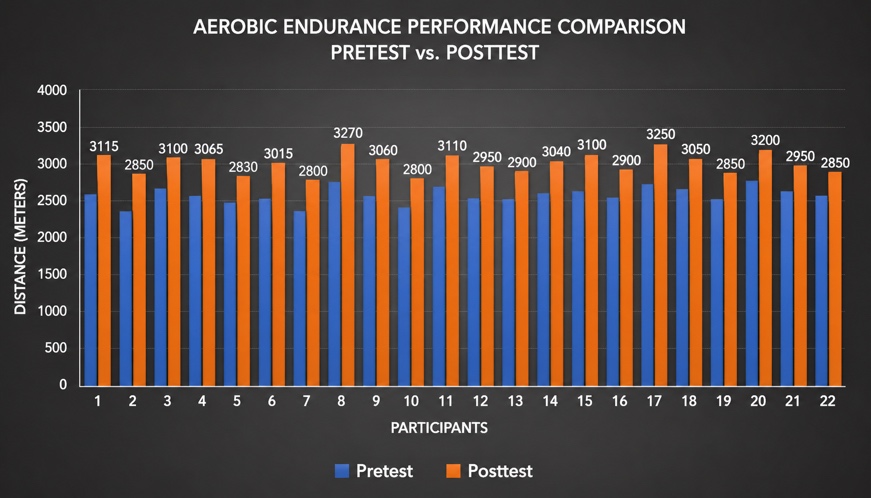
The results obtained in the Cooper Test show a significant improvement in the aerobic capacity of the football players after the intervention, with notable increases in the distance covered in the post-test. The average improvement was 9.79%, with individual differences ranging from 6.90% to 12.07%. The player who achieved the greatest progress (12.07%) increased her distance by 350 meters, while the minimum improvement was 200 meters, which represents 6.90%. These results reflect a positive evolution in the athletes' physical endurance, highlighting an increase in cardiovascular performance capacity as a consequence of the applied training program. This progress suggests an optimization of the athletes' aerobic system, which is essential for maintaining optimal performance in a high-intensity sport like football. The homogeneity in the distribution of improvements indicates the effectiveness of the training protocol and its proper adaptation to individual capabilities.
Graph 1. Results obtained in the Cooper Test
Source: Own creation.
Table 2. Descriptive statistics of the Cooper Test
|
Measure |
Pretest |
Posttest
|
|
Minimum |
2500 |
2800 |
|
Maximum |
2950 |
3270 |
|
Mean |
2700 |
3015 |
|
Mode |
2750 |
3050 |
|
Standard Deviation |
120.50 |
135.65 |
Source: SPSS version 29.0.
There is a general increase in the physical performance of the football players after the intervention, reflected in the increase of the minimum value from 2500 to 2800 meters and the maximum value from 2950 to 3270 meters. The average distance covered also increased, rising from 2700 to 3015 meters, indicating an average improvement of 315 meters in aerobic capacity. Although the standard deviation slightly increased from 120.50 to 135.65 meters, suggesting greater variability in the post-test results, the increase in the mode from 2750 to 3050 meters reinforces the consistency of the observed improvements.
Table 3. Shapiro-Wilk Normality Test of the Cooper Test
|
Condition |
W Statistic |
p- value |
N |
|
Pretest |
0.887 |
0.015 |
22 |
|
Posttest |
0.891 |
0.018 |
22 |
Source: SPSS version 29.0.
Given that the results of the Shapiro-Wilk normality test for the pretest (W = 0.887, p = 0.015) and the posttest (W = 0.891, p = 0.018) present p-values less than 0.05, it is concluded that the data do not follow a normal distribution. This prevents the use of parametric tests such as the Student's t-test, which require this assumption. Therefore, it was decided to use the Wilcoxon signed-rank test, a non-parametric technique suitable for comparing related samples, which does not depend on the normality of the data, thus ensuring a more rigorous and appropriate analysis.
Table 4. Wilcoxon Signed-Rank Test of the Cooper Test
|
Rank Type |
Number of Cases (N) |
Sum of Ranks |
Media de Rangos |
|
Positives |
15 |
345.00 |
23.00 |
|
Negatives |
5 |
56.00 |
11.20 |
|
Draws |
2 |
- |
- |
|
Total |
22 |
- |
- |
Source: SPSS version 29.0.
Table 5. Test Statistic of the Cooper Test
|
Statistic |
Calculated Value |
Bilateral Significance Level (p-value) |
|
W Statistic |
56.00 |
- |
|
Z Statistic |
-2.75 |
0.006 |
|
Significance Level |
- |
0.006 |
Source: SPSS version 29.0.
The analysis of the Wilcoxon signed-rank test reveals that, out of the 22 evaluated football players, 15 showed an improvement in the distance covered in the Cooper test (positive ranks), while 5 experienced a decrease (negative ranks) and 2 maintained their performance unchanged. The sum of the positive ranks was 345.00, with a mean of 23.00, significantly higher than the sum of the negative ranks (56.00) with a mean of 11.20. The W statistic of 56.00 and the Z value of -2.75, along with a p-value of 0.006, indicate a statistically significant difference in performance between the pretest and the posttest. These results confirm that the comprehensive training program significantly impacts the development of aerobic endurance in the under-14 soccer players of the German School Humboldt of Samborondón.
Table 6. Results obtained in the Course-Navette Test
|
Soccer players |
Pretest (levels) |
Posttest (levels) |
Difference (levels) |
Improvement (%) |
|
1 |
8.5 |
10.0 |
+1.5 |
+17.65% |
|
2 |
7.0 |
8.5 |
+1.5 |
+21.43% |
|
3 |
9.0 |
10.5 |
+1.5 |
+16.67% |
|
4 |
8.0 |
9.5 |
+1.5 |
+18.75% |
|
5 |
7.5 |
9.0 |
+1.5 |
+20.00% |
|
6 |
8.0 |
10.0 |
+2.0 |
+25.00% |
|
7 |
6.5 |
8.0 |
+1.5 |
+23.08% |
|
8 |
9.0 |
11.0 |
+2.0 |
+22.22% |
|
9 |
8.0 |
9.5 |
+1.5 |
+18.75% |
|
10 |
7.5 |
9.0 |
+1.5 |
+20.00% |
|
11 |
9.0 |
10.0 |
+1.0 |
+11.11% |
|
12 |
8.0 |
9.5 |
+1.5 |
+18.75% |
|
13 |
7.0 |
8.5 |
+1.5 |
+21.43% |
|
14 |
8.0 |
10.0 |
+2.0 |
+25.00% |
|
15 |
7.5 |
9.0 |
+1.5 |
+20.00% |
|
16 |
8.0 |
9.5 |
+1.5 |
+18.75% |
|
17 |
9.0 |
11.0 |
+2.0 |
+22.22% |
|
18 |
8.0 |
10.0 |
+2.0 |
+25.00% |
|
19 |
7.0 |
8.5 |
+1.5 |
+21.43% |
|
20 |
9.0 |
10.5 |
+1.5 |
+16.67% |
|
21 |
8.0 |
9.5 |
+1.5 |
+18.75% |
|
22 |
7.5 |
9.0 |
+1.5 |
+20.00% |
Source: SPSS version 29.0.
Graph 2. Results obtained in the Course-Navette Test.

Source: Own creation.
The results obtained in the Course-Navette Test show that all the evaluated under-14 football players improved their levels after the intervention of the training program. The improvement in levels varied between +1.0 and +2.0 levels, with percentage increases ranging from 11.11% to 25.00%. The footballers with the greatest progress achieved an increase of two levels, while the 1.5 level increases were the most common. These results reflect an overall improvement in the participants' aerobic capacity, with a positive impact of the program on the development of aerobic endurance, which is essential for their performance on the field.
Table 7. Descriptive statistics of the Course-Navette Test.
|
Measure |
Pretest |
Posttest
|
|
Minimum |
6.5 |
8.0 |
|
Maximum |
9.0 |
11.0 |
|
Mean |
7.85 |
9.40 |
|
Mode |
8.0 |
9.5 |
|
Standard Deviation |
0.75 |
0.85 |
Source: SPSS version 29.0.
In the pretest, the aerobic endurance levels of the football players range from a minimum of 6.5 to a maximum of 9.0 levels, with an average of 7.85 levels and a standard deviation of 0.75. In the post-test, the minimum and maximum values increased to 8.0 and 11.0 levels, respectively, with an average of 9.40 levels and a standard deviation of 0.85. These results indicate a significant improvement in aerobic capacity, reflecting a widespread trend toward higher performance levels in the post-test.
Table 8. Shapiro-Wilk Normality Test of the Course-Navette Test
|
Condition |
W Statistic |
p-value |
N |
|
Pretest |
0.912 |
0.042 |
22 |
|
Posttest |
0.898 |
0.025 |
22 |
Source: SPSS version 29.0.
The results of the Shapiro-Wilk normality test for the Course-Navette Test show W statistics of 0.912 (p = 0.042) for the pretest and 0.898 (p = 0.025) for the posttest. These values indicate that the data do not follow a normal distribution in any of the evaluated conditions. Since the normality of the data is not met, the non-parametric Wilcoxon Signed-Rank test was chosen. This choice is appropriate for comparing the differences between pretest and posttest levels in the Course-Navette Test, as the Wilcoxon test does not require the assumption of normality and allows for the evaluation of whether the observed differences are statistically significant.
Table 9. Wilcoxon Signed-Rank Test for the Course-Navette Test.
|
Rank Type |
Number of Cases (N) |
Sum of Ranks |
Mean of Ranks |
|
Positives |
18 |
369.00 |
20.50 |
|
Negatives |
4 |
40.00 |
10.00 |
|
Draws |
0 |
- |
- |
|
Total |
22 |
- |
- |
Source: SPSS version 29.0.
Table 10. Test statistics of the Course-Navette Test.
|
Statistic |
Calculated Value |
Bilateral Significance Level (p-value) |
|
W Statistic |
40.00 |
- |
|
Z Statistic |
-2.85 |
0.004 |
|
Significance Level |
- |
0.004 |
Source: SPSS version 29.0.
In the results of the non-parametric Wilcoxon Signed-Rank Test for the Course-Navette Test, it is observed that out of the 22 evaluations, 18 showed positive ranks with a sum of ranks of 369.00 and an average rank of 20.50. Only 4 cases resulted in negative ranks, with a sum of ranks of 40.00 and an average rank of 10.00. No ties were recorded. These data indicate a general trend toward improvement in the performance of the football players after the training program. In Table 10, the calculated value of the W statistic is 40.00 and the Z statistic is -2.85, with a p-value of 0.004. This p-value below the threshold of 0.05 confirms that the difference in the levels of the Course-Navette Test between the pretest and the posttest is statistically significant. Therefore, these results support the conclusion that the comprehensive training program has had a positive and significant impact on the aerobic endurance of the under-14 football players.
Discussion
The aerobic capacity of the 14-year-old footballers showed a remarkable improvement after the designed training program was applied, according to the results obtained in this study. The effectiveness of the intervention proposal, aimed at improving the cardiovascular endurance of the football players, is corroborated by the data obtained in the pedagogical tests used.
In the Cooper Test, an increase in the average distance of 315 meters was recorded, which corresponds to a 9.79% improvement compared to the pretest. This increase is particularly relevant because it exceeds the 5% benchmark, which is considered clinically significant in sports studies (Norton et al., 2020). This finding aligns with what Almeida (2022) discovered, who also observed notable improvements in the aerobic endurance of young football players after implementing a specific physical training model. The highest individual progress of 12.07% found in this research indicates that some female football players benefited even more from the program; this is a reflection of a positive reaction to the intervention.
The Course-Navette Test, which measures VO2max thru progressive increases in running speed, showed an increase in the levels achieved, with rises ranging from 1.0 to 2.0 levels, which means a percentage improvement of between 11.11% and 25.00%. These conclusions are consistent with those of Rivera (2023), who also detected similar progress in aerobic capacity after following a similar training program. The average levels obtained in the post-test were 9.40 levels, above the average of the pre-test which was 7.85 levels; this shows a significant improvement in the overall aerobic capacity of the participants.
Anomalies have been found in the data of research on aerobic endurance in parallel studies such as that of Velázquez-Naranjo et al. (2020). Therefore, the selection of the non-parametric test for the analysis was appropriate, as it allowed for the obtaining of results that have statistical relevance.
Significant differences were found between the pretest and posttest measurement values for both tests, as indicated by the Wilcoxon signed-rank test; a p-value of 0.006 was obtained for the Cooper test and a p-value of 0.004 for the Course-Navette test. These findings support the idea that the training program achieved a significant increase in the athletes' VO2max. The number of footballers with positive ranges was high, with 15 out of 22 for the Cooper Test and 18 out of 22 for the Course-Navette Test. This confirms the effectiveness of the program in continuously increasing the aerobic endurance among the participants.
These findings highlight the importance of having a systematic and structured method in the physical training of young footballers. The optimization of aerobic capacity observed in this research not only has consequences for on-field performance but also contributes to the overall well-being of the footballers, which is consistent with previous studies highlighting the fundamental importance of aerobic training for health and athletic improvement (Smith et al., 2021). The overall improvement observed and the consistency of the data demonstrate the effectiveness of the implemented program and provide a solid foundation for future research, as well as the possible implementation of similar programs in the field of youth sports.
Conclusions
1) The implementation of the comprehensive training proposal resulted in a significant improvement in the aerobic endurance of the football players. The results showed an average improvement of 315 meters in the distance covered in the Cooper Test, which equates to a 9.79% improvement. This increase in aerobic capacity shows that the program is effective in improving the overall endurance of the participants.
2) A significant increase was observed in the levels achieved in the Course-Navette Test, with percentage improvements ranging from 11.11% to 25.00%. The data obtained suggest that the program not only improved aerobic endurance in a global manner but also the players' ability to maintain prolonged physical effort during exercise.
3) The program was effective for the majority of the participants, as 68.18% of the footballers showed improvements in the Cooper Test and 81.82% in the Course-Navette Test. The high rate of positive response underscores the program's effectiveness across different initial fitness levels, indicating that the methodology employed is solid and capable of adapting to individual variations.
4) The validity of the methodological design, which included the use of pre and post-tests, the application of the proposal, and statistical analysis using the Wilcoxon Signed-Rank test, is affirmed by the statistical significance of the collected information. This confirms the effectiveness of the program and reinforces the reliability of the conclusions drawn in the study.
5) The results obtained highlight the importance of employing methodological proposals for systematic training in the development of physical abilities in youth sports. The results suggest that similar strategies would be effective in other sports categories and ages, which opens up possibilities for future research and the adaptation of programs to different contexts and needs.
Bibliographic references
Almeida Farinango, E. S. (2022). Validación por especialistas a grupo de ejercicios de resistencia aeróbica para futbolistas Categoría Sub-14/Specialists validation to aerobic resistance exercises group for soccer’s category U-14. PODIUM - Revista de Ciencia y Tecnología en la Cultura Física, 17(1), 240–257. https://podium.upr.edu.cu/index.php/podium/article/view/1179
Ayala-Obando, D., Coque-Martinez, A., Arias-Moreno, E., Estrella-Patarón, C., & Caguana-Caguana, J. (2021). Los ejercicios isométricos como preparación física en el rendimiento deportivo de jóvenes futbolistas. Polo del Conocimiento, 6(6), 1279-1294. https://doi.org/10.23857/pc.v6i6.2819
Bahtra, R., Putra, A. N., Fajri, H. P., Susanto, N., Sanchez, W. G. V., Zanada, J. F., Setyawan, H., Eken, Özgür y Pavlovic, R. (2024). Pequeños juegos paralelos: modelo de entrenamiento de resistencia para jóvenes futbolistas. Retos, 56, 1120–1127. https://doi.org/10.47197/retos.v56.104440
Campbell, D. T., & Stanley, J. C. (1963). Experimental and quasi-experimental designs for research. Houghton Mifflin Company.
Castro Villarroel, R. J., Vargas Cuenca, G. M. y Ávila Mediavilla, C. M. (2023). Influencia del entrenamiento interválico en la resistencia aeróbica en futbolistas de las categorías formativas del Orense S.C. Explorador Digital, 7(2), 26-42. https://doi.org/10.33262/exploradordigital.v7i2.2549
Cooper, K. H. (1968). Aerobics. New York: Random House.
Diker, G., Zileli, R., Özkamçı, H. y Ön, S. (2021). Cambio estacional en el rendimiento aeróbico de deportistas jóvenes de fútbol. Pensar en movimiento: Revista de Ciencias del Ejercicio y la Salud, 19(2), 1-20. https://doi.org/10.15517/pensarmov.v19i2.48255
Erazo, Juan Sebastián, Gálvez Pardo, Ángela Yazmín, Castro Jiménez, Laura Elizabeth, Arguello Gutiérrez, Yenny Paola y Melo Buitrago, Paula Janyn. (2022). Composición corporal, dermatoglifia y resistencia aeróbica en futbolistas bogotanos categoría sub-20. MHSalud, 19(1), 130-144. https://dx.doi.org/10.15359/mhs.19-1.10
García, G. y Secchi, J. (2014). Test course navette de 20 metros con etapas de un minuto. Una idea original que perdura hace 30 años. Apunts Sports Medicina, 49 (183), 93-103. https://www.apunts.org/es-test-course-navette-20metros-con-articulo-X0213371714492019
Hernández-Sampieri, R. y Mendoza, C. P. (2018). Metodología de la investigación: Las rutas cuantitativa, cualitativa y mixta. McGraw-Hill Education.
Hincapié, I., Ramirez, C., López, M. y Vidarte, J. (2022). Condición física del jugador de fútbol universitario en condiciones especiales del municipio de envigado. Actividad física y desarrollo humano, 7(1). https://ojs.unipamplona.edu.co/index.php/afdh/article/view/1648
López-Revelo, J. E. y Cuaspa-Burgos, H. Y. (2018). Resistencia aeróbica en los futbolistas durante el periodo competitivo. Revista Electrónica en Educación y Pedagogía, 2(3), 22-40. https://doi.org/10.15658/rev.electron.educ.pedagog18.09020302
Mendoza Seminario, J. (2023). Valorar la resistencia a la fuerza en los futbolistas del equipo sub-15 del Club de fútbol, Trujillo. Cientifi-K, 8(1), 67–82. https://doi.org/10.18050/cientifi-k.v8i1.05
Mero Avila, M. A. y ZambranoAcosta, JimmyM. (2023). Estrategias para mejorar la resistencia aeróbica de los adolescentes entre 11-14 años. Revista Cognosis, 8(EE1), 25–40. https://doi.org/10.33936/cognosis.v8iEE1.5237
Pulido, R. O., Ortiz-Pulido, R., Gómez-Figueroa, J. A. y Ortiz-Pulido, R. (2022). Efecto del entrenamiento de intervalo en deportistas mexicanos juveniles de fútbol soccer. Retos, 44, 907–917. https://doi.org/10.47197/retos.v44i0.89997
Quelal-Paredes, H. R. y Bravo-Navarro, W. H. (2024). Incidencia del entrenamiento estructurado en la condición física de los deportistas del Sub-19 del Club Deportivo El Nacional. MQRInvestigar, 8(2), 574–595. https://doi.org/10.56048/MQR20225.8.2.2024.574-595
Rivera Arturo, D. A. (2023). Tendencias actuales en la preparación física del futbolista: una revisión documental. PODIUM - Revista de Ciencia y Tecnología en la Cultura Física, 18(3), 1-20. https://podium.upr.edu.cu/index.php/podium/article/view/1540
Rivera Echeverry, M., Vera Rivera, J. L y Ortiz García, m. (2022). Propuesta de intervención del método integral de entrenamiento en el desempeño de deportistas de futbol adolescentes pre – juveniles (13 – 15 años). Revista Educación Física, Deporte y Salud, 3(5), 41-64. https://doi.org/10.15648/redfids.5.2020.3165
Velázquez-Naranjo, C. E., Cubero-Morán, J. y Molina-Guzmán, J. P. (2020). El entrenamiento de la resistencia en los futbolistas de la categoría sub14. Revista científica Especializada en Ciencias de la Cultura Física y del Deporte, 17(46), 87–99. https://deporvida.uho.edu.cu/index.php/deporvida/article/view/642
Conflict of interest
The author declares no conflict of interest.
Author contributions
Author 1: conceptualization, research, project management, writing, project management, review, validation, and editing.
How to cite this article:
Boza, J. (2026). Comprehensive training program for the development of aerobic endurance in U-14 football players in Guayaquil. Sport Science Training and Research (STAR), 1(2), 1-12. https://doi.org/10.53591/star.v1i2.3422